By Dr. Asnat Raziel, bariatric surgeon specializing in obesity treatment, metabolic health and healthy longevity; Director of the Multidisciplinary Center for Obesity Treatment, Assia Medical, Assuta Ramat HaChayal, Tel Aviv
Lifestyle medicine in the military: a new dawn for military medicine
Over the past year, lifestyle medicine in the military has become an issue on the agenda of the US Congress. In November 2025, American lifestyle medicine organizations announced what they called a historic step. For the first time, the field entered the debate over the 2026 US defense budget law. However, most Israeli media outlets missed it. Still, the move teaches us something important: soldiers’ health is part of national security.
In this article, I will explain exactly what was decided, what has not been decided yet, and what Israel can learn from it. It is worth being precise right away: this is a first step, not a completed revolution.
What exactly made it into the US law
Lifestyle medicine is a medical field that treats chronic diseases by changing daily habits. According to the organizations’ press release, the House Armed Services Committee added a section to the 2026 NDAA bill. The NDAA (National Defense Authorization Act) is the annual law that authorizes the US defense budget and programs.
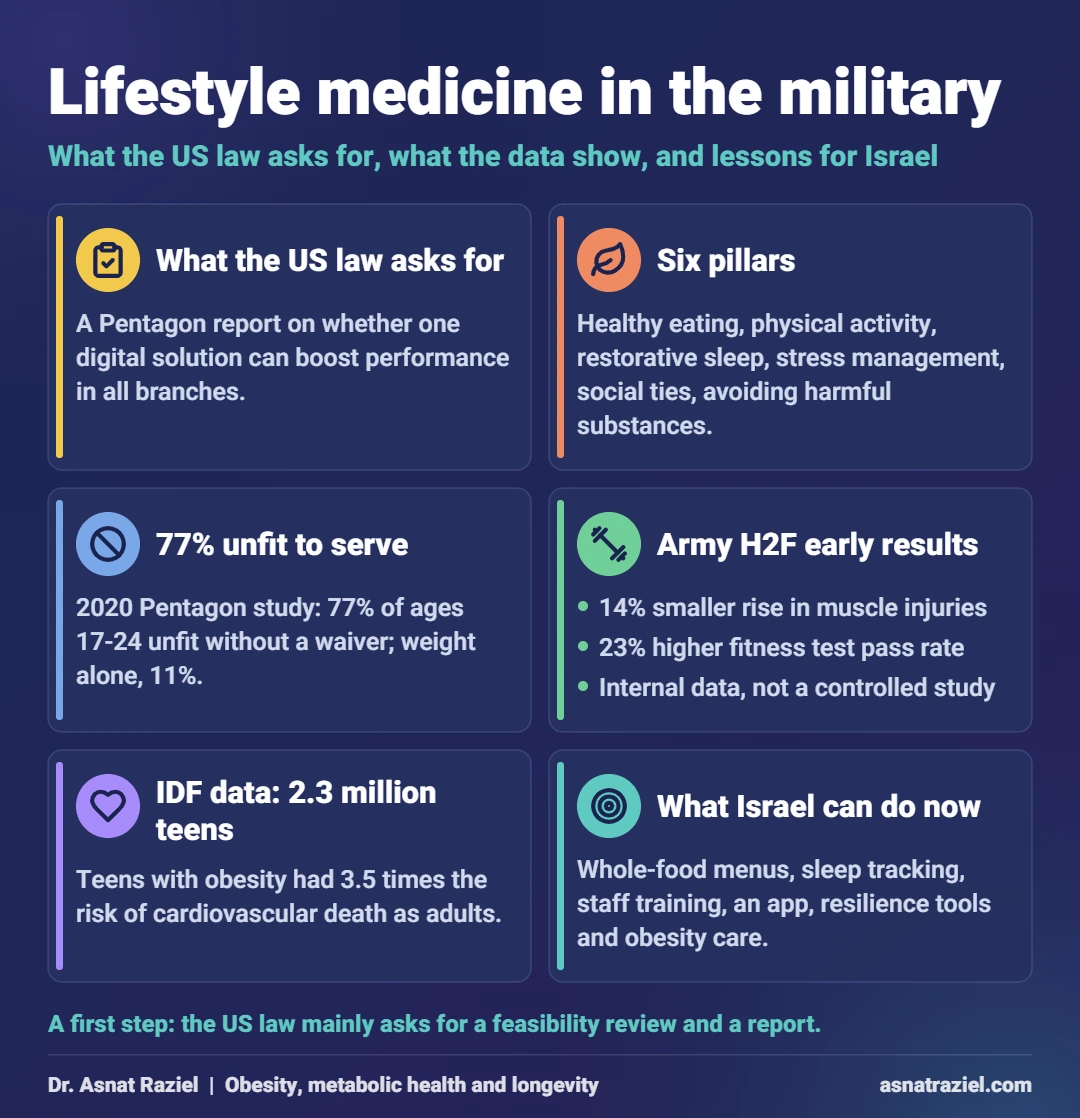
The section deals with optimizing human performance through digital lifestyle and performance medicine solutions. The committee asked the Secretary of Defense for a feasibility report. The question is whether a single digital solution could improve warfighter performance across all branches of the military. In addition, the committee encouraged the Department of Defense to prioritize evidence-based solutions. These solutions should target health habits that affect readiness and the military’s ability to retain its people. President Trump signed the 2026 NDAA into law on December 18, 2025.
The six pillars
The US military calls its approach Lifestyle and Performance Medicine. It rests on six areas:
- Healthy eating.
- Physical activity.
- Restorative sleep.
- Stress management.
- Social connection.
- Avoiding harmful substances.
Alongside the provision, the company LPM Lab and the American College of Lifestyle Medicine announced a partnership. Together, they plan digital platforms for behavior change, training for clinicians and the use of wearable sensors. It is important to note, however, that these are the organizations’ own plans, not requirements set by the law itself.
The college’s annual meeting also showed how far the field has come. I report on it in my article on the LM2026 lifestyle medicine conference.
Lifestyle medicine in the military: why the US needs it
The first reason is manpower. According to a 2020 Pentagon study, 77% of young Americans aged 17 to 24 are not fit to serve without a special waiver. In fact, excess weight alone disqualified 11% of them, making it the single most common reason.
The second reason is the experience the US military has already gained. The US Air Force has run a dedicated program of lifestyle and performance medicine at several bases since 2020. In addition, the US Army runs H2F (Holistic Health and Fitness). Specifically, this program adds physical therapists, dietitians and strength coaches to units.
According to preliminary data from April 2024, brigades with H2F saw a 14% smaller rise in musculoskeletal injuries. Likewise, their fitness test pass rate was 23% higher. These are internal Army figures, not a controlled study. Even so, they point in a clear direction.
Lifestyle medicine in the military: what Israel can learn
In Israel, we have a unique advantage: data from the IDF (Israel Defense Forces), where military service is compulsory for most young people. An Israeli study published in the New England Journal of Medicine looked at 2.3 million adolescents. The researchers examined their BMI at the pre-army medical screening between 1967 and 2010. Teens with obesity had a 3.5 times higher risk of dying from cardiovascular disease in adulthood. Moreover, the risk started to rise even within the normal BMI range.
In other words, draft age is a national window of opportunity. In addition, the ongoing security pressure in Israel harms sleep, eating habits and mental health. You can read more in my article on managing stress for weight loss. Lifestyle medicine in the military can address all of these early on.
What can be done right now
1. Whole-food nutrition: On closed bases, the army kitchen decides what soldiers eat. So it makes sense to cut back on ultra-processed food and serve more vegetables, legumes and whole grains. This is a simple step with a broad impact.
2. Monitoring load and sleep: For example, smartwatches can detect fatigue and overload. Combat soldiers, drivers and surveillance soldiers (the IDF’s lookout units) work grueling shifts. Such tracking may help prevent accidents and errors. To learn why sleep matters so much, see my article on sleep and metabolic health.
3. Training medical teams: Instead of putting out fires, we can prevent them. IDF doctors, nurses and dietitians can train in lifestyle medicine. As a result, the burden on base clinics will also ease.
4. A digital platform: A military app could include a daily menu, a workout plan, sleep tracking and group support. After all, Israel has the technological capabilities to build it.
5. Mental resilience: After years of war and national trauma, stress management is an urgent need. Tools such as mindfulness and breathing exercises should be part of the daily routine, not an add-on.
6. Obesity treatment, including medication: Finally, there is a place for medical treatment of obesity under a doctor’s supervision. Combining medication with nutrition, exercise and sleep reflects a complete medical approach. For an overview of the options, see my guide to obesity medication.
Lifestyle medicine in the military and in society: a healthy army, a healthy nation
In Israel, the conversation about health is largely a conversation about security. The IDF is a people’s army, so soldiers’ health is public health. The American model is still in its early days, and its full results are not yet known. Nevertheless, the direction is right: investing in prevention, not just in treatment.
Israel needs a national program that brings together the Ministry of Health, the Ministry of Defense, the health funds (Israel’s HMOs) and the IDF. Above all, such a program should combine preventive medicine, behavior change, technology and drug treatment for obesity. I also wrote about these principles in my article on treating obesity by changing habits.
The bottom line
The United States has brought lifestyle medicine into its defense budget debate. It is a first step that mainly asks for a feasibility review and a report. Ultimately, however, it signals a shift in thinking: health is security infrastructure. Lifestyle medicine in the military can start here, too, in the kitchen, in sleep and in staff training. The countries that invest in lifestyle today will lead in health over the next decade.
This article is general information and does not replace personal medical advice.
References
Historic Inclusion of Lifestyle Medicine in FY26 National Defense Authorization Act (NDAA)
Congressional Bill S. 1071 Signed into Law
New Study Finds Even More Young Americans Are Unfit to Serve
Lifestyle and Performance Medicine shows promising impact on Airman, Guardian readiness
Army to expand Holistic Health and Fitness program to all soldiers
Body-Mass Index in 2.3 Million Adolescents and Cardiovascular Death in Adulthood