By Dr. Asnat Raziel, bariatric surgeon specializing in obesity treatment, metabolic health and healthy longevity; Director of the Multidisciplinary Center for Obesity Treatment, Assia Medical, Assuta Ramat HaChayal, Tel Aviv
GLP-1 in early pregnancy: why this matters now
GLP-1 in early pregnancy is a question I hear often in my clinic: a woman finds out she is pregnant while on treatment, or plans a pregnancy and asks what is safe. In this article, I focus on what the new safety studies teach us about exposure to these drugs around conception, and on the cost of stopping without support. I wrote in detail about weight changes after stopping treatment in my article on what happens to your weight when you stop GLP-1 before pregnancy.
GLP-1 drugs and pregnancy are a combination that concerns many women today. Over the past decade, Ozempic, Wegovy and Mounjaro have changed the treatment of obesity and type 2 diabetes. At the same time, many women of childbearing age use them. So an important question arises: what happens when you stop treatment and become pregnant?
The drugs work through several pathways. They increase insulin release when blood sugar is high, slow stomach emptying and reduce appetite through the hunger centers in the brain. At first, doctors used them to treat diabetes. Later, regulators also approved higher doses for treating obesity. I wrote about the broader link between these drugs and fertility in my article on incretins, fertility and pregnancy.
Why women stop treatment before pregnancy
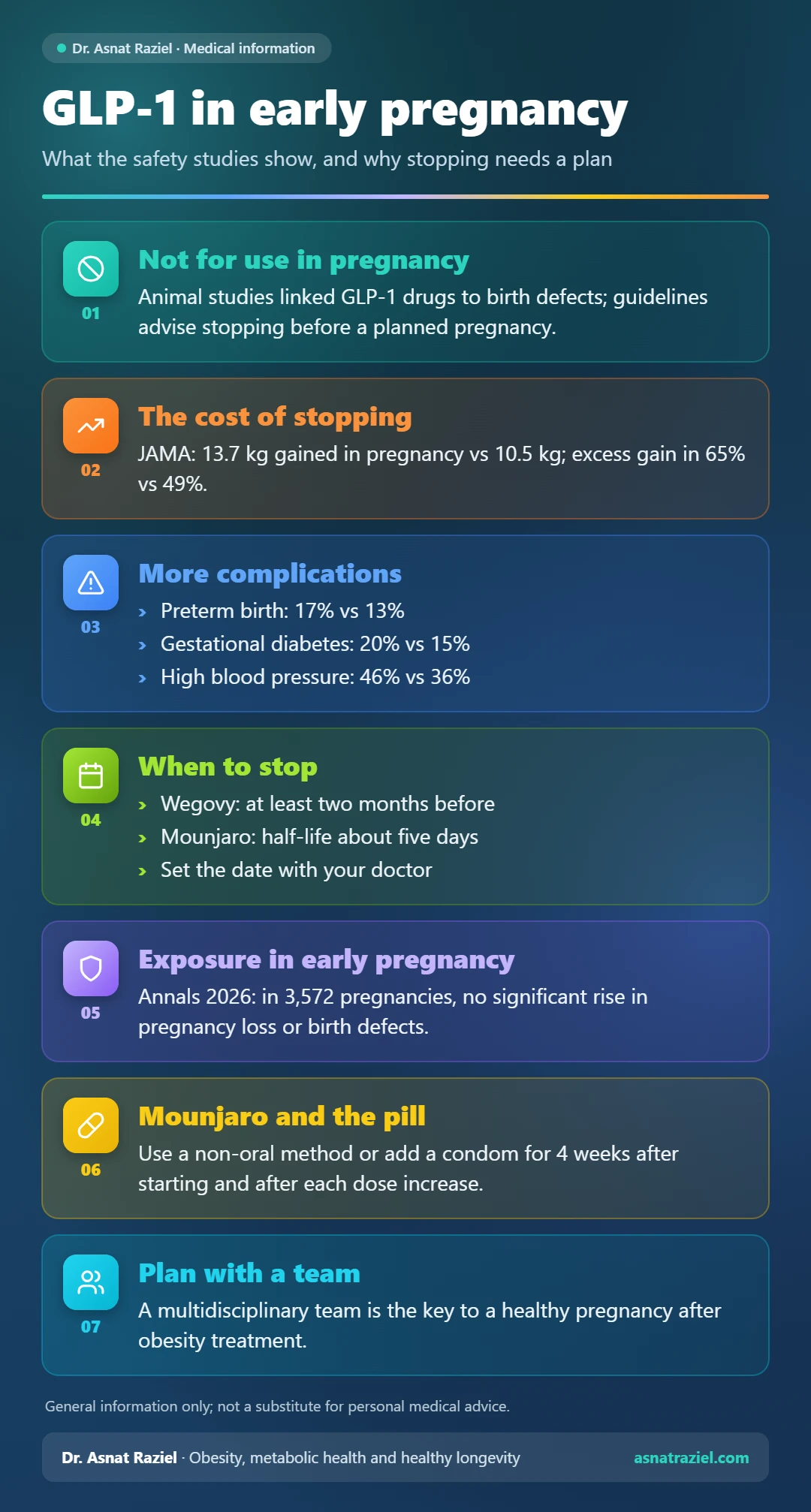
GLP-1 drugs are not suitable for use in pregnancy. Animal studies linked them to structural birth defects, growth delays and fetal death. Accordingly, guidelines recommend stopping them before a planned pregnancy, or as soon as a woman learns she is pregnant. The first World Health Organization guideline on these drugs, from December 2025, also explicitly excludes pregnant women.
However, stopping comes at a price. We know that after stopping GLP-1 drugs, weight tends to rise again, and blood sugar levels may worsen. I wrote about this in detail in my article on weight regain after stopping the injections. The concern is that a similar process will happen during pregnancy, of all times, and harm the health of mother and baby.
The cost of stopping: what the JAMA study found
In November 2025, a large study in the journal JAMA examined exactly this question. Researchers from Massachusetts General Hospital screened 149,790 pregnancies. Among them, they identified 448 pregnancies of women who had a GLP-1 prescription in the period from three years before conception to 90 days after it. The researchers matched each of these pregnancies with three similar pregnancies without exposure to the drug.
The results are clear. Women who stopped treatment gained an average of 13.7 kg during pregnancy, compared with 10.5 kg in the comparison group. That is a difference of 3.3 kg. In addition, excess weight gain occurred in 65% of them, compared with 49%. The risk of complications also rose: preterm birth in 17% vs. 13%, gestational diabetes in 20% vs. 15%, and high blood pressure in pregnancy in 46% vs. 36%.
What did not change in the study
On the other hand, the researchers found no difference in the rate of babies who were large or small for gestational age. Baby length and cesarean rates were also similar. However, the average birth weight percentile was slightly higher in the exposed group, 58.4 vs. 54.8.
It is important to remember that this is an observational study. In other words, it shows a link and does not prove cause. Still, the practical message is clear: a woman who lost weight with GLP-1 and stops ahead of pregnancy needs close support. Otherwise, she may gain weight faster than expected and develop preventable complications.
Planning a pregnancy: when to stop each drug
When it comes to GLP-1 drugs and pregnancy, early planning is crucial. According to the FDA label for Wegovy, you should stop the drug at least two months before a planned pregnancy. The reason is the long half-life of semaglutide, about a week. For Mounjaro (tirzepatide), the half-life is only about five days. So the drug clears the body a little faster, and it is best to set the exact stopping date with your doctor.
During the transition period, I recommend close clinical follow-up and nutritional support. For women with diabetes, the doctor can switch to a treatment suitable for pregnancy, such as metformin (Glucomin) or insulin. You will find more on women with diabetes in my article on GLP-1 treatment for women with diabetes.
GLP-1 in early pregnancy: what if you conceive during treatment?
This happens quite often, especially since so many women use these drugs. The recommendation is clear-cut: stop treatment as soon as you learn you are pregnant. For women with diabetes, switch to a suitable alternative treatment as soon as possible. It is also wise to consult a maternal-fetal medicine specialist. Sometimes follow-up will include targeted scans to rule out birth defects.
So far, the human data are reassuring. In a multinational study that also included data from Maccabi, one of Israel’s health funds (HMOs), exposure to GLP-1 around conception did not raise the risk of birth defects compared with insulin. Moreover, a 2026 study in the Annals of Internal Medicine examined 3,572 pregnancies. Continuing treatment into the first trimester did not significantly raise the risk of pregnancy loss or birth defects. However, the researchers stressed that some of the estimates are imprecise, and that they cannot rule out a risk.
GLP-1 drugs and pregnancy: fertility and contraception
Weight loss may improve fertility, especially in women with polycystic ovary syndrome (PCOS). That is why some pregnancies come as a surprise. In addition, there is a special warning for tirzepatide. According to Lilly’s medical information, the slower stomach emptying may reduce the effectiveness of the pill.
The recommendation is to switch to a non-oral contraceptive, or to add a barrier method such as a condom. This applies for 4 weeks after starting treatment and for 4 weeks after each dose increase. By contrast, the Wegovy label has no similar warning about the pill. An intrauterine device (IUD) is a reliable option in both cases.
GLP-1 in early pregnancy: what the latest review says
A 2026 systematic review brought together 36 studies on GLP-1 drugs around pregnancy and breastfeeding. According to the review, early exposure was not consistently linked to a higher risk for the mother or the baby. On the other hand, data on use throughout pregnancy barely exist. There is also little information on breastfeeding. Therefore, when it comes to GLP-1 drugs and pregnancy, caution remains in place.
After birth, and especially after breastfeeding ends, you can consider returning to treatment. This depends on need, for example to treat remaining weight or to control diabetes, and is worth discussing with your doctor. I wrote about this stage in my guide to losing weight after childbirth.
The safety studies at a glance
- A multinational study that also included Maccabi data: exposure to GLP-1 around conception did not raise the risk of birth defects compared with insulin.
- Annals of Internal Medicine, 2026: in 3,572 pregnancies, continuing treatment into the first trimester did not significantly raise the risk of pregnancy loss or birth defects.
- A 2026 systematic review: across 36 studies, early exposure was not consistently linked to a higher risk for the mother or the baby.
- JAMA, 2025: stopping treatment ahead of pregnancy went with an extra 3.3 kg of weight gain and a higher rate of complications.
The conclusion: accidental exposure in early pregnancy is no reason to panic, but it is not proof of safety either. Data on use throughout pregnancy barely exist, so the recommendation remains to stop treatment and to plan the stop in advance.
The bottom line
GLP-1 drugs and pregnancy do not have to be a contradiction. But the combination requires planning. Stopping before pregnancy may lead to rapid weight gain and complications, so it needs close support. Ultimately, a multidisciplinary approach, with the treating doctor, a gynecologist, a dietitian and an endocrinologist, is the key to a healthy pregnancy after obesity treatment. You will find more on the practical steps in my guide to what to do when you stop a weight loss drug ahead of pregnancy.
The information in this article is general information and does not replace personal medical advice.
References
Gestational Weight Gain and Pregnancy Outcomes After GLP-1 Receptor Agonist Discontinuation
WEGOVY (semaglutide) injection and tablets – Prescribing Information
Can Zepbound (tirzepatide) be used with oral contraceptives or hormone replacement therapy?
Safety of GLP-1 Receptor Agonists and Other Second-Line Antidiabetics in Early Pregnancy
WHO issues global guideline on the use of GLP-1 medicines in treating obesity