By Dr. Asnat Raziel, bariatric surgeon specializing in obesity treatment, metabolic health and healthy longevity; Director of the Multidisciplinary Center for Obesity Treatment, Assia Medical, Assuta Ramat HaChayal, Tel Aviv
How to prevent Ozempic face: start with your muscles
Can you prevent Ozempic face while taking weight-loss medication? In my experience, the answer is often yes, and the plan starts with protecting your muscles. “Ozempic face” is a popular nickname for the change in facial appearance after rapid weight loss. The incretin-based weight-loss medications have brought tremendous good news to millions of people. They lower weight, improve blood sugar and blood pressure, and ease hunger. However, alongside this success, one issue calls for serious medical attention: loss of muscle mass and changes in the face.
The good news is that there is a lot you can do to prevent both. In this article, I explain why they happen, who is at risk and, above all, which four practical steps help.
Why do people lose muscle at all?
Any rapid weight loss, by any method, involves losing both fat and muscle. The difference lies in the pace and the extent. Appetite-suppressing medications make people eat less, sometimes much less. When protein intake is too low and the muscles get no stimulus from physical activity, the body “saves” energy and breaks down muscle.
Volume loss in the face follows the same logic. I explain it in my article on facial changes after weight loss.
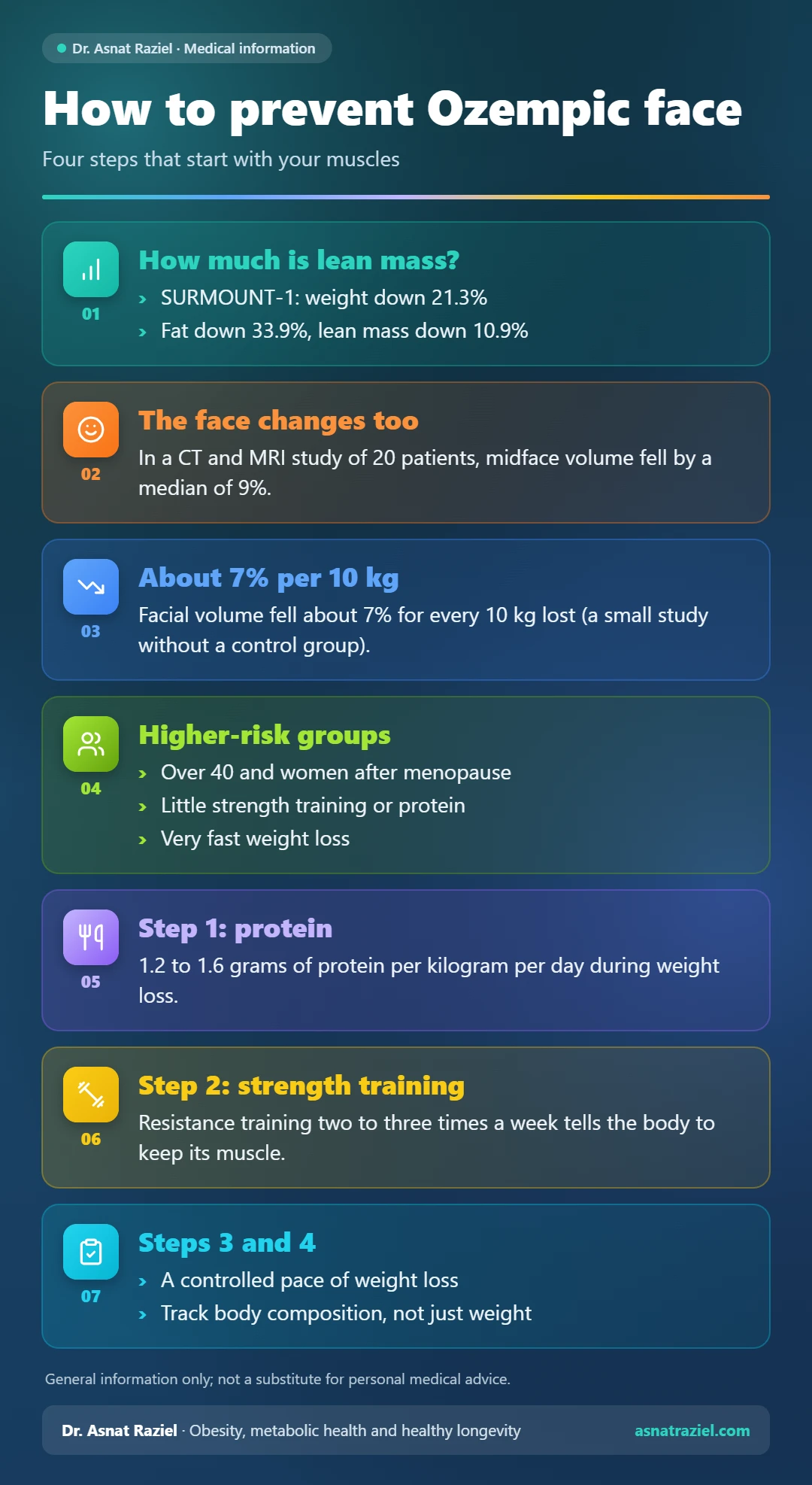
How much is actually lost? In a substudy of the SURMOUNT-1 trial, researchers examined body composition with a DXA scan, a low-dose X-ray test that measures fat, muscle and bone. After 72 weeks of tirzepatide (Mounjaro/Zepbound), body weight fell by 21.3%. Fat mass dropped by 33.9%, and lean mass dropped by 10.9%. In other words, about 75% of the weight lost was fat and about 25% was lean mass.
What’s more, a comprehensive 2024 review found a large gap between studies. In some, lean mass made up 40% to 60% of the weight lost, and in others about 15% or less. Keep in mind that lean mass also includes water, organs and bone, not only muscle.
Why muscle matters so much
Muscle is active metabolic tissue. So when you lose a lot of it, the price is not only cosmetic. A drop in muscle mass can cause weakness and fatigue. It also slows your metabolism, makes it harder to keep losing weight and may even encourage weight regain later on. You can read more about this in my article on why body composition matters more than weight.
What links muscle loss to Ozempic face?
Our faces are made of skin, fat under the skin, muscles and bone. Sharp weight loss removes fat even in places where you would rather not lose it. Some patients develop a “hollow” look. Wrinkles become more visible, the cheeks sag and the jawline becomes too sharp.
In a study that measured facial volume for the first time on CT and MRI scans, 20 patients taking GLP-1 medications took part. Their average weight loss was 11.0 kg. The median volume of the midface fell by 9%, mainly in the superficial fat pads. The researchers calculated a 7% drop in facial volume for every 10 kg lost. However, this was a small, retrospective study without a control group. Still, it shows why steps to prevent Ozempic face and steps to protect muscle go hand in hand.
Ozempic face: the drug or the rapid weight loss?
It’s important to stress that Ozempic face is not a side effect unique to the drug itself. It comes from the process of rapid weight loss. In fact, in the facial study, the loss of superficial volume matched the amount of weight lost. Even so, because weight loss on these medications is large and fast, the change in the face is especially noticeable. I describe other skin changes in my article on how Mounjaro affects the skin.
Who most needs to prevent Ozempic face?
The risk is especially high in several groups. First, people over 40 and women after menopause. Second, people who don’t do strength training or who eat little protein. In addition, people who lose weight very quickly without professional guidance.
Your starting point matters too. People who begin with low muscle mass are at high risk of significant muscle loss. The 2024 review notes that older age and disease severity affect patient selection, because of the risk of sarcopenia, the loss of muscle mass and strength.
Four steps to prevent Ozempic face and muscle loss
First, protein. Getting enough protein is critical. The joint guidance of four American associations sets a target of 1.2 to 1.6 grams of protein per kilogram per day during weight loss. In my clinic, we calculate the target according to goal weight, tailored to each person. How you spread protein across the day matters just as much as the amount. You will find practical ideas in my guide to protein intake.
Second, strength training, not just aerobic exercise. Resistance training two to three times a week sends your body a clear message: this muscle is needed. Even short workouts, adapted to your age and health, make a huge difference. To compare the two types of exercise, read my article on aerobic versus strength training.
Third, a controlled pace of weight loss. There isn’t always a need to rush. Gradual weight loss better protects both your muscles and the look of your face. Fourth, monitoring. Measuring body composition, not just weight, spots unwanted muscle loss in time and allows you to change course. You will find more practical tools in my article on how to prevent muscle loss during weight loss.
The four-step plan at a glance
To put it simply, the same four steps that prevent Ozempic face also protect your body. Protein supplies the building blocks, and strength training tells the body to keep its muscle. Meanwhile, a moderate pace gives your skin and tissues time to adapt. Finally, body composition tracking catches muscle loss early, while it is still easy to correct. If you want to understand what really happens to the face, and when treatment makes sense, see my article on why the face changes with weight loss.
How else can you prevent Ozempic face?
Protecting your muscles is the foundation. In addition, drinking enough, a diet rich in vitamins and minerals, and good-quality sleep support skin health. In some cases, complementary aesthetic treatments may be worth considering. However, they are not a substitute for the physiological basics. The goal is not to “fill in” a thin face, but to keep a strong, healthy body over time.
What the future holds
Research in this field is moving fast. According to the 2024 review, several drugs designed to preserve or improve muscle mass are in development, for use alongside GLP-1 medications. Until they reach routine use, the proven tools to prevent Ozempic face remain protein, strength training and close monitoring.
The bottom line on muscle loss and Ozempic face
Weight-loss medications are a powerful medical tool, but they don’t work in isolation. Without protein, movement and professional support, weight loss can come at the expense of your muscles and vitality. The World Health Organization guideline from December 2025 also recommends combining these medications with a program to change diet and physical activity. So when you combine medication with a tailored lifestyle, you can lose weight and keep your muscle. That way, Ozempic face is not inevitable, and you can truly look and feel good, in your body and in your face.
The information in this article is general and does not replace personal medical advice.
References
Changes in lean body mass with glucagon-like peptide-1-based therapies and mitigation strategies
Radiographic Midfacial Volume Changes in Patients on GLP-1 Agonists
WHO issues global guideline on the use of GLP-1 medicines in treating obesity