By Dr. Asnat Raziel, bariatric surgeon specializing in obesity treatment, metabolic health and healthy longevity; Director of the Multidisciplinary Center for Obesity Treatment, Assia Medical, Assuta Ramat HaChayal, Tel Aviv
Facial changes after weight loss and where the name “Ozempic face” came from
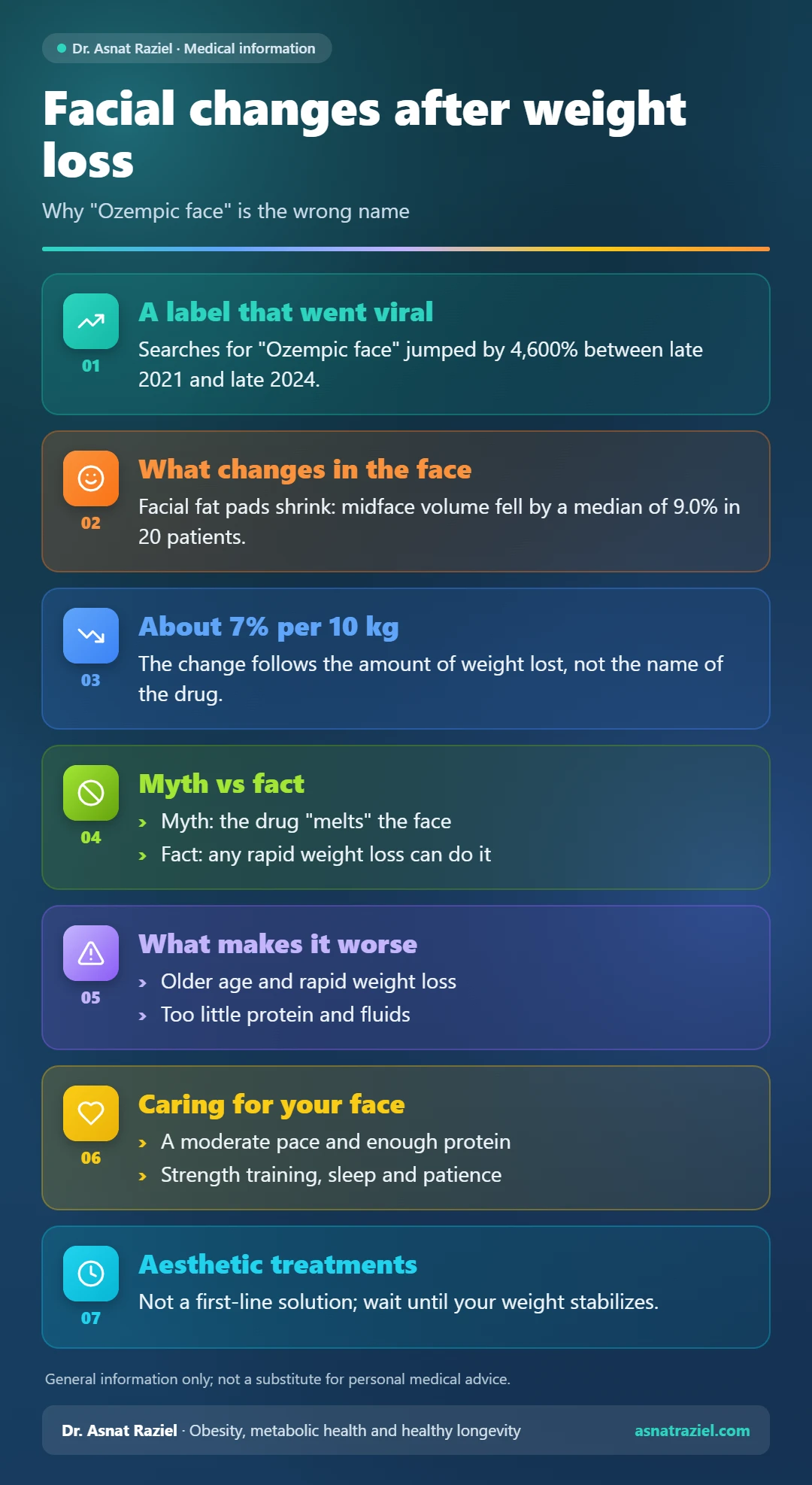
Facial changes after weight loss are common, and in recent years they have been given a catchy name: Ozempic face. The nickname describes a thinner face, sometimes hollow, with less volume in the cheeks and more visible wrinkles. It took off as the use of GLP-1 medications grew. According to an analysis of Google searches, searches for the term jumped by 4,600% between late 2021 and late 2024. But that is exactly where the problem begins. In this article, I separate myth from fact: what really changes in the face, why the name is misleading, and what you can do.
Why is the term a problem?
The term is not medical, it is not accurate, and above all, it is not fair. It gives the impression of a side effect unique to one particular drug. In reality, this is a well-known process that appears with any rapid and significant weight loss, even without medication. A recent review from October 2026 in the field of plastic surgery stated this explicitly. According to the review, the facial changes probably reflect rapid or large weight loss, rather than a proven effect of the drug itself.
In addition, the phrase reinforces a double stigma. On the one hand, it blames a change in appearance on an effective medical treatment. On the other hand, it suggests that something is “wrong” with people who chose to treat their obesity. So instead of a medical conversation, we get a judgmental and sometimes mocking one. That conversation focuses on outward appearance, not on health, quality of life and lowering the risk of disease. A joint international statement by experts already established in 2020 that weight stigma harms health and keeps people away from treatment. I also wrote about this in my article on respectful language about obesity.
It’s important to say clearly that this is not a new phenomenon. After bariatric surgery, extreme diets or illness, the face changes too. This is physiology, not a problem and not a failure.
Facial changes after weight loss: what really happens?
The face is built in layers: bone, muscle, fat under the skin and skin. When you lose weight quickly, your body doesn’t lose fat only from the belly and thighs. The fat pads in the face shrink too. A study from Vanderbilt University measured this change on imaging scans for the first time, in 20 patients taking GLP-1 medications. The median volume of the midface fell by 9.0%. On average, every 10 kg of weight loss came with a 7% drop in midface volume, mainly in the superficial fat layer.
Weight loss can change more than your appearance. It can also affect your partner, as I discuss in weight loss drugs and relationships.
In other words, the change is linked to the amount of weight lost, not to the name of the drug. What’s more, when weight loss is sharp and comes with low protein intake or unsuitable activity, muscle wasting may also join in. This makes the face look even thinner and more tired. A 2026 systematic review listed the factors that worsen skin changes: older age, long-standing obesity, rapid weight loss, drinking too little and not getting enough protein. You can read about the link to muscle in my article on how to prevent Ozempic face.
Myths and facts about facial changes after weight loss
Let’s sum up what the evidence in this article shows. Myth: the drug itself “melts” the face. Fact: the change in the face follows the amount of weight lost, about 7% of midface volume for every 10 kg. Myth: this is a new phenomenon. Fact: similar changes have been known for years after bariatric surgery and extreme diets. Myth: nothing can be done. Fact: a moderate pace, enough protein, strength training and patience all help. Finally, the label itself matters, because weight stigma harms health and keeps people away from treatment. For a broader look at how the face changes and when treatment makes sense, see my article on why the face changes with weight loss.
Does this happen only with medications?
Not at all. Similar changes have been known for years after bariatric surgery, extreme diets and serious illness. The difference is that the new medications allow many people to lose a lot of weight in a short time. That is why facial changes after weight loss have suddenly become a common topic of conversation. It’s also important to remember the other side of the coin. Significant weight loss usually improves blood sugar control, blood pressure and joint pain. That’s the full picture, and it’s important to see all of it.
How to care for your face during weight loss
The good news is that there is a lot you can do, even before considering aesthetic treatments.
1. Moderate, controlled weight loss. The first key is the pace. Gradual weight loss lets the skin and tissues adapt and reduces sudden volume loss in the face. That’s why it’s worth planning a reasonable pace of dose increases with your doctor.
2. Protein, protein, protein. Getting enough protein matters not only for the muscles of the body but also for the tissues of the face. A low-protein diet increases muscle loss and makes the face look “drained”. Joint guidance from four American organizations puts protein at the center of the menu during GLP-1 treatment. See also my article on preserving muscle during weight loss.
3. Strength training. Resistance exercise maintains overall muscle mass. It also promotes the release of anabolic hormones, that is, hormones that build tissue. In this way, it also supports a fresh, vital appearance.
4. Sleep, stress and hydration. Lack of sleep, chronic stress and dehydration harm skin elasticity and worsen a hollow look. These are critical factors, and many people underestimate them.
5. Patience. In many cases, the body settles down after the initial weight-loss phase. The skin partly “fills out”, the appearance softens and the face looks more natural.
What about aesthetic treatments?
Complementary treatments are an option, but not a first-line solution and not a must. If you are considering them, it’s better to wait until your weight stabilizes. The plastic surgery review also stresses timing, weight stability and nutritional status before any procedure. In addition, an approach that respects the face is important. The goal is not to “turn back the clock”, but to support a natural, healthy look. I wrote about the emotional side of this change in my article on body image after major weight loss.
Facial changes after weight loss: time to change the language
The term “Ozempic face” may be catchy, but it is wrong, hurtful and misleading. It shifts the discussion away from what matters most: treating obesity as a chronic disease that is complex and treatable. Instead, it creates a shallow conversation about looks. We have stopped using demeaning expressions in other areas of medicine, so it’s time to do the same here. Let’s talk about facial changes after weight loss as a natural physiological change. Above all, let’s talk about responsible, comprehensive, health-protecting care, without stigma and without labels.
The information in this article is general and does not replace personal medical advice.
References
Radiographic Midfacial Volume Changes in Patients on GLP-1 Agonists
Effects of GLP-1 receptor agonists on aesthetic surgery practice: A contemporary review
Effects of GLP-1 Receptor Agonists on Skin Quality: A Comprehensive Literature Review
Joint international consensus statement for ending stigma of obesity