By Dr. Asnat Raziel, bariatric surgeon specializing in obesity treatment, metabolic health and healthy longevity; Director of the Multidisciplinary Center for Obesity Treatment, Assia Medical, Assuta Ramat HaChayal, Tel Aviv
Long-term obesity treatment in the new drug era
Long-term obesity treatment in this decade looks completely different from what we knew in the past. Doctors once had diet, advice on physical activity and, sometimes, surgery. Today we have advanced medications, treatment combinations, new technologies and a deep biological understanding of how the disease works. Yet this very abundance of options sharpens the need for clinical judgment. So the question is not only which method to choose, but how to manage a chronic, changing disease over many years.
This article is not a guide to picking your first treatment; for that, see how to choose the right obesity treatment for you. Here I focus on what comes after the choice: combining methods, staying on treatment and adapting the plan as life changes.
Where long-term obesity treatment starts: an accurate diagnosis
Every plan begins with an accurate diagnosis. In January 2025, an international Lancet commission published a new definition of obesity. Its 58 experts distinguished between “clinical obesity,” which already impairs organ function, and “preclinical obesity,” which is still only a risk. According to the commission, BMI alone is not enough for an individual diagnosis, and it recommends adding a measure such as waist circumference or direct fat measurement. 76 organizations worldwide have endorsed the definition.
In practice, obesity management relies on several tools that can be combined: lifestyle change with nutritional support, medication by injection or pill, and bariatric surgery. These methods do not compete with one another. They are often complementary, and a patient may move between them over the years. That is why it is important to revisit the plan at every stage, based on results and on changes in your life.
In other words, two people with the same weight may receive completely different recommendations. The considerations include related conditions, age, the history of previous attempts and patient preferences. You can read about the personalized approach in my article on the European framework for personalized treatment.
Medication around bariatric surgery: a delicate balance
Many patients now come to bariatric surgery after a period of treatment with GLP-1 drugs. This situation calls for new thinking. These medications slow stomach emptying and affect fullness, nausea and fluid balance. Around surgery, these effects may become worse without proper management.
Joint guidance from four professional societies, including the American Society for Metabolic and Bariatric Surgery, recommends deciding together with the surgical team, the anesthesia team and the treating physician. Patients without increased risk can usually continue treatment. If the decision is to stop, the recommendation is to skip the weekly injection in the week before surgery. In addition, when there are digestive symptoms, the guidance suggests considering a liquid diet for at least 24 hours before surgery. More details appear in my article on GLP-1 drugs before surgery.
When doctors handle the combination wisely, medication also becomes an important tool after surgery. It helps prevent weight regain and deal with weight-loss plateaus. For example, in a study of 115 patients who regained weight after a sleeve gastrectomy, the average weight loss after six months was 10.3% with semaglutide and 15.5% with tirzepatide.
Long-term obesity treatment: adherence is a system problem
One of the central issues is stopping drug treatment. A large US study of 125,474 patients found that 64.8% of patients without diabetes stopped treatment within a year. Among people with diabetes, the rate was 46.5%. However, the reason is not necessarily a lack of motivation or an ineffective drug. The researchers found that moderate to severe digestive side effects increased the risk of stopping. In contrast, greater weight loss reduced it.
Sometimes the problem is unrealistic expectations or not understanding that this is a chronic treatment. Other times, it is untreated side effects or a lack of professional support. When patients see treatment as a “temporary fix,” dropout rates rise. On the other hand, clear explanations, regular follow-up, nutritional support and personal goals improve persistence. A 2026 follow-up study also showed that after stopping, about one in five patients went back to the same drug, and 35.2% switched to another treatment. See also my article on staying on treatment over time.
In a Camoni column on the maintenance revolution in obesity care (in Hebrew), I explain why the body’s biology pushes toward weight regain after weight loss.
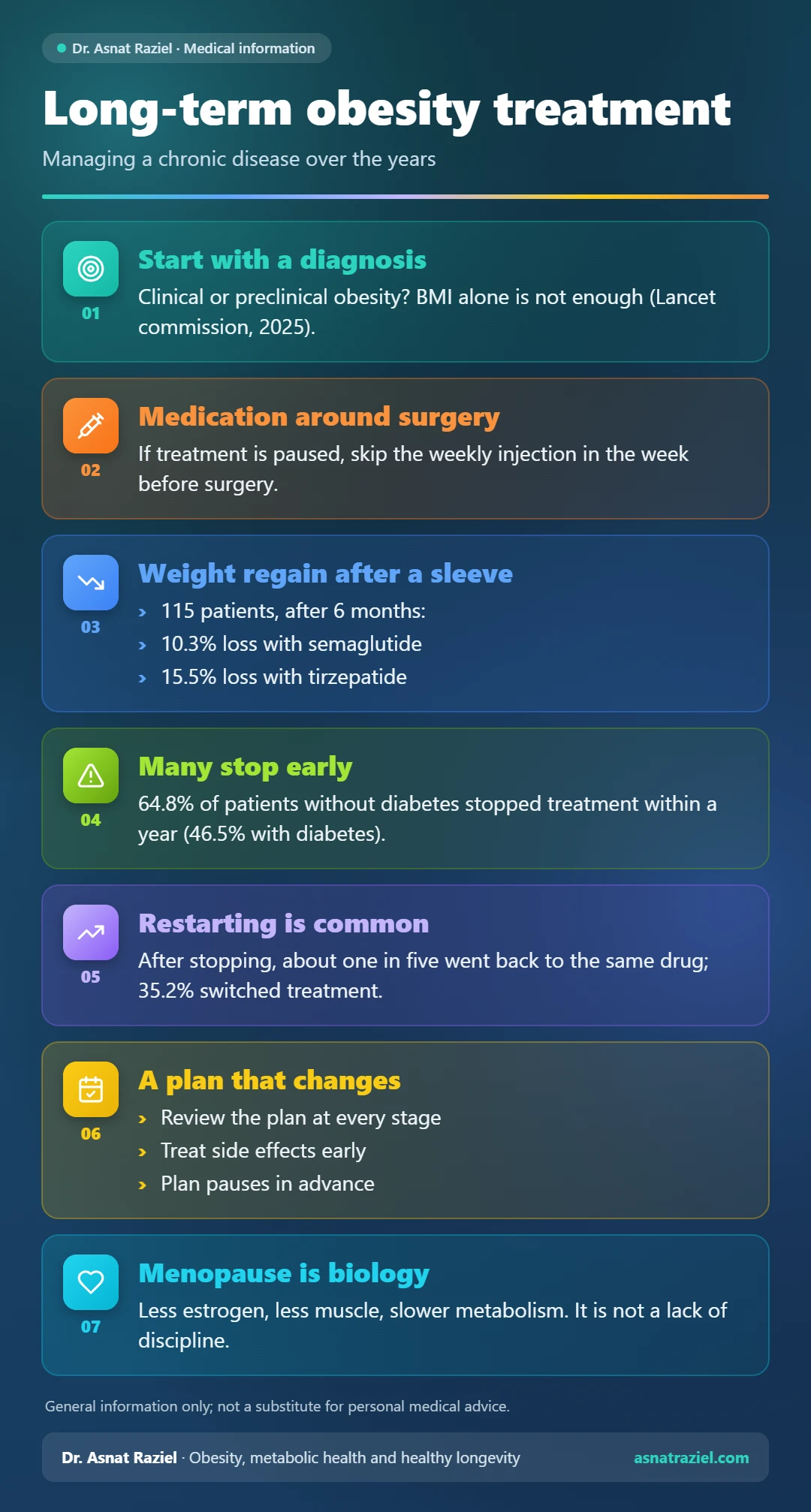
Long-term obesity treatment as a plan that changes over time
What does this look like in practice? First, we review the plan at every stage, based on results and on changes in your life. Next, we combine methods rather than replace them: lifestyle, medication and, when needed, surgery. Then, we treat side effects early, because they are a major reason people stop. In addition, regular follow-up, nutritional support and personal goals keep you on track. Finally, we plan for a pause in treatment in advance, since many patients later return to the same drug or switch to another one. In short, long-term obesity treatment is not a single decision but an ongoing partnership.
Nutrition noise: a new clinical challenge
Medicine today operates amid information overload. Every day, patients face fad diets, conflicting advice, influencers without medical training and promises of quick fixes. This creates confusion, undermines trust and sometimes even causes harm to health.
So the doctor’s challenge is not only to choose the right treatment. It is also to explain knowledge, clear away myths and rebuild trust. In my experience, a patient who receives evidence-based, consistent and personalized information stays on track much better, even when weight loss is modest. Put differently, the quality of the therapeutic relationship matters as much as the medication itself.
Obesity and menopause: biology, not failure
Menopause is a critical period for the development of obesity in women. The drop in estrogen changes how fat is distributed. In addition, muscle mass declines and metabolism slows. This sets the stage for weight gain and a higher cardiometabolic risk, meaning the risk of heart disease, blood vessel disease and diabetes.
It is important to stress that obesity at this stage is not the result of a “lack of discipline.” It is an expected physiological change. Managing obesity treatment during menopause requires an integrated approach to body composition, tailored nutrition and physical activity with a focus on strength. Sometimes we add medication as well, as part of a broader view of health and not just weight. You can read more in my article on obesity during menopause.
The bottom line on long-term obesity treatment
Treating obesity in the new drug era is not only about choosing the right medication. It is about managing a complex chronic disease. Success depends on combining scientific knowledge, clinical judgment, ongoing support and personalization. There is no one-size-fits-all solution, and there are no shortcuts. But when you and your care team manage treatment well, it changes not only your weight but the course of your health as a whole.
The information in this article is general and does not replace personal medical advice.