By Dr. Asnat Raziel, bariatric surgeon specializing in obesity treatment, metabolic health and healthy longevity; Director of the Multidisciplinary Center for Obesity Treatment, Assia Medical, Assuta Ramat HaChayal, Tel Aviv
Cancers linked to obesity are far more common than most people realize: experts now count 13 different types. In this article, I go through them one by one, explain how excess fat tissue fuels them, and show what weight loss can change. I also cover the practical steps you can take today, from measuring your waist to keeping up with screening tests.
Cancers linked to obesity: a link that is changing obesity medicine
Obesity-related cancer has become one of the most important topics in preventive medicine in recent years. For years, obesity was seen mainly as a metabolic and cosmetic problem, with consequences for diabetes, blood pressure and heart disease. Over the past decade, however, it has become clear that obesity is also one of the major risk factors for cancer. This is a deep and well-established biological link, and it affects how common cancer is, how severe it is and sometimes how deadly it is.
Which cancers are linked to obesity?
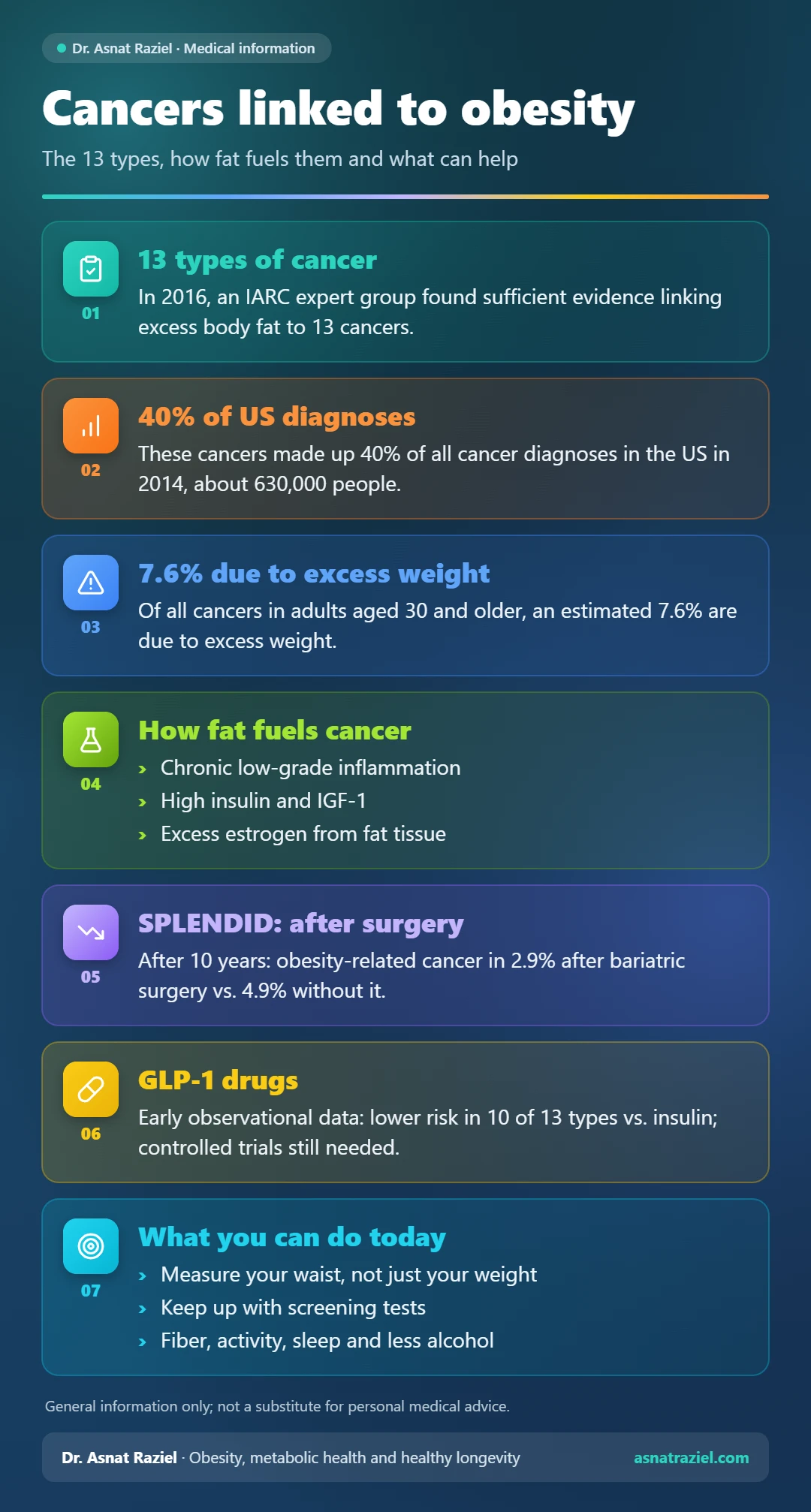
In 2016, an expert group of the International Agency for Research on Cancer (IARC) reviewed more than 1,000 studies. According to the group’s conclusions, there is sufficient evidence linking excess body fat to 13 types of cancer. They include colorectal cancer, breast cancer after menopause, uterine cancer, kidney cancer, pancreatic cancer, liver cancer, gallbladder cancer and ovarian cancer. The list also includes adenocarcinoma of the esophagus, cancer of the upper part of the stomach, thyroid cancer, meningioma (a tumor of the membranes around the brain) and multiple myeloma.
How big is the problem? According to data from the U.S. CDC, these cancers made up 40% of all cancer diagnoses in the United States in 2014. That is about 630,000 people in a single year. It is important to understand that not all of these cases were caused by obesity. Even so, an analysis by the American Cancer Society estimated that 7.6% of all cancers in adults aged 30 and older are due to excess weight. In other words, excess weight is the second most important modifiable risk factor, after smoking.
In some cases, obesity is also linked to diagnosis at a later stage and a worse prognosis. Therefore, obesity affects not only the chance of getting sick but also the course of the disease. I wrote about the broader link between excess weight and other diseases in my article on the complications of obesity.
The 13 cancers linked to obesity at a glance
It helps to group the 13 cancers by the body systems they affect. This makes it easier to remember which symptoms and screening tests matter.
- Digestive system: colorectal cancer, adenocarcinoma of the esophagus, cancer of the upper stomach, liver cancer, gallbladder cancer and pancreatic cancer.
- Hormone-sensitive cancers in women: breast cancer after menopause, uterine cancer and ovarian cancer.
- Other organs: kidney cancer, thyroid cancer, meningioma and multiple myeloma.
Together, these cancers made up 40% of cancer diagnoses in the United States in 2014. For some of them, such as colorectal and breast cancer, effective screening tests already exist.
How obesity drives these cancers
To understand cancers linked to obesity, it helps to start with fat tissue itself. Obesity is not a passive buildup of fat. Fat tissue is an active endocrine organ, meaning an organ that releases hormones, cytokines (signaling proteins of the immune system) and inflammatory substances. This creates a biological environment that encourages cancer processes. The U.S. National Cancer Institute lists several main mechanisms:
- Chronic low-grade inflammation, which can damage DNA and encourage cell growth.
- Insulin resistance and high insulin levels, which act as growth factors.
- Higher IGF-1, an insulin-like growth factor that encourages cell division.
- Excess estrogen produced by fat tissue, which affects breast, uterine and ovarian cancer.
- Changes in adipokines, the hormones of fat tissue: leptin rises and protective adiponectin falls.
In addition, advanced fatty liver and changes in the microbiome add to the risk of liver cancer. Abdominal fat, which surrounds the abdominal organs, is especially active in these processes. You will find a detailed explanation in my article on visceral fat and in my guide to diagnosing and treating fatty liver.
Does weight loss reduce cancers linked to obesity?
This is one of the most important questions, and the answer is becoming clearer. The IARC group noted that intentional weight loss may reduce risk, mainly for breast and uterine cancer. However, it concluded that the evidence in humans was not yet sufficient for a final verdict.
Since then, strong data have accumulated. In the SPLENDID study, researchers compared 5,053 people who had bariatric surgery with 25,265 patients who did not. After 10 years, obesity-related cancer had appeared in 2.9% of those who had surgery, compared with 4.9% in the comparison group. The relative risk fell by 32%. Moreover, cancer deaths fell by almost half: 0.8% compared with 1.4%.
The protective effect does not come from weight loss alone. Lower inflammation, better insulin sensitivity and lower estrogen levels also help reduce cancers linked to obesity. Ultimately, the whole metabolic environment improves.
What about the new drugs?
GLP-1 drugs, such as semaglutide and tirzepatide, are now also being studied in this context. GLP-1 is a natural satiety hormone that the gut releases after a meal. A cohort study of 1,651,452 patients with diabetes compared patients on GLP-1 drugs with patients on insulin. The researchers found a lower risk in 10 of the 13 cancer types, including pancreatic, liver, colorectal and uterine cancer.
On the other hand, compared with metformin, no reduction in risk was found, and the risk of kidney cancer was actually 54% higher. These are therefore early findings from an observational study, not proof. Controlled trials are still needed. You can read more in my article on obesity, cancer and GLP-1 drugs and in my article on weight-loss drugs and cancer risk.
Treating obesity as preventive medicine
The clinical meaning of these data has broad implications. Effective obesity treatment is not just symptom management; it is part of preventive medicine. As with treating high blood pressure or cholesterol, the goal here is to lower the future risk of serious disease.
New medications, bariatric surgery and lifestyle change improve quality of life when they are managed well. In addition, they may change a person’s long-term health path, including their cancer risk.
A broader view of medical responsibility
Given the data, the question is not whether to treat obesity, but when and how. Recognizing obesity as a chronic disease with cancer-related consequences calls for a change in approach. This is true for doctors and for the healthcare system as a whole. Early detection, personalized treatment and long-term follow-up are not luxuries. They are an important tool for preventing obesity-related cancer.
What can you do today?
First, measure your waist circumference, not just your weight. A large waist points to active abdominal fat. Second, screening tests for early detection are especially important for people with obesity. Examples include a fecal occult blood test or colonoscopy, mammography and a gynecological exam, according to age and guidelines. In addition, vaginal bleeding after menopause needs prompt evaluation.
Finally, even modest weight loss improves the metabolic environment. A diet rich in fiber, regular physical activity, good sleep and less alcohol all help. When needed, medication or surgery joins the plan. The decision is made with a doctor, based on each patient’s personal risk.
Bottom line: cancers linked to obesity and the chance to prevent them
The link between obesity and cancer is changing the boundaries of obesity medicine. It is no longer a field that deals only with weight, but a central part of modern preventive medicine. As knowledge grows, it becomes ever clearer that treating obesity is a long-term investment in health. Understanding the cancers linked to obesity is the first step toward preventing them.
The information in this article is general and does not replace personal medical advice.
References
Body Fatness and Cancer – Viewpoint of the IARC Working Group
Association of Bariatric Surgery With Cancer Risk and Mortality in Adults With Obesity