By Dr. Asnat Raziel, bariatric surgeon specializing in obesity treatment, metabolic health and healthy longevity; Director of the Multidisciplinary Center for Obesity Treatment, Assia Medical, Assuta Ramat HaChayal, Tel Aviv
Why a GLP-1 dietitian matters so much
A GLP-1 dietitian is part of the treatment team, not a nice extra. GLP-1 medications sharply reduce appetite, so many people suddenly eat much less. If you do not pay attention to what goes onto your plate, your body may lose muscle and run short of protein, vitamins and fluids. A dietitian who knows these treatments helps make your weight loss healthy and lasting.
In this article, I focus on the dietitian’s role: what the guidelines say, what happens at each stage of nutritional support, and what to ask at your first visit. The eating principles themselves, for days when you are barely hungry, are covered in my article on eating well from a smaller plate when appetite is low.
What the guidelines say about seeing a dietitian
In 2025, four leading US organizations published a joint advisory on nutrition alongside GLP-1 medications. They include the American Society for Nutrition and The Obesity Society. The advisory states that tailored nutrition is an integral part of treatment. In addition, it recommends referring patients to a clinical dietitian. Similarly, the UK’s National Health Service describes obesity treatment as a combination of medication, diet, physical activity and professional support.
Likewise, the US National Heart, Lung, and Blood Institute (NHLBI) emphasizes that obesity medications work best together with lifestyle changes. In other words, the medication reduces hunger, while nutrition determines what your body actually gets. A general overview of obesity management paints a similar picture.
In Israel, too, health funds see the dietitian as part of the team. Leumit’s guide to starting weight-loss injections (in Hebrew) notes that a dietitian can help preserve muscle mass and track body composition.
A GLP-1 dietitian helps protect your muscle
Rapid weight loss always includes some loss of lean body mass. In a body-composition substudy of the STEP 1 trial of semaglutide, participants lost an average of 13.6 kg. Of that, 8.3 kg was fat and 5.3 kg was lean body mass. According to the joint advisory, roughly half of lean body mass is muscle. So muscle makes up about one fifth of the weight lost.
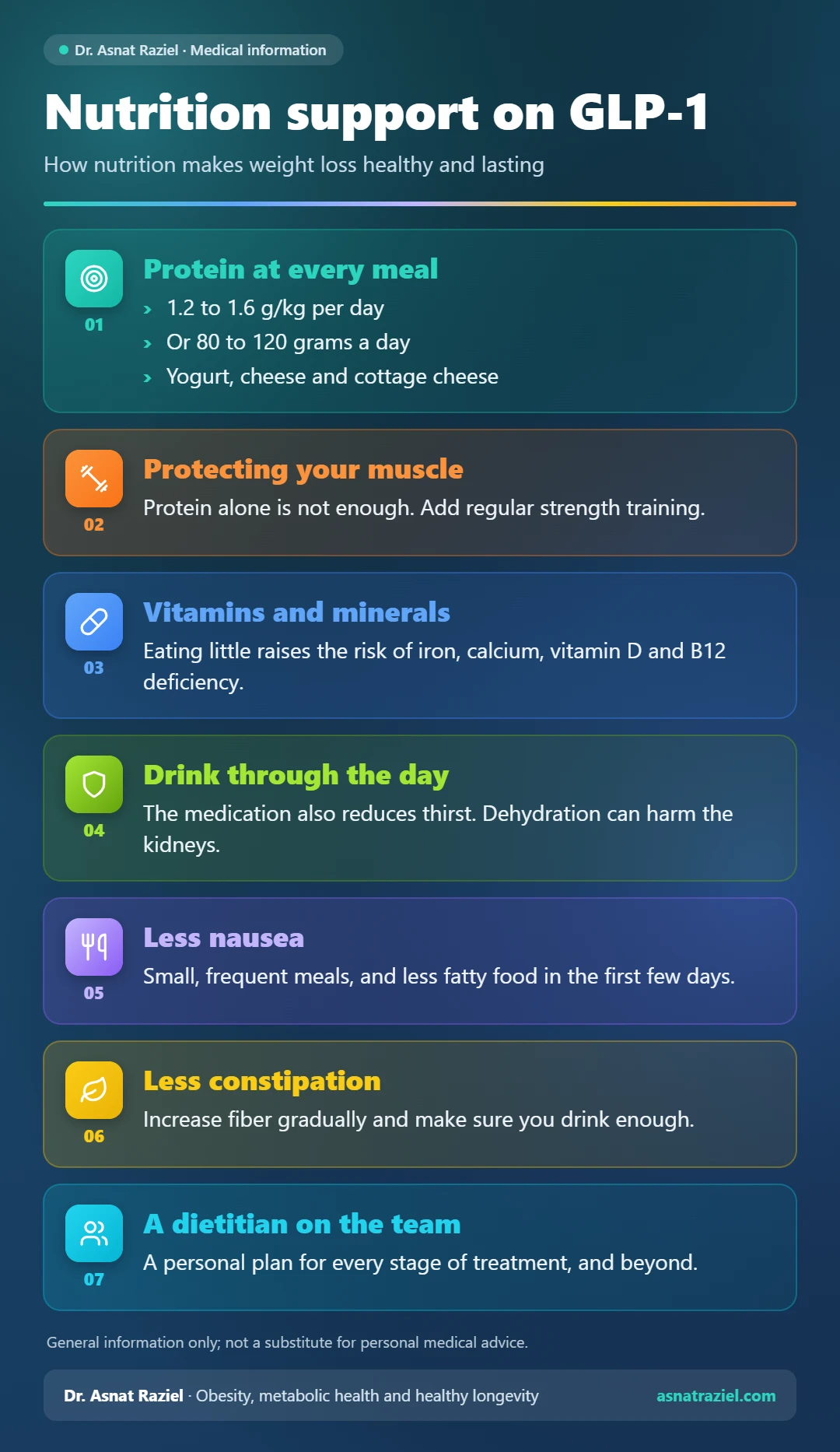
To limit this loss, you need two things together: enough protein and strength training. The advisory states explicitly that protein alone is probably not enough. At our clinic, we encourage patients to start strength training two to three times a week, depending on their ability. I explain this in more detail in my article on lean body mass on GLP-1 drugs.
How much protein: the targets your dietitian will set
- The general recommendation for adults is 0.8 grams per kilogram of body weight per day.
- During active weight loss, higher targets have been proposed: 1.2 to 1.6 g/kg.
- A simple alternative is a target of 80 to 120 grams of protein per day.
- On the other hand, long-term intake of 2 g/kg or more is not recommended.
In many cases, it is easier to reach the target with dairy foods alongside weight loss injections. Yogurt, low-fat cheese and cottage cheese provide a lot of protein in a small volume.
How a GLP-1 dietitian monitors vitamins, minerals and fluids
When you eat little, it is hard to get every nutrient you need. The joint advisory gives a specific warning about intake below 1,200 calories a day for women and below 1,800 for men. At these levels, the risk of iron, calcium, magnesium, zinc, vitamin D, vitamin B12 and other deficiencies rises. That is why the dietitian builds a nutrient-rich menu. Based on your blood tests, the doctor may also recommend a supplement.
Regular blood tests help detect a deficiency early. Usually, they include a complete blood count, iron, vitamin B12 and vitamin D. This way, a deficiency can be corrected before it causes fatigue, hair loss or weakness.
It is also very important to drink. The medication sometimes reduces thirst as well. Dehydration can cause acute kidney injury, so it is wise to drink throughout the day.
A GLP-1 dietitian and side effects
Nausea and constipation are common side effects, especially at the start of treatment and when the dose goes up. The right diet eases most of them. You will find detailed information in my article on side effects of weight loss medications.
Nausea
- Small, frequent meals instead of large ones.
- In the first few days, avoid fatty and fried foods.
- Ginger or mint tea may help.
- Stop eating as soon as you feel full.
Constipation
Gradually increase your fiber intake, for example with vegetables, legumes and prunes. At the same time, make sure you drink plenty. If that is not enough, your doctor can recommend a suitable product.
What a GLP-1 dietitian does at each stage
Support starts with an assessment: eating habits, medical conditions, blood tests and personal preferences. Next, the dietitian builds a plan that fits your stage of treatment and your dose. For example, at the start of treatment, the goal is to ease symptoms. Later, the focus shifts to protein, diet quality and long-term habits. Practical guidance for a daily menu appears in my article on nutrition tailored to weight loss injections.
It is also important to talk about food quality, not just quantity. When you eat little, every bite counts. Therefore, it is best to choose vegetables, legumes, whole grains, quality protein and healthy fats. In contrast, ultra-processed foods and sweetened drinks take up space without providing nutritional value. Alcohol also adds calories and may worsen nausea.
What is more, the dietitian helps you prepare for the day treatment stops or the dose is lowered. The habits you build during treatment are what help you keep your results. That is why working with a GLP-1 dietitian is an investment that keeps paying off afterward.
What to ask your GLP-1 dietitian at the first visit
A first meeting is more useful when you come prepared. First, ask what your daily protein target is: 1.2 to 1.6 g/kg, or 80 to 120 grams a day. Second, ask which blood tests you need and how often, such as a blood count, iron, B12 and vitamin D. Third, ask what to eat if nausea or constipation appears after a dose increase. Next, ask how to combine your menu with strength training two to three times a week. Finally, ask how much to drink, and how the plan will change when treatment stops or the dose is lowered.
The bottom line
The medication reduces hunger, but it does not choose what you eat. A GLP-1 dietitian helps you preserve muscle, prevent deficiencies and ease side effects. Combined with strength training and a healthy lifestyle, this support makes weight loss healthy and lasting. At our clinic, the dietitian is a permanent member of the team.
The information in this article is general and does not replace personal medical advice.
Frequently asked questions
When should I start working with a GLP-1 dietitian?
Ideally before the first injection, or in the first few weeks. That way, you can prepare for the drop in appetite and for side effects.
If I am hardly hungry, do I still need to eat?
Yes. Even when your appetite is low, your body needs protein, vitamins and fluids. Small, planned meals help you meet your targets.
Do I need supplements?
Not always. The decision depends on your diet and your blood tests. The doctor and the dietitian tailor a supplement if one is needed.
Is strength training really necessary?
It is very important. The recommendations stress that protein alone is not enough to preserve muscle, so strength training is a regular part of the plan.
Sources
Overweight and obesity in adults – Treatment (NHS)