By Dr. Asnat Raziel, bariatric surgeon specializing in obesity treatment, metabolic health and healthy longevity; Director of the Multidisciplinary Center for Obesity Treatment, Assia Medical, Assuta Ramat HaChayal, Tel Aviv
Why strength training for weight loss matters so much
Strength training for weight loss is the reliable way to make sure your body loses mostly fat. When people talk about losing weight, they rarely ask what exactly was lost. Yet it is an important question. According to a review from Harvard Medical School, about a quarter of the weight lost on a diet comes from muscle mass. In addition, rapid weight loss may increase that share.
Muscle matters far beyond appearance. It supports your metabolism, strength, stability and balance. So when muscle shrinks, the body burns less energy, even at rest. As a result, keeping the weight off over time becomes much harder. This article offers a practical, step-by-step plan for beginners: what to do on your two training days, how to progress, and how to stick with it.
What happens to muscle when you lose weight
When the body gets less energy than it needs, it draws on several fuel sources. At first, it uses the sugar stores in the liver and muscles. Then it turns to fat. However, when it needs energy quickly, it also breaks down muscle protein.
The implication is clear. An extreme diet, or any treatment that creates a large deficit, may take weight off too quickly, including valuable muscle. The new weight loss medications are not immune either. For example, in the STEP 1 trial of semaglutide, about 38% of the weight lost was lean body mass, according to a joint advisory from four professional organizations. You can read more in my article on weight loss injections and muscle loss. And for a checklist that focuses on measuring and tracking your muscle, see six steps to protect your muscle while losing weight.
What research says about strength training for weight loss
One of the clearest studies in this field was published in the journal NEJM. The researchers divided 160 older adults with obesity into four groups. Three groups received a weight loss program combined with aerobic training, strength training or both. All the exercise groups lost about 9% of their body weight. The difference, however, was in what they lost.
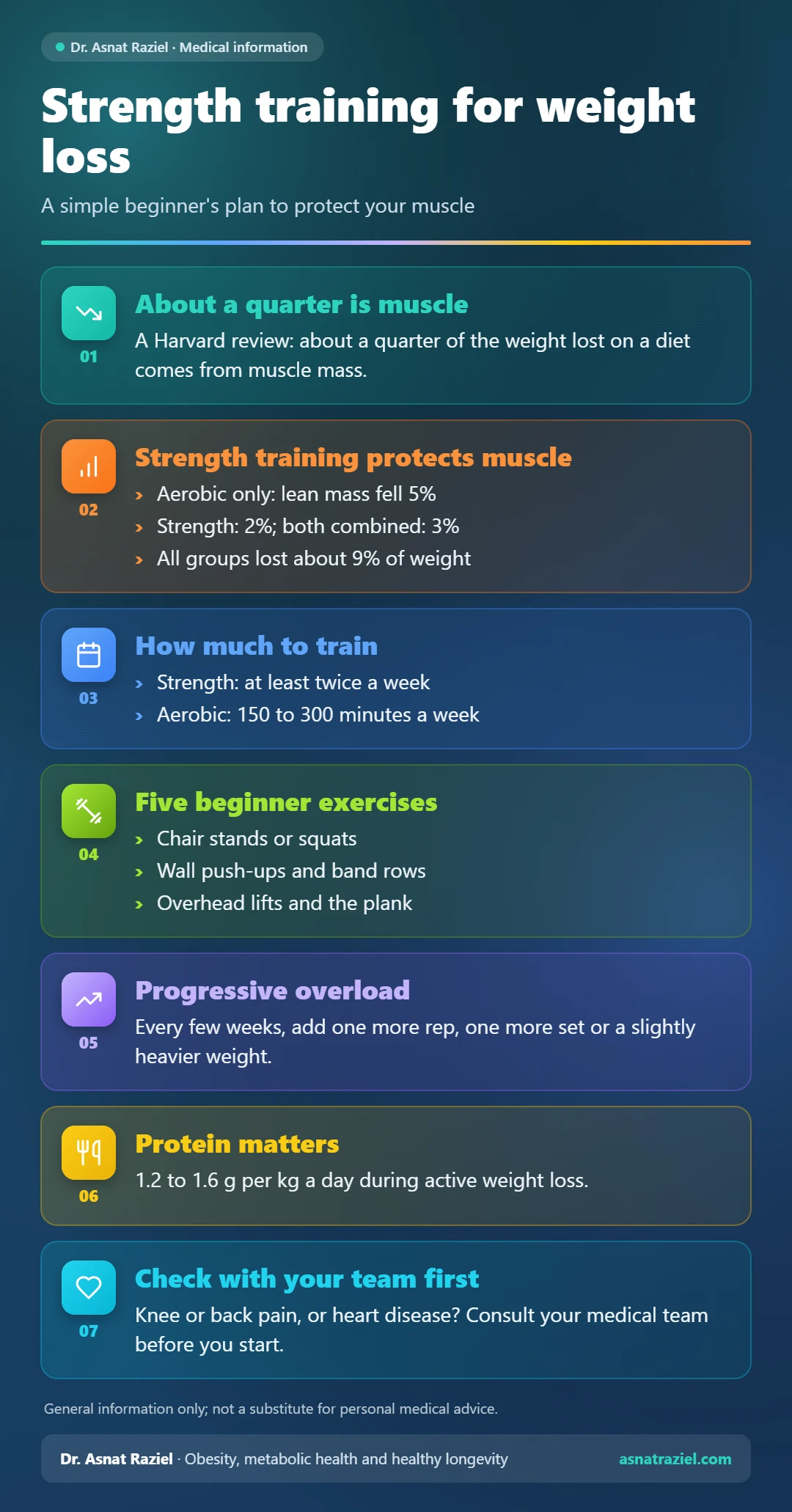
In the aerobic-only group, lean body mass fell by 5%. By contrast, in the strength training group it fell by only 2%, and in the combined group by 3%. Moreover, combining both types of exercise improved physical function the most. In other words, strength training preserves muscle, and adding aerobic exercise improves fitness. A full comparison of the two types is in my article on aerobic versus strength training.
How much to train: the official recommendations
The World Health Organization guidelines recommend 150 to 300 minutes of moderate aerobic activity a week for adults. In addition, they recommend strength training for all major muscle groups at least twice a week. The Harvard review gives the same target: two resistance sessions a week, alongside 150 minutes of brisk walking or light jogging.
For strength training for weight loss, the key tool is resistance training. Resistance training is any exercise in which your muscles work against an external force. You can use weights, resistance bands or your own body weight. So you do not need a gym to get started.
A beginner’s plan for strength training for weight loss
First, choose two fixed days a week, with a rest day in between. Each session lasts 30 to 40 minutes. Start with a short warm-up of walking or joint mobility moves. Then do one exercise for each main area of the body:
- Legs and glutes: chair stands or squats, bending the knees with a straight back.
- Chest and arms: push-ups against a wall or a sturdy table.
- Upper back: rows with a resistance band or with water bottles.
- Shoulders: lifting light weights overhead.
- Core muscles: the plank, holding your body straight on your forearms.
Choose a load that lets you do the exercise with good technique, while the last repetitions feel challenging. Every few weeks, add a little: one more repetition, one more set or a slightly heavier weight. This principle is called progressive overload, and it is what makes the muscle adapt and grow stronger.
Putting the week together
Here is how the recommendations above fit into a single week, without adding anything new:
- Two strength sessions on fixed days, with at least one rest day between them.
- In each session: a short warm-up, then the five exercises for legs, chest and arms, upper back, shoulders and core.
- On the other days: aerobic activity, such as brisk walking, adding up to 150 to 300 minutes over the week.
- Every few weeks: one small step up in repetitions, sets or weight.
Write the sessions in your calendar, and keep the load light at first. The goal of the first weeks is to build the habit and learn good technique.
Protein: the building block of muscle
Muscle is built from protein. That is why strength training for weight loss without enough protein will not deliver the full result. The general recommendation for adults is 0.8 grams of protein per kilogram of body weight per day. However, during active weight loss, the joint advisory sets higher targets of 1.2 to 1.6 grams per kilogram. The Harvard review mentions a range of 1.2 to 1.5 grams per kilogram for people aged 65 and over who do strength training.
It is best to spread protein across the day and include a protein source at every meal. Good examples include eggs, yogurt, legumes, fish, chicken and tofu. You will find more ideas in my guide to protein for weight loss.
A moderate pace protects your muscle
Gradual weight loss gives the body time to adapt and to favor fat as its fuel. On the other hand, losing weight too fast increases muscle breakdown. As a result, your metabolic rate drops, and so does your fitness. So there is no need to rush. It is best to set the right pace for you with your care team. You can read about the risks of going too fast in my article on the dangers of rapid weight loss.
Tips for sticking with strength training for weight loss
Consistency is the hardest part. So put your workouts in your calendar like any other important appointment. In addition, start with a light load to prevent soreness and injury. People with knee or back pain, or with heart disease, should consult their medical team before starting. A physiotherapist or a professional trainer can teach correct technique in the very first sessions.
Measure progress by more than weight. Also pay attention to your waist circumference, your strength and how easily you climb stairs. A body composition test helps you understand what was really lost. Why this matters is explained in my article on body composition. And readers over 60 will find important information in my article on sarcopenia and obesity.
The bottom line
Weight loss includes muscle loss, not only fat loss, especially when it is fast. Strength training for weight loss, twice a week, is the most effective tool to limit that loss. Combined with enough protein, aerobic activity and a moderate pace, it improves metabolism, strength and stability. In the end, keeping your muscle while losing fat is the key to healthy, lasting weight loss.
The information in this article is general and does not replace personal medical advice.
References
Trying to lose weight? Be careful not to lose muscle
Aerobic or Resistance Exercise, or Both, in Dieting Obese Older Adults
Once-Weekly Semaglutide in Adults with Overweight or Obesity
World Health Organization 2020 guidelines on physical activity and sedentary behaviour




