By Dr. Asnat Raziel, bariatric surgeon specializing in obesity treatment, metabolic health and healthy longevity; Director of the Multidisciplinary Center for Obesity Treatment, Assia Medical, Assuta Ramat HaChayal, Tel Aviv
GLP-1 and pregnancy: why new guidance was needed
GLP-1 and pregnancy is a topic on the minds of many women of reproductive age today. Both GLP-1 drugs and other incretin-based medications have changed how we treat obesity and diabetes. They include semaglutide, known as Ozempic and Wegovy, tirzepatide, known as Mounjaro, and liraglutide, known as Saxenda. Still, young women keep asking me an important question: how do you combine effective obesity treatment with a safe, planned pregnancy?
In July 2026, the first comprehensive answer arrived. In a systematic scoping review and consensus statement in the journal Obesity Reviews, experts from Europe, North America and the Middle East joined forces, including a physician from Israel. They reviewed the literature up to July 2025 and drew up practical recommendations for doctors and patients.
Why it matters to treat obesity before pregnancy
Obesity is not just a matter of weight. In fact, it directly affects fertility and the course of pregnancy. Women with obesity often have ovulation problems and insulin resistance. In addition, their risk of gestational diabetes, high blood pressure in pregnancy, preterm birth and cesarean delivery is much higher.
Therefore, reaching a healthy weight before conception is one of the most important steps for the health of both mother and baby. You can read more about the link between weight, hormones and fertility in my article on obesity and hormonal disorders.
How incretin drugs affect the reproductive system
Beyond weight loss, these drugs have metabolic and hormonal effects. They reduce appetite, improve insulin sensitivity and lower chronic inflammation. As a result, ovarian function also improves in some women, which matters when GLP-1 drugs are used before pregnancy.
In women with polycystic ovary syndrome (PCOS), studies have shown several benefits:
- More regular ovulation.
- More frequent periods.
- Lower insulin resistance.
- Better chances of getting pregnant.
- Better success with fertility treatments.
Some of these effects come from the weight loss itself. On the other hand, some are probably linked to a direct effect of the drugs on the reproductive system.
GLP-1 and pregnancy: can you continue treatment?
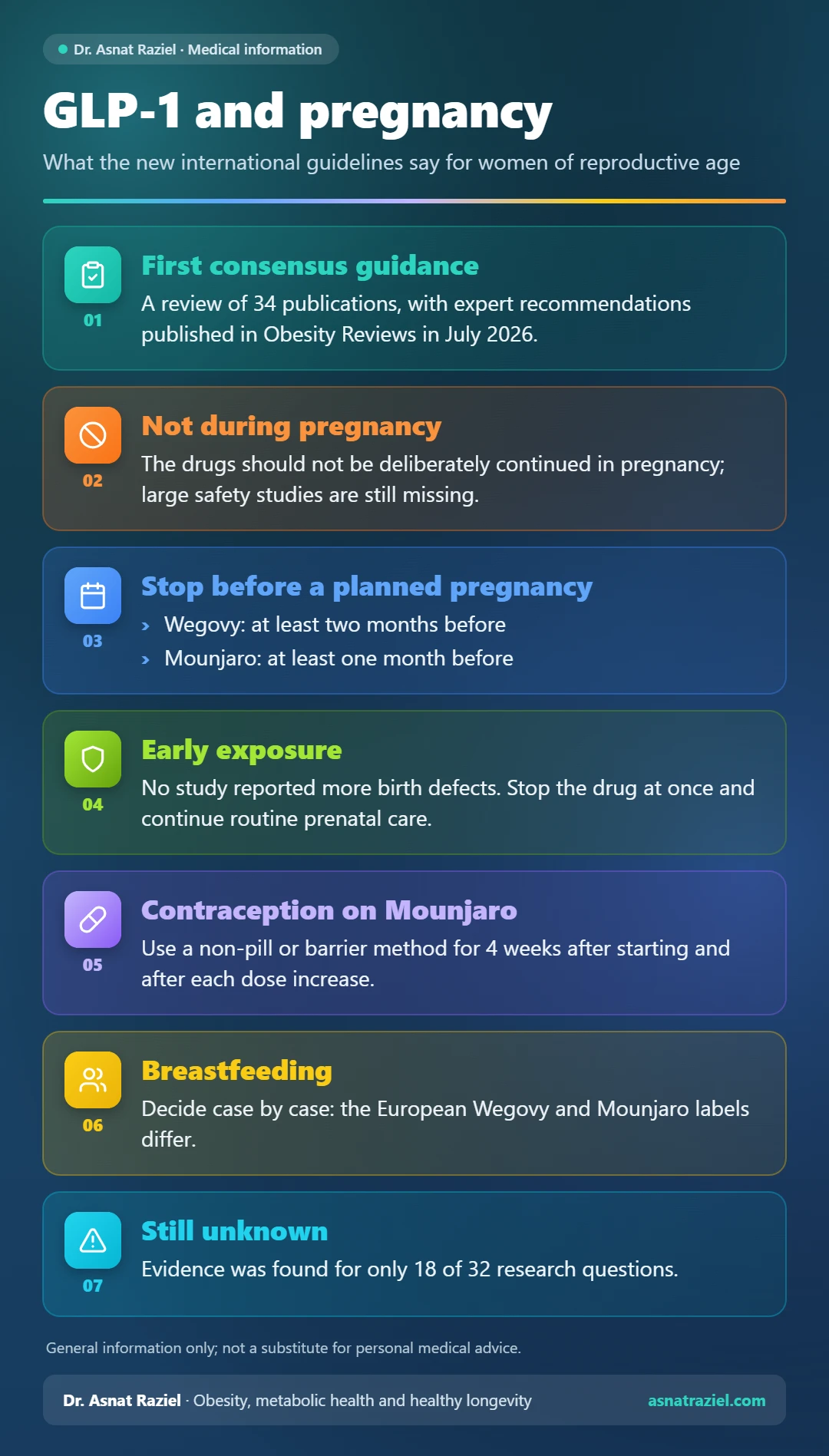
As of November 2026, the answer is still no. The guidelines state explicitly that women should not deliberately continue these drugs during pregnancy. The reason is simple: there are still no large prospective studies that prove they are fully safe.
The review included 34 publications: 11 randomized trials, nine observational studies, two reviews of adverse event reports, nine case reports and three laboratory and animal studies. The number of exposed pregnancies ranged from one to 4,267 in a single study. Most GLP-1 exposures were unplanned and happened in the first weeks of pregnancy. Here is the encouraging news: no study reported an increase in birth defects.
What happens when exposure occurs by accident? Read my summary of GLP-1 exposure in early pregnancy.
However, in most cases the exposure was short. The women stopped the drug as soon as they found out they were pregnant. Only three studies reported exposure throughout the entire pregnancy. So there is not enough information to recommend continuing treatment.
When to stop before a planned pregnancy
The review notes that the ideal length of the break is still unclear. In the meantime, the drug labels set a minimum period. According to the European Medicines Agency’s Wegovy label, women should stop semaglutide at least two months before a planned pregnancy. By contrast, according to the European Mounjaro label, they should stop tirzepatide at least one month beforehand. The difference reflects how long each drug takes to clear from the body. For a practical guide to this period, see my article on stopping weight loss drugs before pregnancy.
Unplanned exposure in early pregnancy
One message in the guidelines is especially reassuring. The current data do not show an increase in birth defects after early exposure. In other words, a woman who finds out she is pregnant while taking Wegovy or Mounjaro does not need to panic.
The recommendation is to stop the drug right away and continue routine prenatal care. It is also a good idea to consult a specialist. Early exposure on its own is not a reason to end a pregnancy. You can read more about this in my article on GLP-1 drugs in diabetes and pregnancy.
Do GLP-1 drugs reach the baby during pregnancy?
This is one of the most intriguing questions. Placenta studies and a small number of umbilical cord blood samples found only minimal transfer of GLP-1 drugs to the fetus during pregnancy. However, the number of studies is very small. Moreover, only one study, in animals, followed the offspring after birth as well. So we cannot yet say that the drugs are completely safe for the fetus.
What about breastfeeding?
Here too, knowledge is starting to build. In a small study, researchers tested milk samples from eight breastfeeding women who were taking semaglutide. They did not find the drug in any sample. Even so, this was only a small study, and it did not examine the babies themselves.
That is why the guidelines recommend deciding on treatment during breastfeeding case by case. It is worth knowing that the labels are not consistent. The European Wegovy label states that women should not use semaglutide while breastfeeding. On the other hand, the European Mounjaro label notes that tirzepatide levels in milk were undetectable to very low, and that doctors may consider treatment during breastfeeding.
GLP-1 and pregnancy: what about contraception?
Here there is a difference between the drugs. Tirzepatide slows stomach emptying and may reduce how well the body absorbs birth control pills. The effect is most noticeable at the start of treatment and after each dose increase. For this reason, Australia’s medicines regulator (TGA) recommends switching to a non-pill method, or adding a barrier method such as a condom. The advice covers the four weeks after starting treatment and the four weeks after each dose increase. The US label says the same.
In addition, the new guidelines stress structured contraception counseling for every woman of reproductive age who starts treatment. This way, women can prevent an unplanned pregnancy during drug exposure.
Possible benefits before conception
The review found some interesting early evidence. Incretin treatment before conception may reduce gestational diabetes, high blood pressure in pregnancy and even preterm births. The likely explanation is the improvement in weight and metabolic health.
Still, the link is not yet proven. Most of the studies were observational rather than randomized. Alongside this, the guidelines recommend support from a clinical dietitian for every woman of reproductive age who takes these drugs, especially when preparing for pregnancy.
The period after birth
The guidelines also address the time after delivery. In women who had gestational diabetes, the drugs appear effective for weight loss and blood sugar control. On the other hand, the right time to start treatment is still unknown, and doctors also need to consider breastfeeding. You can read more about this stage in my article on weight loss after giving birth.
What we still don’t know
Despite the progress, the researchers found evidence for only 18 of the 32 research questions they defined. That means almost half of the questions remain unanswered. The open questions include:
- The ideal length of the break before trying to conceive.
- How the drugs affect body composition in pregnancy.
- Long-term effects on children exposed in the womb.
- Full safety during breastfeeding.
- Nutritional status, vitamins and muscle mass before pregnancy.
- The best way to combine incretin drugs with fertility treatments.
The bottom line on GLP-1 and pregnancy
The new document marks a shift in thinking. Instead of seeing incretin drugs as a threat to women of reproductive age, they are becoming a tool to prepare well for pregnancy. At the same time, medical responsibility calls for caution. Today’s recommendation is clear: use the drugs before pregnancy when there is a medical indication, use reliable contraception, stop the drug before a planned pregnancy or as soon as you find out you are pregnant, and stay under medical follow-up.
In the end, when it comes to GLP-1 and pregnancy, good metabolic health before conception is a great gift to both mother and baby. The recommendations may change as more research accumulates. So it is wise to plan a pregnancy together with your doctor, especially while you are on medication for obesity.
The information in this article is general and does not replace personal medical advice.
References
Wegovy: EPAR – Product Information
Mounjaro: EPAR – Product Information
Subcutaneous Semaglutide during Breastfeeding: Infant Safety Regarding Drug Transfer into Human Milk