By Dr. Asnat Raziel, bariatric surgeon specializing in obesity treatment, metabolic health and healthy longevity; Director of the Multidisciplinary Center for Obesity Treatment, Assia Medical, Assuta Ramat HaChayal, Tel Aviv
Polycystic ovary syndrome: far more than the ovaries
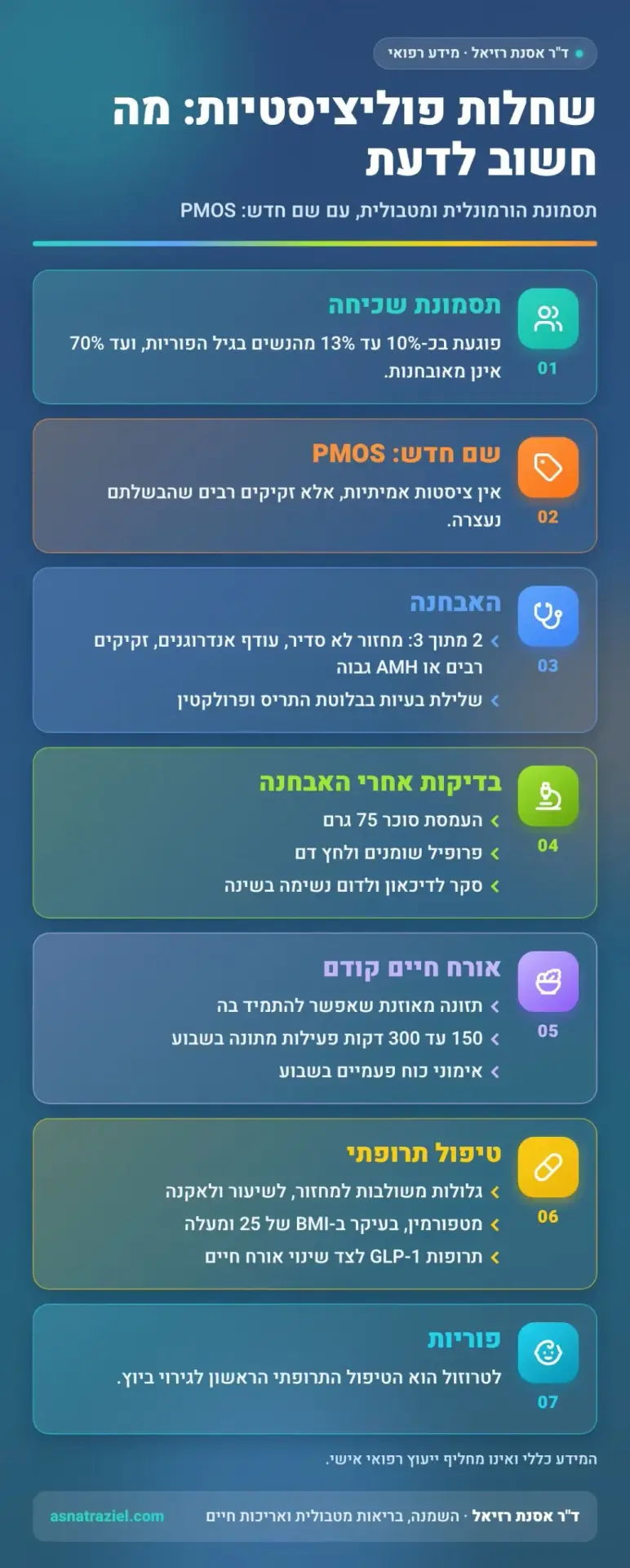
Polycystic ovary syndrome (PCOS) is the most common hormonal disorder in women of reproductive age. According to the World Health Organization, the syndrome affects about 10% to 13% of women in this age group. Yet up to 70% of them do not know they have it. That is why many women come to me after years of irregular periods, acne and difficulty losing weight, without anyone having connected the dots.
The good news: the syndrome can be diagnosed with simple tests. And there are effective treatments for each of the symptoms, as well as for the metabolic risk that comes with them.
A new name: PMOS
In May 2026, The Lancet published the international consensus on a new name for the syndrome: Polyendocrine Metabolic Ovarian Syndrome, or PMOS. The process involved 56 professional and patient organizations, and more than 14,000 survey respondents.
Why change the name? First, these ovaries do not contain true cysts. What the ultrasound shows are many small follicles whose maturation has stalled. Second, the old name hid the metabolic side and reduced the syndrome to “an ovary problem.” During a three-year transition period, both names will be used side by side. In this article I will keep using “polycystic ovary syndrome” and PCOS, because these are the terms most women know.
Polycystic ovary syndrome: what happens in the body?
At the heart of the syndrome are two mechanisms that feed each other. The first is an excess of “male” sex hormones (androgens). The second is insulin resistance, a state in which the cells respond weakly to insulin and the pancreas secretes large amounts of it to compensate.
High insulin levels stimulate the ovaries to produce androgens. They also make it harder to lose weight and encourage the buildup of abdominal fat. This relationship is part of a broader picture of obesity and hormonal disorders that influence one another. It is important to know, however, that the syndrome also occurs in lean women.
Common symptoms
The picture varies from woman to woman, but these are the main signs:
- Irregular, infrequent or absent periods.
- Excess hair on the face, chin, chest or abdomen.
- Acne, oily skin or thinning hair on the crown.
- Difficulty getting pregnant because of irregular ovulation.
- Weight gain, mainly around the abdomen.
What’s more, the international guidelines highlight high rates of anxiety, depression and poor body image among women with the syndrome. This, too, is part of treatment, not an “add-on.”
How is polycystic ovary syndrome diagnosed?
In adult women, diagnosis requires two of three features: irregular periods with an ovulation disorder, clinical or laboratory signs of excess androgens, and ovaries with many follicles on ultrasound. According to the international guidelines, the ultrasound can be replaced with a blood test for AMH (anti-Müllerian hormone, a hormone that reflects the number of follicles in the ovary). AMH alone, however, is not enough for a diagnosis.
In adolescents, the rules are stricter: both irregular periods and excess androgens are required, without relying on ultrasound. At any age, the doctor first rules out other causes, such as thyroid problems or excess prolactin.
Tests worth doing after diagnosis
The guidelines recommend assessing the body’s blood sugar status. The most accurate test is a 75-gram oral glucose tolerance test (OGTT). It is also worth checking a lipid profile and blood pressure. The guidelines further recommend asking about snoring and fatigue as signs of sleep apnea, and screening for depression.
Long-term risks
The syndrome stays with a woman beyond her reproductive years. According to the World Health Organization, it raises the risk of type 2 diabetes, high blood pressure, high cholesterol and heart disease. It is also linked to fatty liver, gestational diabetes and thickening of the uterine lining. That is why I see polycystic ovary syndrome as a lifelong metabolic condition, not just “a period problem.”
Treating polycystic ovary syndrome: lifestyle first
A healthy lifestyle is the foundation for every woman with the syndrome, even when there is no need to lose weight. The guidelines do not recommend one specific diet. Instead, they recommend a balanced diet that can be sustained over the long term.
In practice, a menu rich in protein, whole grains and vegetables improves insulin sensitivity. For example, a plate that is half vegetables slows the rise in blood sugar after a meal. As for physical activity, the guidelines recommend 150 to 300 minutes per week of moderate activity, or 75 to 150 minutes of vigorous activity. Strength training twice a week also helps preserve muscle mass.
I want to stress this: modest weight loss often improves menstrual regularity and ovulation. Even so, the success of treatment is not measured by weight alone.
Polycystic ovary syndrome: drug treatment
The choice of medication depends on the woman’s goal: regulating her cycle, treating excess hair and acne, losing weight or getting pregnant. That is why we tailor treatment to each individual.
Birth control pills and metformin
Combined oral contraceptive pills regulate the cycle and reduce excess hair and acne. Metformin improves insulin sensitivity. The guidelines recommend considering it mainly for women with a BMI of 25 or higher. Its common side effects are nausea and diarrhea, and with long-term use it is worth checking vitamin B12 levels.
GLP-1 medications for women with excess weight
The guidelines allow obesity medications such as liraglutide and semaglutide to be considered alongside lifestyle change. A meta-analysis of four trials with 176 participants showed an average reduction of 5.16 cm in waist circumference compared with placebo, as well as a drop in testosterone levels.
On the other hand, a Swedish review of 11 trials found a modest reduction in BMI, of 1.38 units on average. On menstrual cycles and excess hair, the data are still incomplete. In other words, these medications are promising, but research in women with the syndrome is still limited.
An important point for women planning a pregnancy: GLP-1 medications must be stopped before conceiving, according to the instructions for each product. In addition, Mounjaro may reduce the effectiveness of the birth control pill.
Polycystic ovary syndrome and fertility
The ovulation disorder is the main reason for difficulty conceiving. The international guidelines recommend letrozole as the first-line medication for inducing ovulation. If it does not work, the next steps are hormone injections or in vitro fertilization (IVF).
In addition, a recent meta-analysis of three trials (252 participants) compared GLP-1-based treatment with metformin. It showed an increase in spontaneous pregnancies, but not in the overall pregnancy rate. The researchers themselves stress that the data are limited.
A multidisciplinary approach throughout life
The best care brings together several professionals: a physician, a dietitian, a gynecologist and sometimes a psychologist. At our clinic, we work with each woman to build a plan that fits the stage of life she is in. This is especially true for the many women of reproductive age whose goals change over time.
The bottom line
Polycystic ovary syndrome is a hormonal and metabolic syndrome, not just “cysts on the ovaries.” The new name, PMOS, reflects this. Early diagnosis, blood sugar and lipid testing, and a healthy lifestyle are the foundation. Beyond that, personalized medications help with the menstrual cycle, the skin, weight and fertility. If these symptoms sound familiar, it is worth getting a proper evaluation.
The information in this article is general and does not replace personal medical advice.
Questions and answers
Can you get pregnant with polycystic ovary syndrome?
Yes. Most women with the syndrome are able to conceive, sometimes with the help of ovulation induction. According to the guidelines, letrozole is the first-line medication.
Does the syndrome go away after weight loss?
Not completely. However, modest weight loss often improves the menstrual cycle, ovulation and metabolic markers.
Can lean women have the syndrome too?
Yes. Women at a normal weight can also develop the syndrome, and some of them have insulin resistance as well.
What is the difference between PCOS and PMOS?
It is exactly the same syndrome. The name PMOS emphasizes its hormonal and metabolic side, and the diagnostic criteria have not changed.