By Dr. Asnat Raziel, bariatric surgeon specializing in obesity treatment, metabolic health and healthy longevity; Director of the Multidisciplinary Center for Obesity Treatment, Assia Medical, Assuta Ramat HaChayal, Tel Aviv
The obesity drug market is moving from injections to pills
In recent years, the obesity drug market has become one of the most turbulent and expensive arenas in medicine. Researchers originally developed GLP-1 drugs for diabetes, but today they are a central tool in the global fight against obesity. Their impact is not only medical. It is also economic, regulatory and social, with consequences for health systems, drug companies and patients themselves.
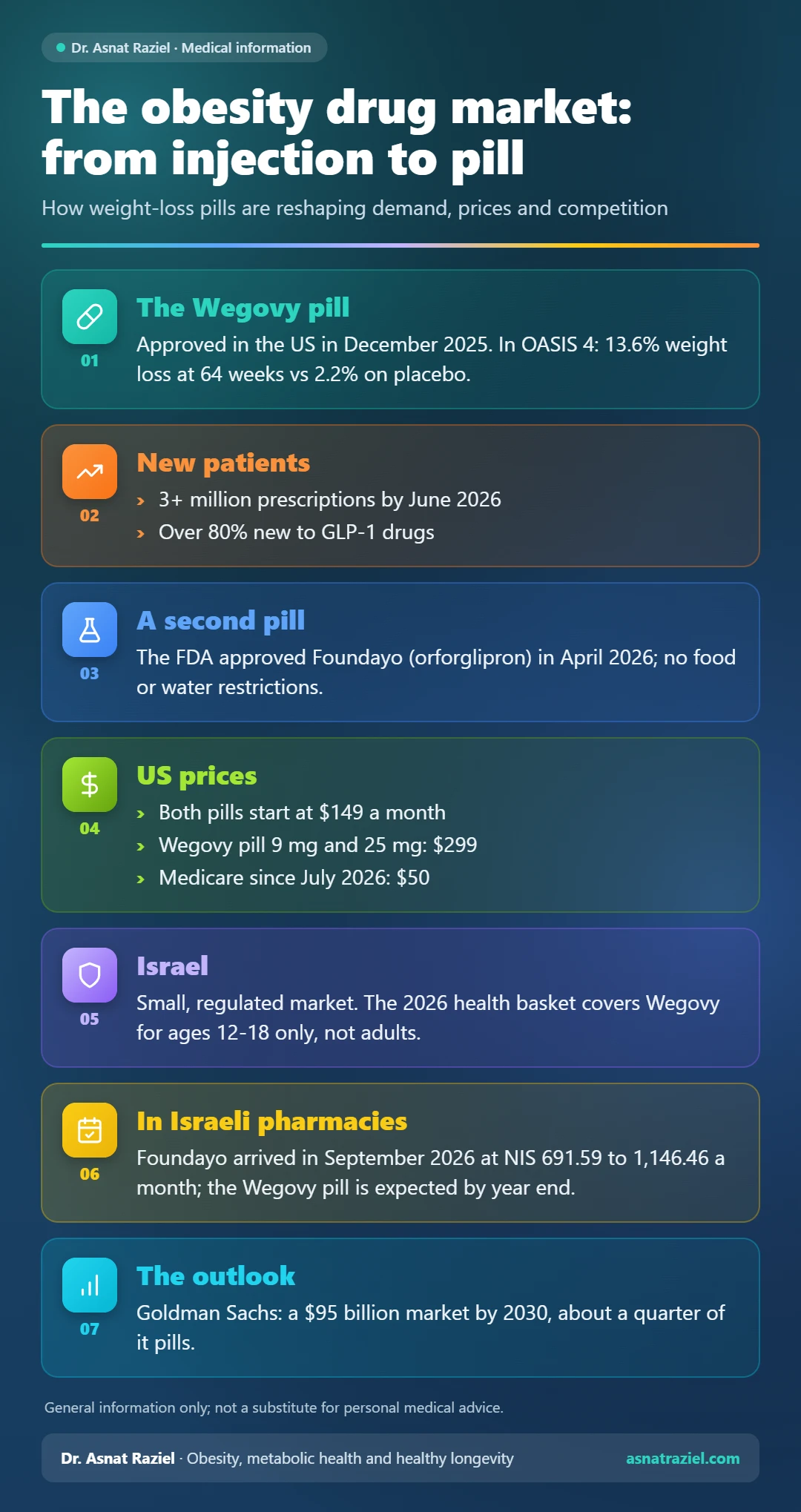
The turning point came in December 2025, when the FDA approved the Wegovy pill in the United States. For the first time, a treatment with effectiveness close to that of the injections became available as a pill. In the OASIS 4 trial, the pill led to an average weight loss of 13.6% after 64 weeks. In the placebo group, by comparison, weight loss was 2.2%.
The pill is expanding demand
For many people, injecting was a psychological or practical barrier. A pill, on the other hand, feels like an everyday, accessible treatment, much like blood pressure medication. The data back this up. According to Novo Nordisk, by June 2026 pharmacies had filled more than three million prescriptions for the Wegovy pill. What’s more, over 80% of new prescriptions were for people who had never taken a GLP-1 drug before. In other words, the pill did not just replace the injection. It brought in entirely new patients.
New competition in the obesity drug market
Turning a protein-based drug such as semaglutide into a pill requires advanced absorption technology and manufacturing on a huge scale. As a result, competition remains mostly in the hands of large companies. The first pill of this kind was Rybelsus, which is used for diabetes, and you can read about it in my article on Rybelsus and weight loss. However, non-protein pills are already here. In April 2026, the FDA approved Foundayo (orforglipron) from Lilly. It can be taken at any time of day, with no food or water restrictions. I compare the two pills in my article on Foundayo vs oral semaglutide.
Prices, discounts and insurers
The Wegovy pill launched on January 5, 2026 at $149 a month for the low doses. The 9 mg and 25 mg doses cost $299 a month. Lilly also sells Foundayo through direct-to-consumer shipping, starting at $149 a month for the lowest dose. In addition, since July 2026, eligible patients on Medicare, the US government health insurance program, pay $50 a month for both drugs.
On the one hand, a pill increases the number of patients. On the other hand, you must take semaglutide pills on an empty stomach, and that takes discipline. For some patients, this may hurt adherence and affect real-world results.
A double-edged sword for health funds and insurers
In the short term, wider use increases spending. In the long term, however, there is potential for savings through fewer complications of obesity, from diabetes to liver and heart disease. This gap between the immediate cost and the future benefit explains the strict criteria. Many health systems choose co-payments, eligibility requirements or time-limited subsidies. For an unexpected angle on the economics, see my article on airlines and weight-loss drugs.
The obesity drug market in Israel
In Israel, the market is small and regulated. Funding depends on the national health basket, Israel’s health funds (HMOs) and their supplementary insurance plans. The 2026 health basket added Wegovy injections for adolescents aged 12 to 18, but not for adults. In September 2026, Foundayo arrived in Israel, priced at NIS 691.59 to NIS 1,146.46 a month, depending on the dose. The Wegovy pill arrived in November 2026 and is available through Form 29C, the Ministry of Health pathway for medications not yet registered in Israel. So the pace of uptake here depends mainly on the ability to cover the cost.
The role of doctors
In practice, doctors shape demand. They diagnose, select patients, tailor treatment and manage expectations. In a world where industry ties, sponsored research and clinical guidelines are closely intertwined, professional responsibility is clear. We need to stay transparent, rely on data and fit the treatment to the person, not to the market.
Bottom line on the obesity drug market
The obesity drug market is not a passing trend. Goldman Sachs estimated that the global market will reach $95 billion by 2030, with pills taking about a quarter of it. Will competition bring prices down? Probably yes, but gradually. Ultimately, more options and growing demand are likely to put real pressure on prices. For a look at a neighboring field, see also my article on the longevity market.
The information in this article is general and does not replace personal medical advice.
Questions and answers about the obesity drug market
Demand, competition and price
How is the pill likely to affect market size and global demand?
The pill expands the market. It removes a barrier for patients who avoided injections despite a clear medical reason to treat. The first data already show this: most prescriptions for the pill went to people new to treatment. In addition, the more accessible treatment becomes, the more obesity is seen as a chronic disease that needs ongoing care, like high blood pressure.
Does the shift to pills change the level of competition?
Partly, yes, but not necessarily in favor of smaller players. A protein-based pill requires complex absorption technology and large-scale manufacturing. By contrast, non-protein pills such as Foundayo are simpler to produce at scale. That is why they could shift the balance of power.
How does the form of the drug affect price and patient numbers?
The starting price in the United States is relatively low, but the actual cost depends on insurance, discounts and dose. The number of patients is rising. However, patients must take oral semaglutide on an empty stomach, with a wait before eating, and this may hurt adherence. On the other hand, its impressive effectiveness in trials supports wider use.
Funding, Israel and the doctor’s role
What are the economic implications for health funds and insurers?
Direct spending goes up because many patients need long-term treatment. At the same time, there is potential for savings through less diabetes, high blood pressure, fatty liver and sleep apnea. The problem is that the savings come in the long term, while the cost is immediate. As a result, we can expect eligibility criteria, co-payments and sometimes outcome-based payment agreements.
How does Israel compare with the rest of the world?
Israel is a small, regulated market. Many adults buy these drugs privately or at a discount through their supplementary insurance. In the United States, by contrast, there are many commercial models and direct-to-consumer discounts. In practice, funding drives the pace of uptake far more than patient demand does.
What role do doctors play in shaping demand?
Doctors play a central role: diagnosis, assessing how severe the obesity is, selecting patients, setting expectations and providing long-term follow-up. That is why transparency about conflicts of interest matters, along with reliance on guidelines, controlled data and truly personalized care.
Will competition bring prices down?
Yes, but gradually. At first, companies offer targeted discounts. As more options with similar effectiveness arrive, insurers will gain bargaining power. The competition has already begun, for example with the identical $149 starting price for both pills. I compare the pills used for diabetes and for obesity in my article on Rybelsus vs the Wegovy pill.
References
Oral Semaglutide at a Dose of 25 mg in Adults with Overweight or Obesity
Novo launches Wegovy weight-loss pill for sale in US
The anti-obesity drug market may prove smaller than expected
No more injections? New weight-loss pill to launch in Israel next week