By Dr. Asnat Raziel, bariatric surgeon specializing in obesity treatment, metabolic health and healthy longevity; Director of the Multidisciplinary Center for Obesity Treatment, Assia Medical, Assuta Ramat HaChayal, Tel Aviv
Mounjaro meal plan: why the medication alone is not enough
A Mounjaro meal plan is part of the treatment itself, not an add-on. The medication reduces your appetite, but it does not teach you what to eat. That is why it pays to build a menu rich in protein, vegetables and fiber, and low in simple sugars. This way, the weight you lose comes mainly from fat, not from muscle.
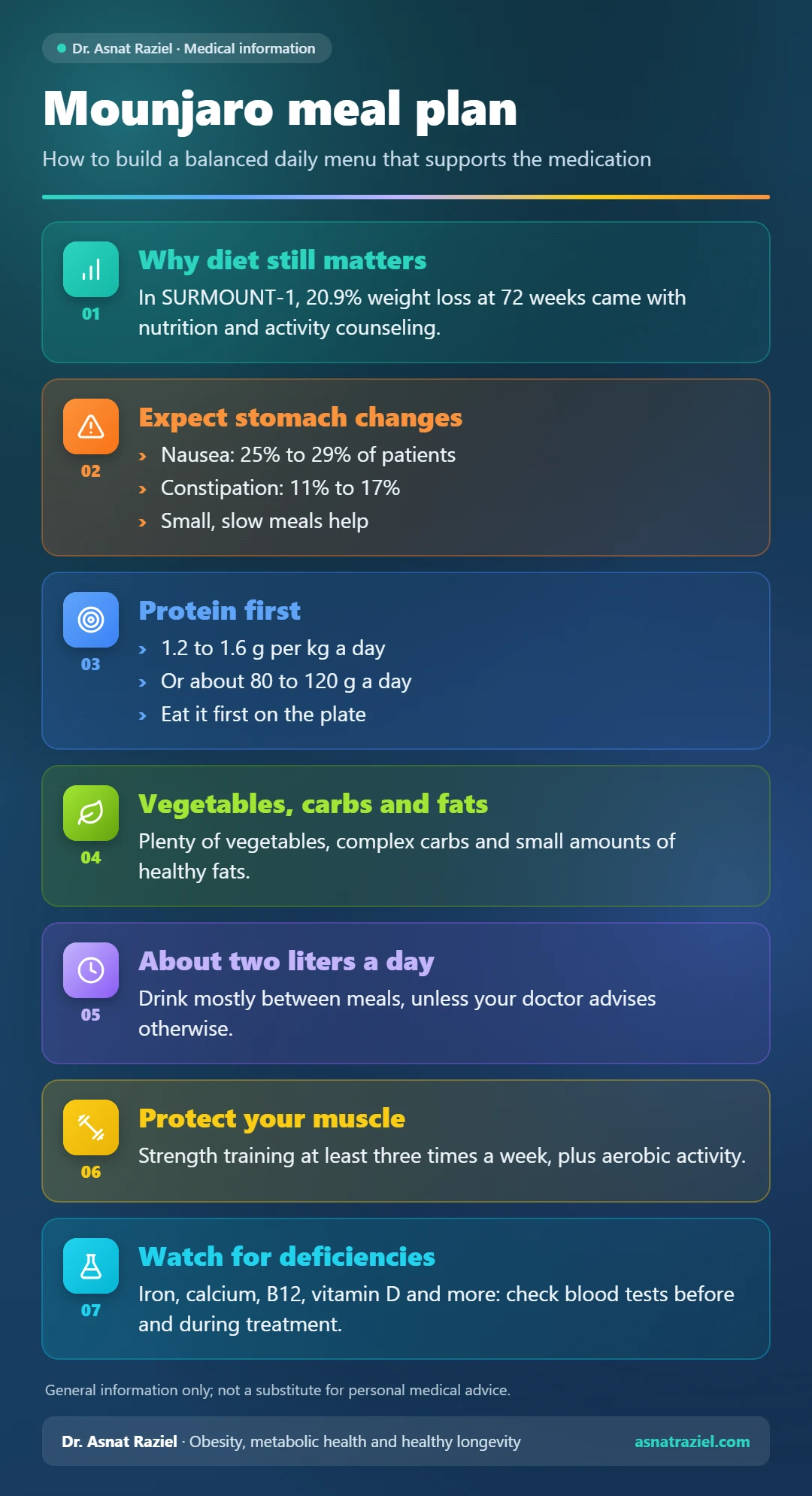
Mounjaro contains tirzepatide, the first medication that mimics two satiety hormones: GLP-1 and GIP. In the SURMOUNT-1 trial, patients on the 15 mg dose lost an average of 20.9% of their body weight after 72 weeks. However, all participants also received nutritional counseling and guidance on physical activity. In other words, even the impressive results in the trial relied on lifestyle.
Your body changes, and so do your needs
Many patients who start Mounjaro report a drop in appetite. Some become sensitive to fatty or heavy food and feel mild nausea at first. This is a natural part of the process. The main reason is that the stomach empties more slowly during treatment.
According to the FDA prescribing information for tirzepatide (Zepbound), nausea occurred in 25% to 29% of patients in the obesity trials, and constipation in 11% to 17%. So adjusting your diet matters from the very first week:
- Small meals at regular times.
- Chewing slowly and stopping at the first feeling of fullness.
- Drinking throughout the day, and less during the meal itself.
- At first, it is best to skip fatty dishes, carbonated drinks and very spicy food.
I wrote in detail about coping with nausea and constipation in my guide to Mounjaro side effects.
Five principles of a Mounjaro meal plan
1. Protein at every meal
Protein protects muscle mass and keeps you feeling full for longer. A joint advisory from four American societies mentions a target of 1.2 to 1.6 grams of protein per kilogram of body weight per day during weight loss. Alternatively, you can aim for about 80 to 120 grams a day. A simple tip: eat the protein on your plate first. That way, it does not get “crowded out” when fullness comes quickly. Good sources include chicken, fish, eggs, Greek yogurt, low-fat cheeses, tofu, lentils and other legumes. You will find more ideas in my guide to protein intake.
For an easy high-protein dinner, try my baked chicken thighs with vegetables.
2. Plenty of vegetables, in every color
Vegetables provide fiber, vitamins and minerals. In addition, fiber helps balance blood sugar and prevent constipation. Early in treatment, steamed or lightly stir-fried vegetables are sometimes better than a large salad. Increase your fiber gradually, along with your fluid intake.
3. Carbohydrates in moderation, and of good quality
There is no need to give up carbohydrates completely. Still, it is wise to choose complex carbohydrates: quinoa, sweet potato, brown rice, oats and whole grains. On the other hand, sweets, sugary drinks and white flour products raise blood sugar and weaken fullness.
To put these food groups together, you can use Harvard’s Healthy Eating Plate. It fills half the plate with vegetables and fruits, a quarter with whole grains and a quarter with healthy protein.
4. Healthy fats, in small amounts
Fats are important for hormone function and for fullness. Choose avocado, nuts, almonds, tahini and olive oil. But here, too, moderation is key. A high-fat meal slows stomach emptying even further and may increase nausea and diarrhea.
5. Drink enough
During treatment it is easy to forget to drink, because thirst also decreases. What’s more, vomiting or diarrhea can lead to dehydration and even kidney damage. So aim for about two liters a day, mostly between meals, unless your doctor has told you otherwise. Water and herbal teas are the best choice. Carbonated drinks, by contrast, may increase bloating.
Example: a Mounjaro meal plan for one day
The following example is only a starting point. It is best to adjust the amounts with a dietitian, according to your weight, age and activity level.
- Breakfast: Greek yogurt with oats, berries and a few nuts.
- Lunch: baked chicken breast or fish, quinoa and steamed vegetables.
- Afternoon: a piece of fruit, or a handful of almonds with low-fat cheese.
- Dinner: an omelet, a large salad and a slice of whole-grain bread.
- Before bed, if you are hungry: a small yogurt or chamomile tea.
The most important rule is to listen to your body. Eat when you feel real hunger, and stop as soon as you feel pleasantly full. To learn more about nutrition principles during treatment, read my nutrition guide for weight loss injections.
Protecting your muscle: the menu alone is not enough
Part of the weight lost during treatment is lean body mass. According to a review of GLP-1-based therapies, lean mass made up 40% to 60% of the weight lost in some studies, and 15% or less in others. This mass also includes water, organs and bone, not just muscle. That is why the joint advisory recommends strength training at least three times a week, along with aerobic activity. I also wrote about this in my article on how to avoid losing muscle as you lose weight.
Vitamins and minerals while you lose weight
When you eat less, it is easy to develop deficiencies. The joint advisory lists nutrients to watch: iron, calcium, magnesium, zinc and vitamins A, D, E, K, B1, B12 and C. In addition, it suggests considering vitamin D, calcium and B12 supplements in advance for people at risk. Check with your doctor or dietitian about:
- Blood tests before and during treatment.
- Whether you need a multivitamin supplement.
- Whether protein powder could help you reach your daily target.
An international consensus statement from 2025 also stresses nutritional follow-up and lifestyle support throughout every stage of treatment.
Mindful eating: the key to a Mounjaro meal plan that works
The medication gives you physical fullness. Mindful eating, on the other hand, brings emotional fullness. Eat slowly, without your phone or the TV. Breathe, taste, and notice the moment your body says “enough.” Over time, this habit stays with you even when the medication is no longer there.
The bottom line: a Mounjaro meal plan as a foundation for habits
Mounjaro lets you eat less, but it does not teach you what to eat. Our job is to use the quiet the medication creates to build new, stable habits. A Mounjaro meal plan rich in protein and vegetables, together with regular exercise and good sleep, makes the change last. It also makes it easier to maintain your results after treatment ends, as I explained in my article on nutrition after stopping GLP-1 drugs.
The information in this article is general and does not replace personal medical advice.
References
Tirzepatide Once Weekly for the Treatment of Obesity
ZEPBOUND (tirzepatide) – Prescribing Information
Changes in lean body mass with glucagon-like peptide-1-based therapies and mitigation strategies