By Dr. Asnat Raziel, bariatric surgeon specializing in obesity treatment, metabolic health and healthy longevity; Director of the Multidisciplinary Center for Obesity Treatment, Assia Medical, Assuta Ramat HaChayal, Tel Aviv
Ozempic, Wegovy and Mounjaro: why now?
Ozempic, Wegovy and Mounjaro have led a revolution that, over the past decade, has changed how medicine views obesity. In the past, treatment relied almost entirely on diet, exercise and personal discipline. Today it is clear that obesity is a chronic disease with deep biological and hormonal roots. New drugs grew out of this understanding, and these three changed the rules of the game. In this article, I explain how they differ, who they suit, and why they do far more than help you lose weight.
Ozempic: it started with diabetes and changed obesity care
Ozempic began life as a drug for type 2 diabetes. Its active ingredient is semaglutide, which you inject once a week. It mimics a natural hormone called GLP-1, which the gut releases after eating. The hormone signals fullness to the brain. In practice, the drug reduces hunger, slows stomach emptying and improves blood sugar control.
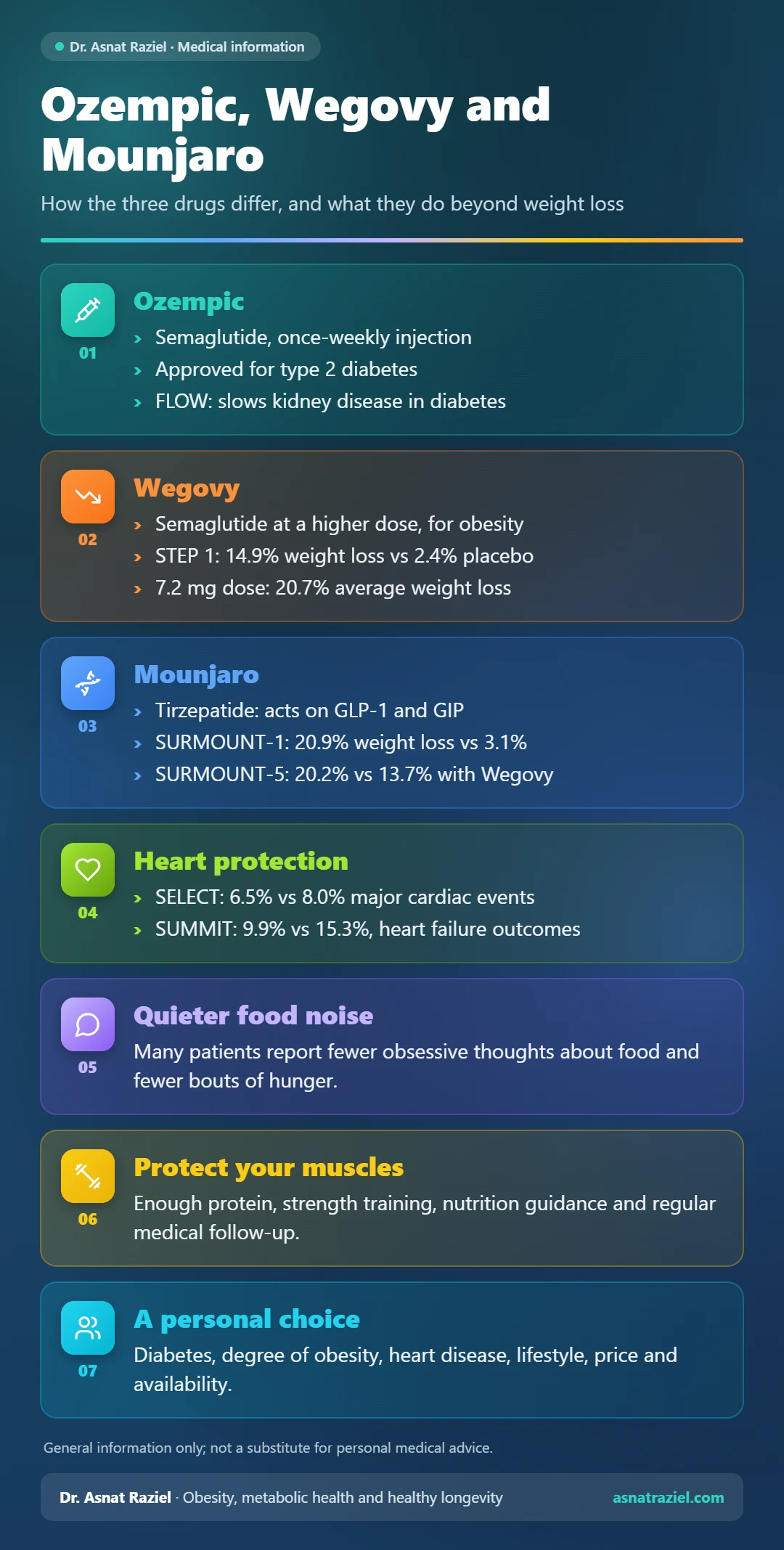
Over time, it became clear that Ozempic also leads to consistent weight loss. Still, it is important to be precise: Ozempic’s approval covers people with type 2 diabetes. Besides controlling blood sugar, it lowers their cardiac risk. In the FLOW trial, it also reduced the risk of worsening kidney disease in people with diabetes. For people with obesity who do not have diabetes, the right product is Wegovy.
Wegovy: the same ingredient, a different goal
Wegovy uses the same active ingredient as Ozempic, but at a higher dose. From the outset, its purpose was to treat obesity. In other words, it is not just a marketing version. Its goal is significant weight loss in people with a high BMI or related health conditions. In the STEP 1 trial, patients lost an average of 14.9% of their weight after 68 weeks, compared with 2.4% on placebo.
These drugs are now used very widely, and I review the figures in weight loss drug use in Israel and the US.
Today, Wegovy is no longer just one injection. In March 2026, the U.S. Food and Drug Administration (FDA) approved a higher 7.2 mg dose, with an average weight loss of 20.7%. In addition, the FDA approved a daily Wegovy pill in December 2025. I cover the new dose in my article on the STEP UP trial of Wegovy 7.2 mg.
Mounjaro: the next generation
Mounjaro is one of the most innovative drugs in the field. Its active ingredient is tirzepatide. It acts not only on GLP-1 but also on a second hormone called GIP. Combining these two hormonal pathways has a particularly strong effect on hunger, fullness and blood sugar control.
In the SURMOUNT-1 trial, patients on the 15 mg dose lost an average of 20.9% of their weight after 72 weeks, compared with 3.1% on placebo. Moreover, the SURMOUNT-5 trial compared the two drugs head to head. Mounjaro led to 20.2% weight loss, compared with 13.7% with Wegovy. Therefore, Mounjaro is especially suitable for people with significant obesity, with or without diabetes. It also suits people who did not respond well enough to other drugs. You will find a full comparison in my article on Mounjaro vs Wegovy.
Beyond the scale: what Ozempic, Wegovy and Mounjaro do for the body
A common mistake is to think of them only as weight-loss shots. In reality, the effect is much broader. These drugs act on the entire metabolic system. They improve glucose control, lower the risk of diabetes and help reduce blood pressure and blood fats.
The heart is a striking example. The SELECT trial enrolled 17,604 people with heart disease and excess weight, without diabetes. A major cardiac event occurred in 6.5% of patients on Wegovy, compared with 8.0% on placebo. As a result, the FDA approved Wegovy to reduce cardiac risk. Similarly, in the SUMMIT trial, Mounjaro reduced cardiovascular death or worsening heart failure: 9.9% compared with 15.3% on placebo.
Beyond that, many patients describe a deep change in their relationship with food. They report fewer obsessive thoughts, fewer bouts of hunger, and a sense of calm and control they had never known. This phenomenon is called food noise, the constant, intrusive thoughts about food. I wrote about it at length in my article on food noise.
These drugs are not a magic fix
It is important to stress that the drugs do not work on their own. Rapid weight loss without enough protein and strength training can lead to muscle loss and weakness. That is why four U.S. professional organizations published joint nutrition recommendations for patients in 2025. According to them, drug treatment should be paired with nutrition guidance, suitable physical activity and regular medical follow-up. How do you protect your muscles during treatment? I cover that in my article on muscle mass during GLP-1 treatment.
There are also side effects, mainly in the digestive system. Examples include nausea, constipation and diarrhea. In most cases, you can manage them with gradual dose increases and proper support. In addition, when treatment stops, the weight tends to come back. So the plan should also include a maintenance phase.
What comes next: the next wave is on its way
The revolution keeps evolving. Today there are already daily pills, such as the Wegovy pill and Foundayo. At the same time, researchers are studying even more powerful drugs that act on three hormones. A leading example is retatrutide. As a result, the toolbox keeps growing, and the choice is becoming more personal and precise.
The right choice among Ozempic, Wegovy and Mounjaro is personal
No single drug suits everyone. Choosing between Ozempic, Wegovy and Mounjaro depends on your medical condition and on whether you have diabetes. It also depends on the degree of obesity, heart disease, lifestyle and personal preferences. Price and availability through Israel’s health funds (HMOs) also come into play.
The bottom line on Ozempic, Wegovy and Mounjaro
The real revolution behind Ozempic, Wegovy and Mounjaro is not only in the drugs themselves. It is in the approach: personalized treatment that respects each person’s biology and life. When you choose the drug well and combine it with a healthy lifestyle, it is not a shortcut. Instead, it is a real opportunity for deep, lasting change.
This article provides general information and is not a substitute for personal medical advice.
References
Once-Weekly Semaglutide in Adults with Overweight or Obesity
Tirzepatide Once Weekly for the Treatment of Obesity
Tirzepatide as Compared with Semaglutide for the Treatment of Obesity
Semaglutide and Cardiovascular Outcomes in Obesity without Diabetes
Tirzepatide for Heart Failure with Preserved Ejection Fraction and Obesity
Effects of Semaglutide on Chronic Kidney Disease in Patients with Type 2 Diabetes
Wegovy HD (semaglutide 7.2 mg) approved in the US, providing 20.7% mean weight loss
The STEP 1, SELECT and FLOW trials were funded by Novo Nordisk; the SURMOUNT-1, SURMOUNT-5 and SUMMIT trials were funded by Eli Lilly.