By Dr. Asnat Raziel, bariatric surgeon specializing in obesity treatment, metabolic health and healthy longevity; Director of the Multidisciplinary Center for Obesity Treatment, Assia Medical, Assuta Ramat HaChayal, Tel Aviv
Curiosity and brain health: the brain doesn’t wear out just because of age
Curiosity and brain health are closely linked. Many people believe that declining memory, attention and learning ability are an unavoidable part of aging. However, modern research paints a far more optimistic picture. In fact, the brain keeps its ability to change, form new connections and adapt well into older age. One of the ways to preserve that ability is surprisingly simple: stay curious.
Curiosity is the brain’s “gym”
When we learn something new, ask questions or try a new hobby, many neural networks work at the same time. As a result, this activity strengthens the brain in several ways:
- First, it encourages new connections between nerve cells. This property is called neuroplasticity, the brain’s ability to change in response to experience.
- In addition, it strengthens the areas involved in memory and learning.
- Likewise, it improves problem-solving skills.
- Finally, it supports mental flexibility, even at an advanced age.
Like a muscle, the brain responds to challenge. The more it learns and adapts, the stronger it keeps getting.
“Use it or lose it”: what we don’t use gets weaker
One of the central principles in the study of cognitive aging is very simple: if you don’t use your abilities, they weaken. People who keep exercising their skills regularly usually maintain good cognitive abilities over the years. This includes work, learning and other intellectual activity. On the other hand, a sharp drop in mental activity is linked to a faster decline in function.
Researchers explain this with a concept called cognitive reserve. It is a store of neural connections and ways of thinking that the brain builds over a lifetime. A brain with a large reserve copes better with age-related damage. Sometimes it even functions well despite changes caused by disease. Learning, challenging work and social ties all build this reserve. That is why it is never too late to start.
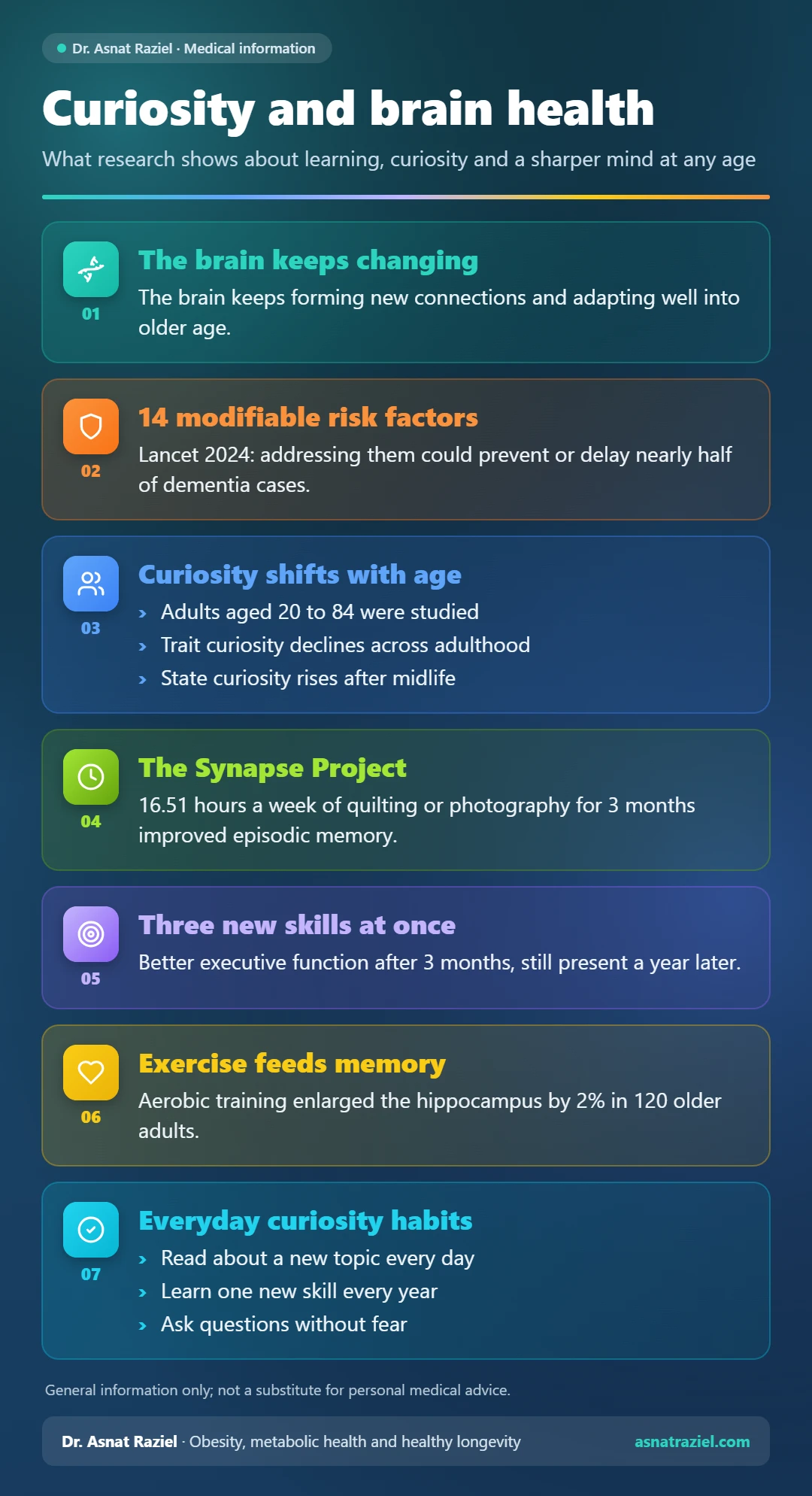
The 2024 report of the Lancet Commission on dementia also supports this direction. The report identified 14 modifiable risk factors for dementia. Among them are less education, physical inactivity, social isolation and hearing loss. According to the commission, addressing these factors could prevent or delay nearly half of all dementia cases.
Curiosity and brain health: not all curiosity is the same
Psychologists distinguish between two types of curiosity. The first is state curiosity, the momentary wish to know the answer to a specific question. The second is trait curiosity, a deep and stable interest in the world, in people and in ideas.
A UCLA study published in PLOS One in 2025 looked at both types in adults aged 20 to 84. The researchers found that general, trait curiosity tends to decline across adulthood. By contrast, state curiosity dipped slightly in early adulthood. After that, it rose sharply after midlife and kept rising into old age. In other words, many older adults stay highly interested in the topics that matter to them.
The researchers suggest that preserved curiosity may support brain health and might even help protect against dementia. However, this is a hypothesis, not a direct finding of the study. Therefore, follow-up research is needed to test it.
Why is learning so important?
Learning activates several brain systems at once: memory, attention, decision-making, planning, creativity and emotional regulation. For this reason, it is one of the most complete workouts the brain can get.
For example, the Synapse Project followed older adults who spent three months learning quilting, digital photography or both. On average, participants put in 16.51 hours a week. By the end of the study, their episodic memory had improved, meaning their memory for events and experiences. The improvement appeared in comparison with groups that took part in activities that did not challenge their thinking. Interestingly, social activity alone produced only limited cognitive benefit in this study. In other words, the mental challenge is the key ingredient.
In another study, older adults who learned at least three new skills at once for three months improved their executive functions. The skills included Spanish, photography, drawing and using a tablet. Moreover, the improvement was still present a year after the program ended.
Not just crossword puzzles
Logic puzzles and sudoku can be fun. Still, researchers stress that the most effective workout for the brain is acquiring new skills. Here are some examples:
- Learning a new language.
- Playing a musical instrument.
- Photography or painting.
- A university or online course.
- Cooking new recipes.
- Working with new technologies and AI tools.
- Volunteering or teaching others.
The main thing is for the brain to face a challenge it is not familiar with. At the same time, it is worth paying attention to the other side of technology. Long hours of passive screen time do not challenge the brain in the same way, as I wrote in my article on digital dementia.
The body protects the brain, too
Brain health does not depend only on intellectual challenges. Regular physical activity, good sleep, a Mediterranean diet, blood pressure control and stress management all affect blood flow to the brain and how it works. For example, a controlled trial in 120 older adults showed that aerobic exercise increased the volume of the hippocampus, the brain’s memory center, by 2%. In addition, the growth went hand in hand with higher levels of BDNF. This is a growth factor that supports the formation of new nerve cells.
Sleep and weight also play a role. You can read more about the link between sleep and the brain and about how obesity affects the brain. Research also shows that the link between obesity and brain health starts early and deepens with age.
How to nurture curiosity and brain health at any age
You don’t need a revolution. Even small lifestyle changes add up over time:
- Read about a new topic every day.
- Listen to podcasts from unfamiliar fields.
- Learn one new skill every year.
- Travel to new places.
- Talk with people whose interests differ from yours.
- Ask questions and don’t be afraid of not knowing.
Every new experience challenges the brain and encourages it to keep changing.
The bottom line on curiosity and brain health
One of the most encouraging messages of longevity medicine is that the brain stays far more flexible than we once thought. Curiosity and brain health go hand in hand with lifelong learning, physical activity and a healthy lifestyle. All of these are not just ways to pass the time. Rather, they are a real investment in brain health and quality of life for years to come.
Perhaps the secret to a young brain is not avoiding aging. Perhaps it is simply to keep being interested in the world, to keep learning and growing, at every age.
The information in this article is general and does not replace personal medical advice.
References
Curiosity across the adult lifespan: Age-related differences in state and trait curiosity
The impact of sustained engagement on cognitive function in older adults: the Synapse Project
One-year cognitive outcomes from a multiple real-world skill learning intervention with older adults
Dementia prevention, intervention, and care: 2024 report of the Lancet standing Commission
Exercise training increases size of hippocampus and improves memory




