By Dr. Asnat Raziel, bariatric surgeon specializing in obesity treatment, metabolic health and healthy longevity; Director of the Multidisciplinary Center for Obesity Treatment, Assia Medical, Assuta Ramat HaChayal, Tel Aviv
Maria Branyas: the woman who lived to 117
Maria Branyas lived for 117 years and 168 days, and her body became a rare case study in the secret of long life. Researchers in Barcelona mapped her biology in depth and published the results in the journal Cell Reports Medicine. They found a fascinating paradox. Alongside signs of extreme aging, her body also carried markers of biological youth. In addition, she never developed the serious diseases of old age. As a result, her case offers a look at aging itself, almost without the effects of disease.
Who was Maria Branyas?
She was born in San Francisco on March 4, 1907, to Spanish parents. When she was eight, the family moved to Spain. From January 2023, she was the oldest verified living person in the world. Eventually, she died in August 2024, in her sleep, at a nursing home in the town of Olot in Catalonia.
Throughout her long life, she never had cancer, cardiovascular disease or dementia. That set her apart from some of her siblings. An international team led by Prof. Manel Esteller of the Josep Carreras Leukaemia Research Institute analyzed samples of her blood, saliva, urine and stool. In this way, the researchers mapped her genome, proteins, metabolism, microbiome and immune system.
The paradox: very old and very young at the same time
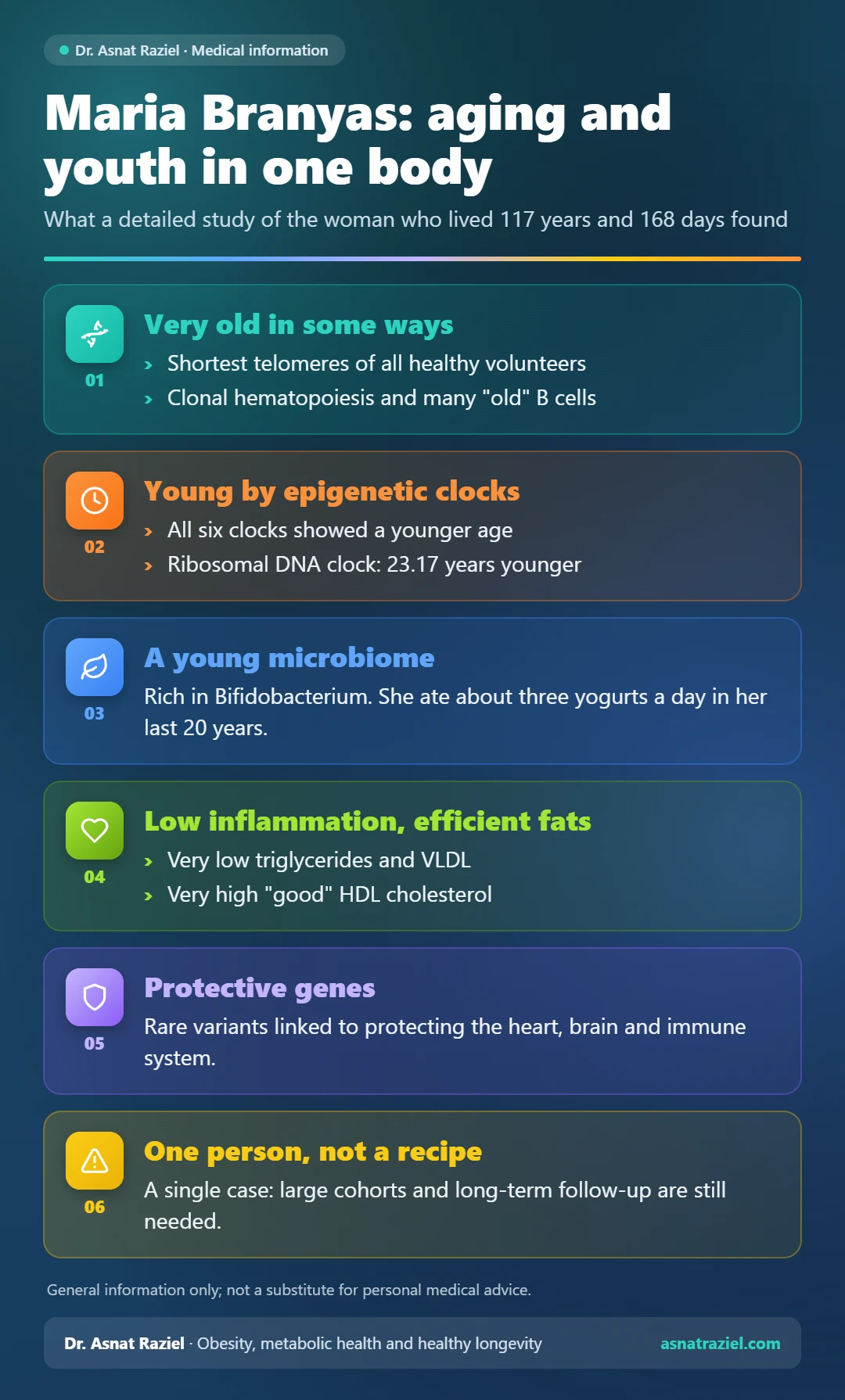
On the one hand, her telomeres were the shortest of all the healthy volunteers in the study. A telomere is a protective “cap” at the end of a chromosome. It gets shorter every time a cell divides, so it serves as a marker of cellular aging. The researchers also found clonal hematopoiesis, which means genetic changes in blood cells that appear with age. Likewise, they identified many “old” B cells in her immune system.
On the other hand, epigenetic clocks measured her as much younger than her actual age. These tools estimate biological age from chemical marks on DNA. A scientist named Steve Horvath developed one of the first clocks in 2013. In Maria Branyas, all six clocks tested showed a younger biological age, across three different tissues. What’s more, on another clock based on ribosomal DNA, the gap reached 23.17 years in her favor. In other words, her body “behaved” far younger than the number on her ID card. I wrote more about these tools in my article on aging clocks.
The secrets found in the body of Maria Branyas
A young microbiome
Her microbiome, the community of bacteria in the gut, was rich in beneficial Bifidobacterium. Usually, these bacteria decline with age. According to the researchers, she ate about three yogurts a day during the last 20 years of her life. However, the study does not prove that the yogurt itself contributed to her longevity. You can read more about the link between gut bacteria and the pace of aging in my article on the microbiome and biological age.
Low inflammation and efficient fats
At the same time, the level of inflammation in her blood was exceptionally low. Her fat metabolism was also unusual. The researchers measured very low levels of triglycerides and VLDL cholesterol, along with a very high level of “good” HDL cholesterol. According to them, it is one of the most efficient lipid profiles ever documented.
Protective genes
Finally, her genome carried rare variants in genes linked to protecting the heart, the brain and the immune system. Some of them are also tied to efficient function of the mitochondria, the power plants of the cell. I covered this topic in depth in my article on mitochondria and aging. I looked at another long-lived genome in my article on Jonathan the tortoise.
What can we learn from Maria Branyas?
The researchers reached an intriguing conclusion: extreme longevity is not the absence of aging. On the contrary, aging showed up in her in full force. Yet strong protective mechanisms worked alongside it and kept it from turning into disease. Dr. Esteller described this as a “fascinating duality: the simultaneous presence of signals of extreme aging and of healthy longevity.”
Some of her advantages were genetic and inborn. However, some were probably also linked to her lifestyle: a diet rich in fermented foods, low inflammation and good metabolic health. The researchers also mentioned a healthy diet, social connections and avoiding harmful habits. These principles apply to us too, as I explain in my articles on the longevity diet and on the approach of living well, not just living long.
What does this mean in practice? First, it is worth protecting the diversity of your gut bacteria with dietary fiber, vegetables, legumes and fermented foods. Second, low-grade chronic inflammation is tied to everyday habits: movement, good sleep, losing excess weight and not smoking. In addition, a healthy blood lipid profile depends on diet and activity, and also on medication when needed. None of these steps guarantees 117 years. Still, all of them support good, healthy years.
It is important to remember the limits of this study. It is the case of one person, so we cannot draw absolute rules from it. Even the researchers themselves wrote that the field needs large cohorts and long-term follow-up. Therefore, it is best to see the findings as a clue and a direction for research, not a recipe.
The bottom line
The story of Maria Branyas reminds us that healthy longevity is not a single magic trick. Instead, it is a mosaic of genetics, a beneficial microbiome, low inflammation, efficient metabolism and preserved cell function. We don’t choose our genes. Even so, we can influence many of the other factors, at least in part. If you want to know what else affects your biological clock, read about whether biological age can be turned back.
The information in this article is general and is not a substitute for personal medical advice.
Questions and answers
If she ate three yogurts a day, should I do the same?
Fermented foods rich in beneficial bacteria are part of a healthy diet. But we cannot credit her long life to yogurt alone. The researchers also stressed that they cannot link any single habit to the outcome. For that reason, any major dietary change should be tailored to you personally.
Are short telomeres always a bad thing?
Short telomeres are a marker of cellular aging. Yet her case shows they are only part of the picture. The researchers even suggested that in her case the telomeres acted like a “clock” of age rather than a predictor of disease. In other words, it is possible to stay in good health even with very short telomeres, as long as other protective mechanisms work well.
References
The multiomics blueprint of the individual with the most extreme lifespan
Scientists find signs of extreme aging and youth in the same 117-year-old
What Scientists Found Inside a 117-Year-Old Woman Reveals New Clues to Long Life
Spain’s Maria Branyas Morera, world’s oldest living person, dies at 117, her family says




