By Dr. Asnat Raziel, bariatric surgeon specializing in obesity treatment, metabolic health and healthy longevity; Director of the Multidisciplinary Center for Obesity Treatment, Assia Medical, Assuta Ramat HaChayal, Tel Aviv
Obesity and physical function: losing weight isn’t enough
Obesity and physical function are now two sides of the same medical question. In the past, obesity was seen as a problem of weight and appearance. Today it is clear that it is a metabolic disease that affects almost every system in the body. But when it comes to older adults, to women around pregnancy and childbirth, and to patients taking GLP-1 medications, the picture becomes even more complicated.
At the European Congress on Obesity, ECO 2026, a special session was held on sarcopenic obesity and obesity in older age. The session was led by a working group of the European Association for the Study of Obesity (EASO). It was based on EASO’s new position statement on adults aged 65 and over. The message that came up again and again was clear: we need to protect muscle, function, independence and quality of life. I discuss weight-loss drugs and frailty in a separate article.
Why BMI is no longer enough in older age
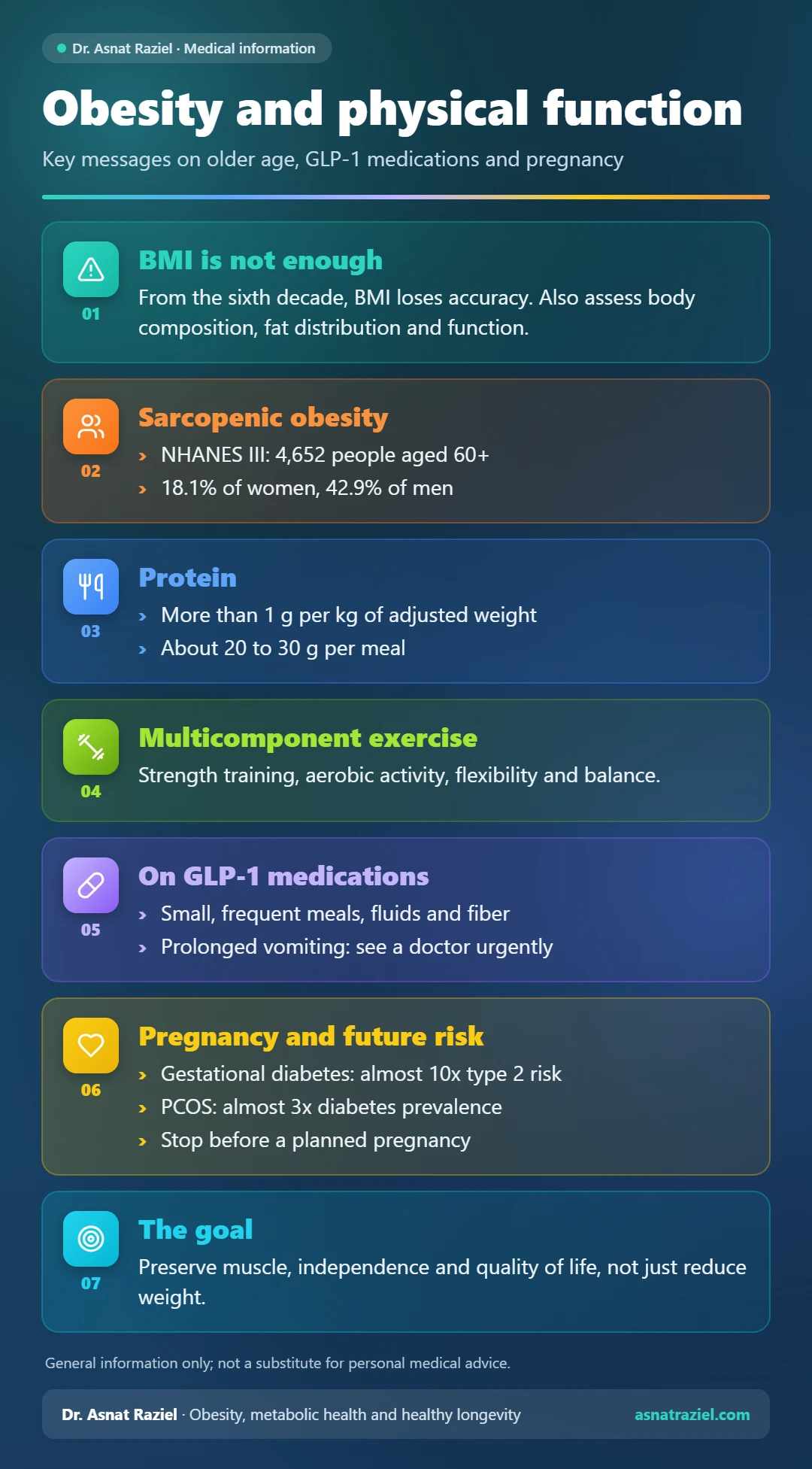
One of the key messages of the session was that BMI alone isn’t enough to diagnose obesity in older age. Over the years, body composition changes. Muscle mass declines, and fat builds up around the internal organs and inside the muscle. Therefore, the position statement recommends also assessing body composition, fat distribution, mental health and functional ability.
According to the speakers, from the sixth decade of life onward, BMI gradually loses its accuracy. A person can appear to be at a normal weight but actually have deep abdominal fat, chronic inflammation and insulin resistance. Likewise, the new definition of clinical obesity requires confirming excess fat with an additional measurement, such as waist circumference or waist-to-height ratio.
In addition, the speakers argued that the obesity paradox is probably overstated. According to this paradox, excess weight is sometimes protective in older age. However, when more precise measures such as physical fitness, waist-to-height ratio and muscle quality are examined, this protection almost disappears.
Sarcopenic obesity: the silent danger
One of the most prominent terms in the session was sarcopenic obesity. This is a condition in which there is both excess fat and a decline in muscle mass and function. In an analysis of the NHANES III survey of 4,652 people aged 60 and over, the prevalence reached 18.1% of women and 42.9% of men. Prevalence varies widely depending on the definition and the measurement method.
This condition raises the risk of falls, fractures and loss of independence. Moreover, in the same survey, women with sarcopenic obesity had a higher risk of death. Therefore, the goal in older age is not maximum weight loss, but careful weight loss that preserves muscle. You can read more in my article on sarcopenia and obesity.
Obesity and physical function: eat less, but not too little
Another central topic was the risk of malnutrition during weight loss, especially with GLP-1 medications. A sharp drop in food intake can lead to deficiencies in vitamins, minerals and protein. That’s why the speakers emphasized three things: enough protein, spreading it properly throughout the day and suitable physical activity.
The EASO position statement supports a daily intake of more than 1 gram of protein per kilogram of adjusted body weight. In addition, the European consensus on incretin-based therapy recommends spreading protein throughout the day. The target is about 20 to 30 grams per meal. At the same time, multicomponent exercise is recommended: strength training, aerobic activity, flexibility and balance. You’ll find a practical guide in my article on protein intake during weight loss.
GLP-1 medications: not just weight loss
Medications such as Wegovy, Ozempic and Mounjaro have transformed obesity treatment. Even so, the session stressed that they require close medical and nutritional follow-up. The main risks are digestive side effects and reduced protein intake. In addition, there is a risk of muscle loss, nutritional deficiencies and emotional changes.
The speakers suggested several simple steps to reduce side effects: small, frequent meals, adequate fluids and dietary fiber. It is also possible to slow down the dose escalation when needed, and sometimes to use protein supplements and a multivitamin temporarily. In the case of prolonged vomiting, see a doctor urgently, because of the risk of dehydration, electrolyte disturbances and thiamine deficiency.
Women, pregnancy and obesity: thinking years ahead
A fascinating part of the session dealt with the link between obesity, pregnancy and future health. The speakers explained that pregnancy complications don’t end on the day of delivery. Gestational diabetes, preeclampsia and polycystic ovary syndrome are in effect a crystal ball for future risk of diabetes, heart disease and obesity.
For example, a meta-analysis published in the BMJ examined women after gestational diabetes. Their risk of type 2 diabetes was almost 10 times higher. Similarly, in women with polycystic ovary syndrome, the prevalence of diabetes is almost 3 times higher, and it rises further in the presence of obesity.
The session also emphasized that obesity medications are not recommended during pregnancy and breastfeeding. Therefore, treatment should be stopped before a planned pregnancy, according to the interval set for each medication. Even so, the data on unplanned pregnancies during treatment are relatively reassuring. A large study from the Nordic countries, the United States and Maccabi, one of Israel’s health funds (HMOs), examined exposure to GLP-1 drugs in early pregnancy. The researchers found no major increase in birth defects compared with insulin.
Obesity and physical function: preserving independence
One of the most important statements in the session concerned the goal of treatment. In older age, the goal is not only to extend life, but to preserve independence and function. The new approach recognizes that weight loss alone isn’t enough. That’s why we also need to look at muscle mass, diet quality, mental health, sleep and physical fitness.
In practice, follow-up should include simple measures such as handgrip strength, walking speed and the ability to get up from a chair. This makes it possible to detect a decline in function early, even before a fall or a fracture.
The bottom line on obesity and physical function
The link between obesity and physical function is at the heart of the new approach. Today’s obesity medicine is precise, humane and focused on the whole person. Ultimately, success isn’t just a number on the scale. Success means muscle that is preserved, independence that is maintained and a good quality of life for years to come.
The information in this article is general and does not replace personal medical advice.
References
Definition and diagnostic criteria of clinical obesity
Safety of GLP-1 Receptor Agonists and Other Second-Line Antidiabetics in Early Pregnancy




