By Dr. Asnat Raziel, bariatric surgeon specializing in obesity treatment, metabolic health and healthy longevity; Director of the Multidisciplinary Center for Obesity Treatment, Assia Medical, Assuta Ramat HaChayal, Tel Aviv
Beyond weight loss: the era of metabolic rehabilitation
Metabolic rehabilitation is the approach that is now reshaping obesity medicine. It combines medication, personalized nutrition, physical activity and the preservation of muscle mass. The goal is to improve not only weight, but overall health and the chances of long-term success.
In recent years, the conversation has centered on the incretin drugs. These include semaglutide (Wegovy) and tirzepatide (Mounjaro). However, a clearer understanding is emerging: weight loss, as important as it is, is only the beginning.
What the new review says
A review published in June 2026 in the International Journal of Obesity takes a broader view of treatment success. According to the authors, success should not be measured in kilograms alone. Instead, we should look at metabolic health as a whole: muscle mass, physical fitness, bone health, quality of life and day-to-day function.
The researchers call this approach metabolic rehabilitation. They propose making it a standard part of drug treatment for obesity. In other words, the aim is to move from treatment focused on weight to treatment that builds a healthy, strong and functional body for years to come.
Not just losing weight, but building a healthy body
According to the authors of the review, the incretin drugs have brought about a genuine revolution. They reduce hunger, improve metabolic control and lead to substantial weight loss. However, they do not address every aspect of the disease.
Obesity is a chronic disease that affects many systems: the muscles, the heart, the liver, the bones and physical function. Therefore, even successful drug treatment needs a systematic process of rebuilding. Put simply, it is not enough to lose fat; you also need to build strength.
Muscle mass becomes a treatment target
One of the central issues is the loss of lean body mass during treatment. In many studies, part of the weight lost is not fat but lean tissue. Still, the authors stress an important point. A drop in lean mass, as measured by a DXA scan (a low-dose X-ray test of body composition), does not necessarily mean that muscle quality or strength has suffered. Moreover, according to the review, no clinical study published to date has shown that incretin drugs impair muscle function.
Even so, muscle is a key metabolic organ. It uses glucose, influences metabolic rate and helps maintain balance. In addition, it protects against frailty in older age. I discussed this in more detail in my article on why body composition matters more than weight.
What is metabolic rehabilitation?
Metabolic rehabilitation goes far beyond a fitness program or a diet. It is a multidisciplinary medical model that combines four components:
- Structured exercise, with an emphasis on strength training.
- Personalized nutrition, including adequate protein.
- Behavioral and emotional support.
- Ongoing medical monitoring of body composition and function.
According to the review, each component on its own improves insulin sensitivity, helps preserve muscle mass and strengthens cardiorespiratory fitness. When they are combined with medication, the effects complement each other. As a result, the fat loss is of higher quality, and the body responds with less metabolic slowdown. It is important to note that the authors describe the evidence for this combination as “emerging,” not as definitively proven. For a different angle on rehabilitation, see my article on virtual reality in medicine.
Strength training as part of the prescription
One of the most striking recommendations is to make resistance training part of the medical prescription. The drugs reduce how much you eat. Strength training, on the other hand, gives the muscle the stimulus it needs. It preserves muscle, strengthens bone and improves physical strength.
The World Health Organization guidelines recommend that adults get 150-300 minutes of moderate-intensity aerobic activity per week. In addition, they recommend strength training for all major muscle groups on two or more days a week. You can find a comparison of the two types of exercise in my article on aerobic versus strength training, as well as practical details on strength training during weight loss.
Alongside exercise, the researchers recommend adequate protein intake throughout the weight-loss period. That way, muscle can be built and repaired even when food intake is smaller. I wrote about this at length in the nutrition guidelines for preserving muscle during drug treatment.
Metabolic rehabilitation in the new guidelines
The review does not stand alone. In July 2026, three European organizations, EASO, EFAD and ECPO, published a consensus statement in The Lancet Diabetes & Endocrinology. According to a news release from the Medical University of Vienna, the experts state that nutrition, physical activity and psychological support are “not optional extras.” They also recommend including strength training in the program, tracking body composition and testing hand grip strength.
Likewise, the World Health Organization issued its first guideline on GLP-1 drugs for obesity in December 2025. The guideline recommends combining the medication with a behavioral program of nutrition and physical activity. Furthermore, it defines obesity as a chronic disease that requires long-term care.
Time to stop looking only at the scale
The key message of the review is that weight alone is not a sufficient measure of success. One patient may lose dozens of kilograms but also lose muscle, fitness and function. By contrast, another patient may lose somewhat less, yet greatly improve strength, fitness and quality of life.
That is why the researchers propose a broad assessment: body composition, muscle mass, physical function, cardiorespiratory fitness, bone health and metabolic markers. In other words, BMI and the number on the scale are only part of the picture.
Metabolic rehabilitation and healthy longevity
The next generation of treatment will combine advanced drugs, personalized nutrition, strength training, behavioral support and monitoring of function. This marks a shift from treatment aimed at weight loss to treatment that rebuilds metabolic health. In addition, metabolic rehabilitation is especially important after treatment ends, as I wrote in my article on weight regain after stopping the medication.
For longevity medicine, this is significant news. The goal is not only to extend life, but to extend the years of good health. In other words, to reach older age with strong muscles, healthy bones and good function.
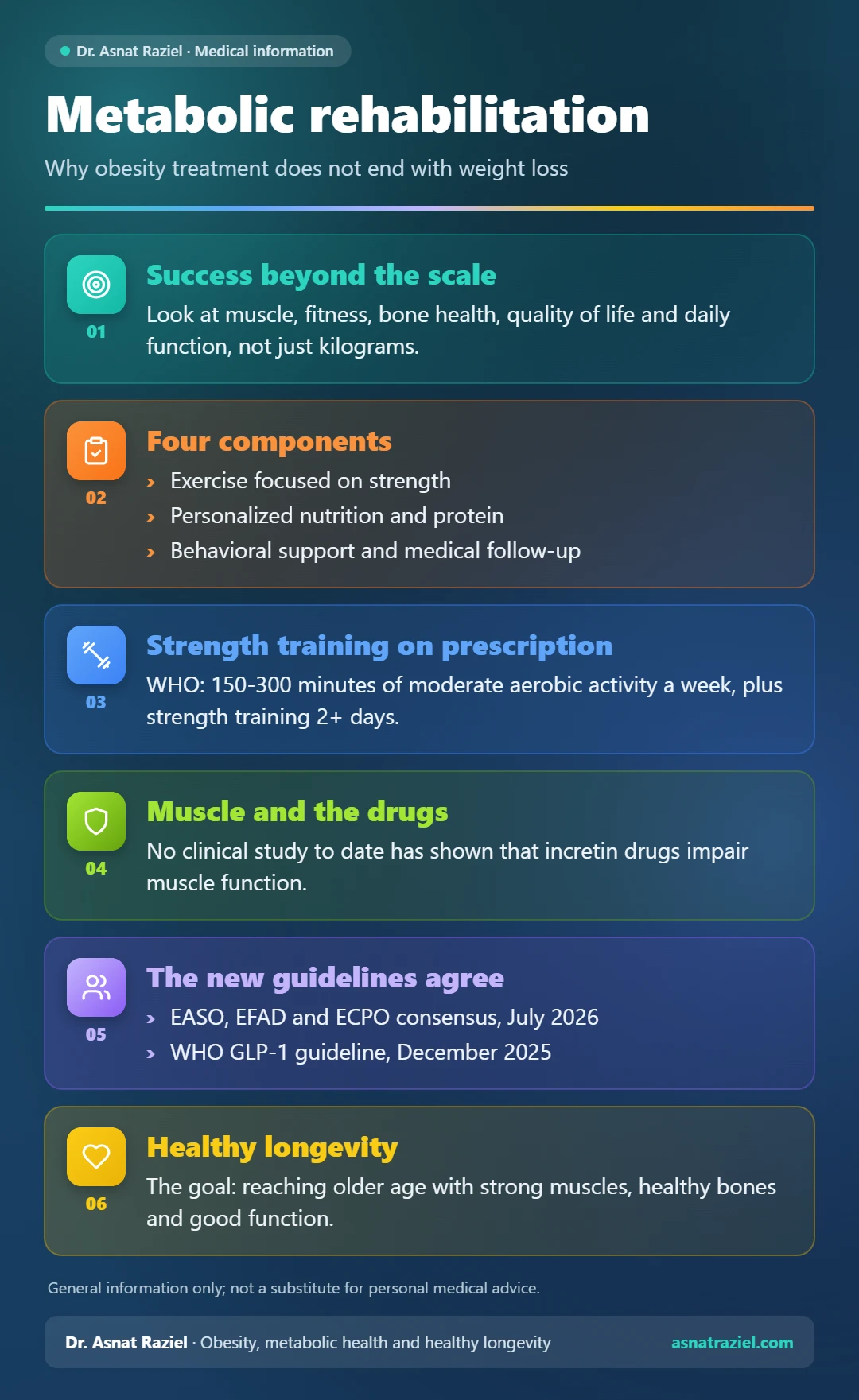
The bottom line on metabolic rehabilitation
The new drugs will remain a cornerstone of obesity treatment, but they will not work alone. Ultimately, metabolic rehabilitation turns weight loss into real, lasting health. If you are starting drug treatment, ask your care team about an exercise plan, protein and body composition monitoring as well.
The information in this article is general and does not replace personal medical advice.
References
Supportive measures are crucial in drug-based obesity treatment
WHO issues global guideline on the use of GLP-1 medicines in treating obesity




