By Dr. Asnat Raziel, bariatric surgeon specializing in obesity treatment, metabolic health and healthy longevity; Director of the Multidisciplinary Center for Obesity Treatment, Assia Medical, Assuta Ramat HaChayal, Tel Aviv
Virtual reality in medicine: the future is already here
Virtual reality in medicine is no longer science fiction. Until not so long ago, virtual reality (VR) was mainly a tool for games and entertainment. Today, it is one of the most intriguing technologies in medicine. Many studies are testing it for pain relief, anxiety treatment, rehabilitation after stroke, encouraging physical activity and brain training.
The secret of the technology is its ability to make the brain “believe” it is somewhere else. When patients are fully immersed in a virtual world, the brain responds to it as if it were real. That is exactly why it affects pain, emotions, movement, learning and habits.
Treating pain without drugs
Pain is the most advanced area. Studies have tested virtual reality during dressing changes for burns, dental treatment, medical procedures, childbirth and chronic pain. The patient “dives” into a world of snow, nature, play or meditation. In this way, the brain’s attention shifts from the pain to the experience.
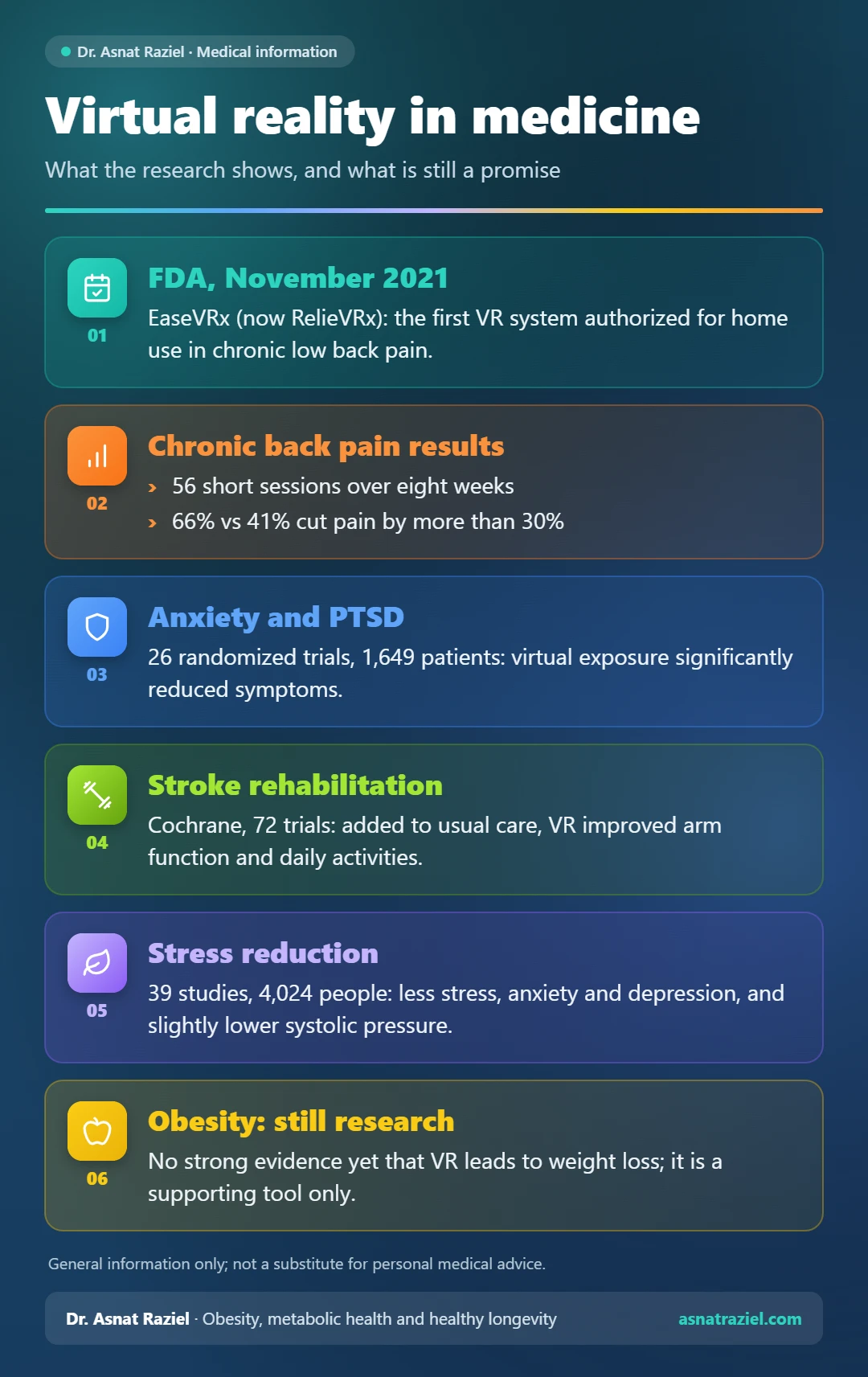
In November 2021, the FDA authorized the EaseVRx system from AppliedVR, now called RelieVRx. It was the first virtual reality system authorized for home use in chronic low back pain. The program includes 56 short sessions over eight weeks and draws on the principles of cognitive behavioral therapy. In a study of 179 participants, 66% of users reported a pain reduction of more than 30%, compared with 41% in the control group.
However, not all software is alike. A 2026 meta-analysis included 25 trials and 2,610 patients with chronic back pain. The researchers found large differences between types of programs, and the quality of the evidence ranged from very low to moderate. So the field is promising, but it still needs more research.
Virtual reality in medicine for anxiety and PTSD
Virtual reality in medicine allows gradual, safe exposure to frightening situations. This makes it possible to treat fear of heights, fear of flying, social anxiety, driving anxiety and dental anxiety. In addition, it is used to treat post-traumatic stress disorder (PTSD) in combat soldiers and trauma survivors.
The therapist controls the intensity of the exposure and moves at a pace that suits each patient. A 2026 meta-analysis of 26 randomized trials and 1,649 patients examined the method. Virtual exposure significantly reduced symptoms of phobia, anxiety and PTSD. In other words, this is one of the best-supported uses of the technology in mental health.
Rehabilitation after stroke and brain injury
The world of rehabilitation is changing as well. Instead of repeating boring exercises again and again, patients play games that work their arms, legs and balance. The brain receives thousands of stimuli, which encourages the formation of new neural connections. This phenomenon is called neuroplasticity.
What does the evidence say? A Cochrane review of 72 trials found that virtual reality on its own is not better than conventional physical therapy for arm function. However, as an add-on to usual care, it improved arm function and activities of daily living. In addition, a 2024 meta-analysis of 55 studies found a benefit in motor function, independence and quality of life. Researchers are also testing the method in Parkinson’s disease and multiple sclerosis.
Exercise that becomes an experience
One of the biggest challenges in health is sticking with physical activity. Here, virtual reality can help. Instead of cycling in front of a wall, you can hike in the Alps or run along the beaches of Hawaii. You can also kayak among glaciers, or play tennis, box and dance with players from all over the world.
It feels like a game, but in practice it is a full aerobic workout. For people with excess weight, older adults or anyone who feels intimidated by the gym, it is a pleasant and safe way to start moving. Smartwatches and artificial intelligence are also joining the effort to encourage movement.
Virtual reality in medicine and obesity treatment
Here the field is still at the research stage, but the direction is interesting. Researchers are testing virtual reality as a way to train control over emotional eating and to practice resisting temptation. In addition, it may improve mindful eating, strengthen the feeling of fullness and support mindfulness training.
Some studies use an “avatar,” a digital figure of the patient. The avatar shows how the body might change after weight loss, which may boost motivation and persistence. Still, there is no strong evidence yet that virtual reality leads to weight loss. I review the data in my article on VR for weight loss. Therefore, it is only a supporting tool, alongside professional treatment.
Brain training, meditation and stress reduction
Virtual reality is also entering the world of longevity. Researchers are developing games that combine memory, decision-making, spatial navigation, concentration and reaction speed. The goal is to preserve brain plasticity and slow cognitive decline. This is part of the vision of healthy aging.
Instead of sitting in front of a wall, you can “sit” on a tropical beach, in a rainforest or under the night sky. A meta-analysis of 39 studies with 4,024 participants found that such interventions reduced stress, anxiety and depression. In addition, they slightly lowered systolic blood pressure. Repeated sessions produced especially good results. I wrote about other methods in my guide to stress relief techniques.
Medical training for doctors
Medical teams benefit from the technology, too. Doctors use it to train for laparoscopic and robotic surgery, resuscitation, catheterization and emergencies. They also practice teamwork in the operating room, without any risk to patients. In surgery, this technology fits well with artificial intelligence in bariatric surgery.
The companies leading the field
In recent years, an industry of digital therapeutics, software-based treatments, has emerged. Here are some of the leading companies:
- AppliedVR: a pioneer in chronic pain treatment, with the RelieVRx system for home use.
- XRHealth: an Israeli-American company that runs virtual clinics for pain, rehabilitation, anxiety and physical therapy.
- Penumbra REAL System: systems for neurological rehabilitation and physical therapy after stroke and brain injury.
- Floreo: social skills training for children and adults on the autism spectrum.
- MindMaze: advanced systems for movement rehabilitation after stroke and brain injury.
- SyncThink: a combination of virtual reality and eye tracking to assess concussions and neurological disorders.
Where is virtual reality in medicine heading?
The future of virtual reality in medicine includes integration with artificial intelligence, smartwatches and motion sensors. In addition, real-time heart rate and breathing measurements, brain wave monitoring and digital twins (a computer model of the body) will be added. As a result, the experience will adapt itself to each person and change according to their physical and emotional state.
What would I like to experience?
If I could choose, I would pick an experience that combines health, nature and inspiration. Imagine walking the trails of the Dolomites in Italy, with cowbells and a light breeze. Then a bike ride along the lakes of Switzerland, and a sunrise yoga class on a beach in the Maldives. You could also dive among the coral reefs of Australia, go on a safari in Africa, or even walk on Mars and look at the Earth from space.
When experiences like these are combined with exercise, meditation, cognitive training and medical follow-up, they are not just entertainment. They may become an important tool for reducing stress, improving fitness and preserving healthy years. Perhaps this is a fine example of how technology does not distance us from people. On the contrary, it helps us live well, move, learn and age slowly.
The information in this article is general and does not replace personal medical advice.
References
Device Classification Under Section 513(f)(2)(De Novo): EaseVRx




