By Dr. Asnat Raziel, bariatric surgeon specializing in obesity treatment, metabolic health and healthy longevity; Director of the Multidisciplinary Center for Obesity Treatment, Assia Medical, Assuta Ramat HaChayal, Tel Aviv
Muscle-preserving drugs: the new challenge for weight-loss medications
Muscle-preserving drugs are one of the most exciting directions in obesity medicine today. The reason is simple: impressive weight loss is only part of the story. Alongside fat, some patients also lose muscle and bone. In this article, I explain what we know about this effect, how you can limit it right now, and what studies show about the next generation of treatments.
GLP-1 medications, including Ozempic, Wegovy, Rybelsus and Mounjaro, have fundamentally changed how we treat obesity and diabetes. They help people lose a significant amount of weight, lower the risk of cardiovascular disease and improve fatty liver. However, this great success raises an important question: what happens to our muscles while we lose weight?
Not every kilogram you lose is fat
When a person loses weight, the body doesn’t shed only fat tissue. Part of the loss comes from lean mass, meaning everything that isn’t fat: muscle, organs, bone and fluids. Sometimes there is also a certain decrease in bone density.
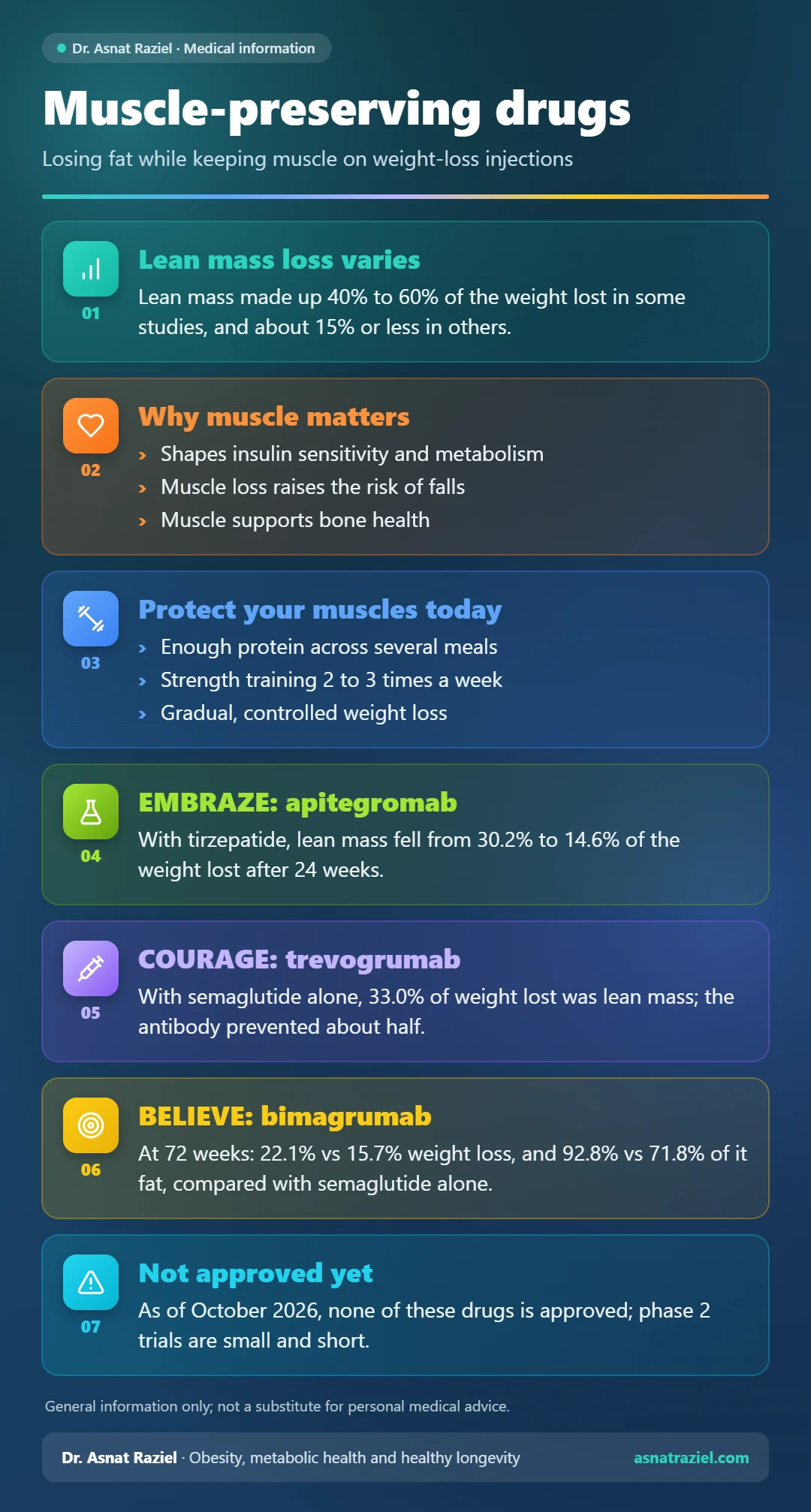
So how much lean mass is lost? The answer varies widely between studies. According to a comprehensive review of GLP-1 therapies, lean mass made up 40% to 60% of the weight lost in some studies. In other studies, by contrast, it accounted for only about 15% or less. In addition, the researchers point out that lean mass also includes water and organs. As a result, it is not exactly the same as muscle mass.
Why do muscles matter so much?
Muscle is not just the “engine” that moves us. It is also a vital metabolic organ that affects insulin sensitivity, how we use sugar and our metabolic rate. Our quality of life in older age depends on it, too.
A significant loss of muscle can lead to weakness, fatigue and poorer physical function. It also raises the risk of falls and may speed up frailty, especially after age 60. Moreover, muscles provide the mechanical stimulus that bones need. That is why losing muscle may go hand in hand with losing bone. I have also written about the link between obesity and muscle loss in my article on sarcopenia and obesity.
Do the medications themselves cause muscle loss?
Not necessarily. Much of the loss stems from the rapid weight loss itself and from a sharp drop in food and protein intake. When someone eats very little and doesn’t exercise, the body also breaks down muscle for energy.
What’s more, according to the same review, muscle also seems to adapt in a positive way. The researchers describe less fat inside the muscle and better insulin sensitivity. In other words, muscle quality may improve even as muscle quantity goes down. Still, older adults and patients with underlying conditions are at higher risk, so they need close monitoring.
Muscle quality matters as well as muscle size, which is why I also wrote about fat inside muscle as a longevity marker.
For this reason, most experts advise against relying on the injection alone. Nutrition and physical activity are an essential part of successful treatment. I discuss this in more detail in my article on weight-loss injections and muscle loss.
How to protect your muscles until muscle-preserving drugs arrive
Until then, the key is to combine medication with a simple, consistent plan:
- Get enough protein, spread over several meals throughout the day. You’ll find practical tips in my guide to protein during weight loss.
- Do strength training two to three times a week.
- Add moderate aerobic activity to improve fitness and heart health.
- Aim for gradual, controlled weight loss rather than chasing speed.
- Track your body composition, not just the number on the scale.
Today, many clinics include measurements of muscle mass, body fat percentage and sometimes bone density in routine follow-up. In my article on strength training during weight loss, I explain how to build a suitable workout plan.
Resistance training remains the foundation. Maccabi’s guide to sarcopenia and muscle loss (in Hebrew) also stresses enough protein, spread across the day.
The next generation: muscle-preserving drugs in clinical trials
Concern about muscle loss has led to the development of drugs designed to preserve, and even increase, muscle during weight loss. Most of them block myostatin or closely related proteins. These are natural proteins that limit muscle growth. As of November 2026, none of these drugs has been approved for weight loss. Moreover, most of the data below come from company announcements of phase 2 results.
Apitegromab with tirzepatide
In the EMBRAZE trial, researchers combined the antibody apitegromab with tirzepatide, the active ingredient in Mounjaro. After 24 weeks, lean mass made up 30.2% of the weight lost in the tirzepatide-only group. In the combination group, however, it accounted for just 14.6%. In other words, the combination preserved 54.9% more lean mass.
Trevogrumab with semaglutide
In the COURAGE trial, Regeneron tested the antibody trevogrumab together with semaglutide. With semaglutide alone, 33.0% of the weight lost after 26 weeks was lean mass. Adding the antibody prevented about half of that loss. However, the arm that also received a third drug had high discontinuation rates and two deaths. The company found no direct link to the treatment. I covered this trial in depth in my article on the COURAGE trial.
Bimagrumab with semaglutide
The BELIEVE trial, published in Nature Medicine in March 2026, tested the antibody bimagrumab. After 72 weeks, the combination with semaglutide led to 22.1% weight loss, compared with 15.7% on semaglutide alone. In addition, 92.8% of the weight lost on the combination was fat, versus 71.8% on semaglutide alone.
These are phase 2 trials, which are relatively small and short. Therefore, it is still unclear whether preserving lean mass will also improve strength, function and health over the years. Only large, long-term trials will answer that question.
The future of muscle-preserving drugs: less fat, better health
Obesity medicine is shifting from a focus on weight alone to a focus on the quality of weight loss. The goal is not just to lower the number on the scale. Rather, the goal is to lose mostly fat, preserve muscle, protect bones and improve long-term metabolic health.
If muscle-preserving drugs prove themselves, we may be able to achieve major fat loss with almost no harm to muscle. Such a combination could change not only how we treat obesity, but also how we think about healthy aging. In the meantime, the best tools are already in our hands: protein, strength training and medical follow-up.
The information in this article is general information only and is not a substitute for personal medical advice.
References
Changes in lean body mass with glucagon-like peptide-1-based therapies and mitigation strategies
Frailty in older adults: evidence for a phenotype
The EMBRAZE and COURAGE trials were funded by the companies developing the drugs.