By Dr. Asnat Raziel, bariatric surgeon specializing in obesity treatment, metabolic health and healthy longevity; Director of the Multidisciplinary Center for Obesity Treatment, Assia Medical, Assuta Ramat HaChayal, Tel Aviv
Mitochondria and aging: why is everyone talking about it?
Mitochondria and aging come up today in almost every conversation about longevity. You hear about them at scientific conferences, in health books, on podcasts and all over social media. At the same time, supplements such as coenzyme Q10, urolithin A and molecules that raise NAD+ are being marketed as the next big promise. They promise youth, energy and health.
But have we really found the “fountain of youth” inside every cell in our body? The answer is far more complicated, but also fascinating.
The powerhouse of the cell, and much more
For decades, we were taught that mitochondria are “the powerhouse of the cell.” Indeed, their main job is to turn food into usable energy. This energy is stored in a molecule called ATP, the body’s energy currency.
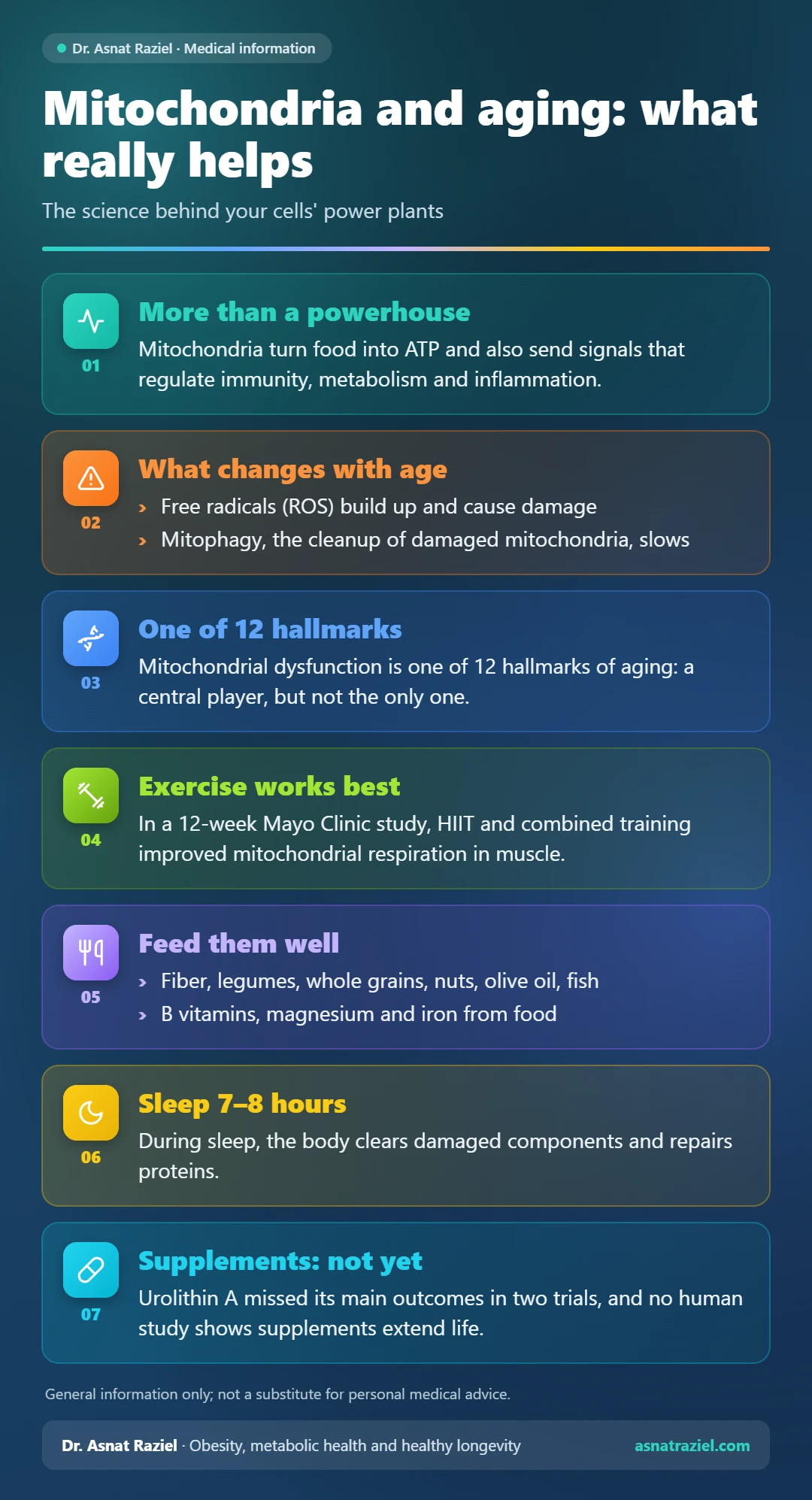
Today, however, it is clear that mitochondria are much more than an energy factory. A comprehensive review in Cell Metabolism describes them as the cell’s “processor,” which takes in information and sends out signals. For example, they regulate the immune system and produce signaling molecules that travel between organs. In addition, they influence metabolism, inflammation and repair mechanisms in the cell. In other words, the quality of our mitochondria affects our quality of life.
The link between mitochondria and aging: what changes over time?
Like any engine that runs nonstop, mitochondria wear out over time. When they produce energy, free radicals, or ROS (reactive oxygen species), form naturally. In small amounts, these are essential for passing messages within the cell. But when they build up, they damage proteins, fats and membranes. Eventually, they also damage the mitochondria’s own DNA.
At the same time, the cell’s cleanup systems lose efficiency with age. This is especially striking in mitophagy, the process that clears away damaged mitochondria. The result is a vicious cycle: less energy, more oxidative damage, more inflammation and ongoing harm to cell function. I explore one way researchers hope to fix such damage in my article on a protein repair enzyme.
Are mitochondria the cause of aging?
This is one of the big questions in research on mitochondria and aging. Many researchers believe that mitochondrial damage is one of the engines of aging. In their view, it contributes to Alzheimer’s, Parkinson’s, heart disease, diabetes and certain cancers. Other scientists, by contrast, argue that aging is what damages the mitochondria, rather than the other way around.
The truth probably lies somewhere in between. Aging is a process in which many systems affect one another. In the “Hallmarks of Aging” paper in the journal Cell, mitochondrial dysfunction is one of 12 hallmarks. In other words, it is a central player, but not the only one. Aging is also tied to inflammation, epigenetic clocks and the microbiome, as I wrote about gut bacteria and biological aging. I looked at a different angle on aging in my article on Jonathan the tortoise.
The good news: mitochondria and aging are not a matter of fate
Unlike genetics, mitochondrial health is strongly shaped by lifestyle. So we have quite a few tools in our hands.
Exercise is the most powerful medicine
One of the most consistent findings is that exercise encourages the formation of new mitochondria and improves their quality. In a Mayo Clinic study, young and older adults trained for 12 weeks. The researchers took muscle biopsies before and after training. High-intensity interval training (HIIT) and combined training improved mitochondrial respiration in muscle. Strength training alone, however, did not improve this measure, although it did increase muscle mass.
What’s more, interval training reversed some of the age-related changes in mitochondrial proteins, especially in the older adults. That is why combining aerobic and strength training is the right choice. Each workout creates a small load, and the body responds by building a stronger, more resilient energy system. You can read more about choosing between types of training in my article on aerobic vs. strength training.
Good nutrition feeds your mitochondria too
Mitochondria run on the raw materials we give them. The best diet includes fiber-rich carbohydrates, legumes and whole grains. It also includes nuts, avocado, olive oil, fish and plenty of vegetables. B vitamins, magnesium and iron from food also take part in energy production. You’ll find more on this in my guide to the longevity diet.
Sleep: when the cell repairs itself
During sleep, deep maintenance processes take place. The body clears out damaged components, repairs proteins and activates quality-control mechanisms. So seven to eight hours of sleep a night is not just rest. It is part of the cell’s renewal process. I wrote about the link between sleep and metabolism in my article on sleep and metabolic health.
What about the expensive supplements?
Here it is important to separate science from marketing. Supplements such as NAD+, urolithin A and coenzyme Q10 attract a lot of interest. Some of them even have promising early studies. For example, in a controlled trial in JAMA Network Open, 66 adults aged 65 to 90 received urolithin A or a placebo for four months. The supplement improved muscle endurance and some blood markers. However, it did not improve the walking test or ATP production in muscle, which were the main outcomes.
In another study, in middle-aged adults, the supplement improved muscle strength by about 12%. Yet there too, the main outcome did not improve. In addition, both studies were funded by the supplement’s manufacturer. More broadly, no human study has shown that such supplements extend life. Ice baths, saunas and red light therapy also rest mainly on lab and animal studies for now. In short, the potential exists, but the science on mitochondria and aging does not yet allow big promises.
Mitochondria and aging: the future of longevity medicine
One of the most exciting directions in research is treatments that restore the quality of the mitochondria themselves, not just a specific disease. Researchers are testing drugs that encourage mitophagy and the formation of new mitochondria. They are also studying drugs that improve energy production and reduce chronic inflammation. In the future, we may measure mitochondrial quality as part of assessing biological age. That way, we could tailor personal treatment to each individual. I have also written about the new longevity drugs being tested today.
The bottom line
The link between mitochondria and aging is real, but mitochondria are not the “fountain of youth.” They are one of the cornerstones of metabolic health and healthy aging. Fortunately, the way to protect them is not hidden in an expensive pill. Rather, it lies in daily habits: regular exercise, a Mediterranean diet, quality sleep, less stress and a healthy weight.
Perhaps in the future, drugs will arrive that strengthen mitochondria in a targeted way. Until then, the most effective way to protect our cells’ “power plants” is already in our hands. It starts with every step, every meal and every good night’s sleep.
This article provides general information and is not a substitute for personal medical advice.
References
Hallmarks of aging: An expanding universe




