By Dr. Asnat Raziel, bariatric surgeon specializing in obesity treatment, metabolic health and healthy longevity; Director of the Multidisciplinary Center for Obesity Treatment, Assia Medical, Assuta Ramat HaChayal, Tel Aviv
An Alzheimer’s blood test: detecting the disease before memory loss
An Alzheimer’s blood test is no longer a distant dream. Alzheimer’s disease begins in the brain many years, sometimes decades, before clear memory problems appear. During this time, the person works, lives independently and functions as usual. Beneath the surface, however, amyloid and tau proteins are building up in the brain.
Over the past year, the picture has changed. The FDA has already cleared two blood tests that help with diagnosis. At the same time, there is a drug that clears amyloid deposits and slows the disease in its earliest stages. At the Alzheimer’s Association International Conference, AAIC 2026, held in London on July 12–15, Lilly presented 16 studies on the subject. So are we entering a new era?
A blood test instead of a brain scan?
The star of the field is the marker P-tau217. It is a phosphorylated form of the tau protein, and its level in the blood rises as Alzheimer’s disease progresses. Until now, confirming amyloid deposits in the brain required a dedicated PET scan or a spinal fluid test. These tests are expensive and not available everywhere. In addition, a lumbar puncture is an invasive procedure.
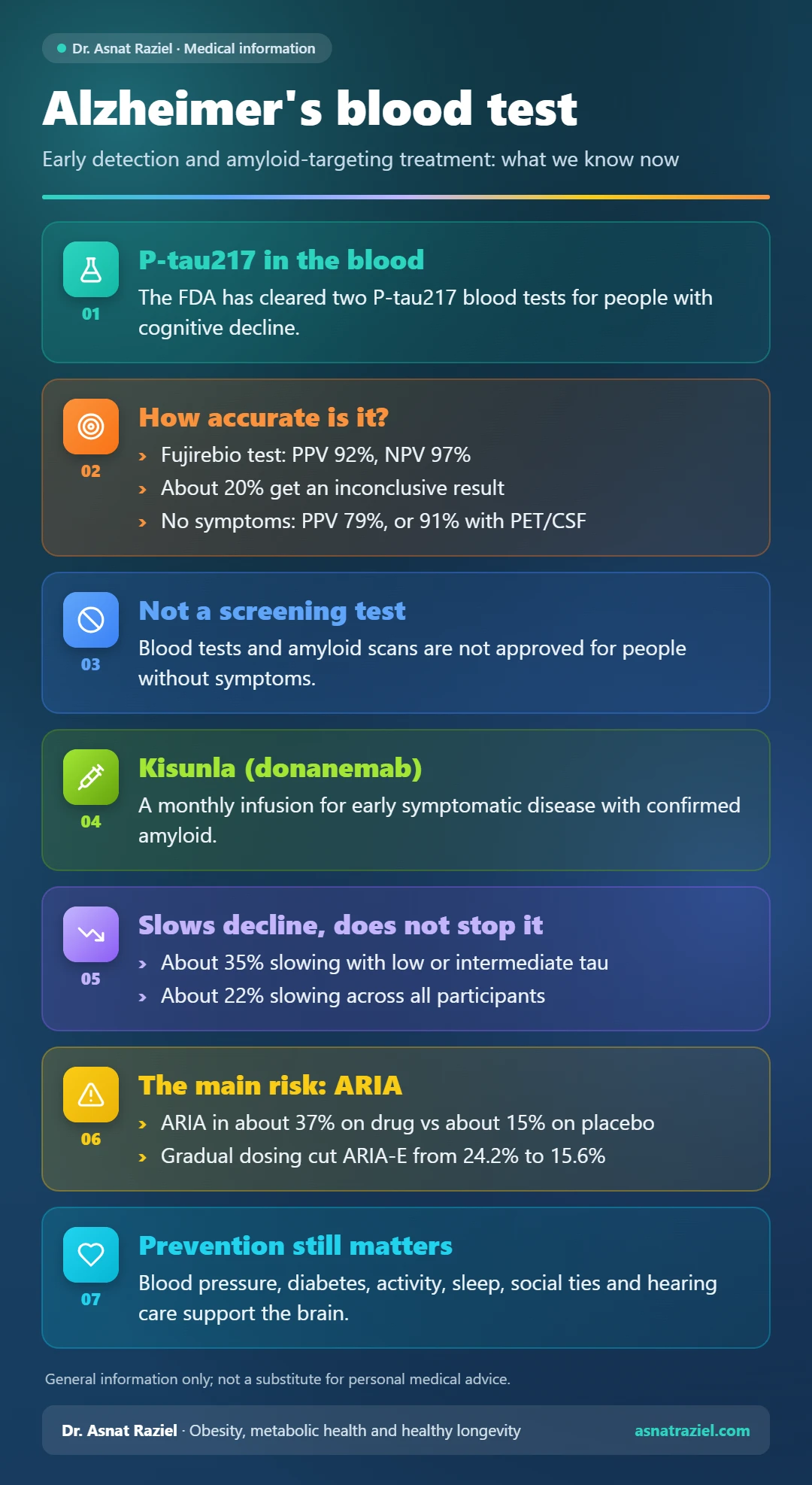
In May 2025, the FDA cleared the first blood test of its kind, made by Fujirebio. The test is intended for adults aged 50 and over with signs of cognitive decline, in a specialist clinic setting. In the clearance study, its positive predictive value was 92% and its negative predictive value 97%. However, in about 20% of those tested, the result was inconclusive and required further workup.
In August 2026, a second test joined it. The FDA cleared Roche’s Elecsys pTau217 test, developed together with Lilly. The test is intended for people aged 55 and over with cognitive decline. It is not a stand-alone diagnostic test, and doctors must interpret it together with the clinical findings.
What did the data at AAIC 2026 show?
Lilly presented data on P-tau217 tests in people without cognitive impairment. According to the company, the tests identified Alzheimer’s pathology well, similar to an amyloid PET scan. Yet the company itself stresses that blood tests and amyloid scans are not currently approved for people without symptoms.
Earlier studies already provide numbers. A study published in JAMA Neurology in September 2025 included 2,916 people without cognitive impairment. As a single test, P-tau217 achieved a positive predictive value of 79%. In other words, about 8 out of 10 positive results truly reflected amyloid in the brain. When a confirmatory PET or spinal fluid test was added, the value rose to 91%.
An Alzheimer’s blood test is still not a screening test
Alongside the excitement, it is important to be precise. Today, an Alzheimer’s blood test is not for every healthy person. A high P-tau217 level does not tell you when symptoms will appear. Nor does it predict how fast the disease will progress, or whether dementia will develop at all.
In addition, a positive result has emotional, family, insurance and financial consequences. Therefore, before expanding testing to people without symptoms, we need to define who should be tested. We also need to know how to interpret the result, what follow-up to offer and what can be done about it. I wrote about a different line of research, metabolic markers in the blood, in my article on a test that may predict the future of the brain.
Kisunla: a treatment that reduces amyloid deposits
After an Alzheimer’s blood test and amyloid confirmation, the question of treatment arises. The treatment side focuses on Kisunla, whose scientific name is donanemab. It is a monoclonal antibody that binds to amyloid deposits in the brain and helps clear them. The FDA approved it in July 2024 for adults in the early symptomatic stage of the disease: mild cognitive impairment or mild dementia, with confirmed amyloid. Patients receive it as an intravenous infusion once every four weeks.
In September 2025, the European Union approved the drug, but only for people who carry one copy of the APOE ε4 gene or none. It is important to understand that the drug does not restore lost memories and is not a cure. The goal is to slow the decline while most abilities are still preserved.
Slowing the disease, but not stopping it
The phase 3 TRAILBLAZER-ALZ 2 trial included 1,736 people in the early stage of Alzheimer’s. After 76 weeks, treatment slowed clinical progression by about 35% in participants with low or intermediate tau levels. Among all participants, including those with a high tau burden, the slowing was about 22% on a measure combining cognition and daily function.
This is an important achievement in a field that for years offered no treatment that changes the course of the disease. Even so, patients on the drug continued to decline, only at a slower pace. That is why timing is critical. Treatment in time, before extensive damage and a high tau burden, offers the best chance of preserving function.
An Alzheimer’s blood test and treatment: the main risk is ARIA
Anti-amyloid antibodies carry a risk of a phenomenon called ARIA, amyloid-related imaging abnormalities. Doctors see these changes on MRI. ARIA-E is swelling or fluid buildup in the brain, and ARIA-H is tiny bleeds or deposits of blood products.
In TRAILBLAZER-ALZ 2, some form of ARIA appeared in about 37% of patients on the drug, compared with about 15% on placebo. ARIA-E swelling appeared in 24.0%, and in about 6% it came with symptoms. The risk was especially high in people who carry two copies of APOE ε4. In addition, the investigators attributed three deaths in the drug group and one in the placebo group to treatment. Therefore, doctors run a workup before treatment, repeat MRIs and an APOE ε4 test, and take special care with people on blood thinners.
Can the risk be reduced?
Yes, to some extent, and this matters to anyone considering treatment after a positive Alzheimer’s blood test. The TRAILBLAZER-ALZ 6 trial tested gradual dose escalation. The rate of ARIA-E fell from 24.2% on the standard regimen to 15.6% on the stepped regimen. At the same time, symptomatic ARIA-E fell from 4.8% to 2.8%, with no loss of amyloid clearance. As a result, most countries that approve the drug, including the United States, updated the dosing instructions.
Lilly also presented data on pretreatment with steroids at AAIC 2026. According to an interview with Dr. John Sims of Lilly, the steroids did not reduce the efficacy of amyloid clearance. However, there is currently no recommendation for their routine use. They may help mainly with infusion reactions. In addition, there is a link between metabolic risk factors and dementia, as I described in an article on obesity, dementia and glucosamine.
What happens after the infusions end?
A unique advantage of donanemab is the option to stop the infusions once the amyloid burden falls below a set threshold. Follow-up data from TRAILBLAZER-ALZ 2 covered three years. The slowing on the CDR-SB, a measure of dementia severity, reached 1.2 points compared with an external comparison group. People who completed treatment by week 52 also showed similar slowing.
More than 75% of participants reached amyloid clearance. According to the model, amyloid builds up again slowly, at a median rate of 2.4 Centiloid units per year. In other words, in the future we may offer a defined course of treatment rather than lifelong infusions. On the other hand, we still need to learn when to consider restarting treatment.
An Alzheimer’s blood test and treatment must move forward together
These developments mark a transition. Instead of waiting for advanced dementia, medicine is trying to identify the biological disease at its earliest stage. An Alzheimer’s blood test opens the door to accessible diagnosis. But such a diagnosis is only worth something when we know whom to offer it to, how to support the person and which interventions change their future.
Anti-amyloid drugs are also not risk-free, and they are not suitable for every patient. Nor do they replace treating risk factors. Normal blood pressure, controlled diabetes and blood lipids, physical activity, good sleep and social connections all matter a great deal. In addition, not smoking and treating hearing loss contribute to brain health. Obesity plays a role too, as I wrote about obesity and Alzheimer’s and about controlling blood pressure through weight loss.
Bottom line
The real revolution will not come from a single test or a single drug. Rather, it will come from combining accurate diagnosis, early treatment, safe monitoring and prevention. Above all, a lifestyle that supports the brain over the years remains the foundation.
The information in this article is general and does not replace personal medical advice.
References
Donanemab in Early Symptomatic Alzheimer Disease: The TRAILBLAZER-ALZ 2 Randomized Clinical Trial
Plasma Phosphorylated Tau 217 to Identify Preclinical Alzheimer Disease
Fujirebio receives marketing clearance for Lumipulse G pTau 217/β-Amyloid 1-42 Plasma Ratio
Roche, Eli Lilly’s Alzheimer’s blood test gets U.S. FDA clearance
Lilly’s early Alzheimer’s disease treatment approved in the EU
Modified Titration Dosing Reduces ARIA-E Risk With Donanemab: A Discussion With John Sims, MD
The TRAILBLAZER trials were funded by Eli Lilly.




