By Dr. Asnat Raziel, bariatric surgeon specializing in obesity treatment, metabolic health and healthy longevity; Director of the Multidisciplinary Center for Obesity Treatment, Assia Medical, Assuta Ramat HaChayal, Tel Aviv
Glucosamine and Alzheimer’s: why is the new study drawing attention?
Glucosamine and Alzheimer’s became a headline pairing in the summer of 2026. A new study in the journal Nature Metabolism pointed to a surprising possibility. Glucosamine, one of the world’s most popular supplements for joint pain, may be linked to a worsening of Alzheimer’s disease. However, the research is still preliminary, and it does not prove cause and effect.
To understand what this means, it helps to start with the big picture. Dementia has become one of humanity’s greatest health challenges. As life expectancy rises, so does the number of people with cognitive decline, memory loss and impaired function. Beyond the medical problem, it is also an enormous social, economic and family challenge.
Dementia: a growing disease worldwide
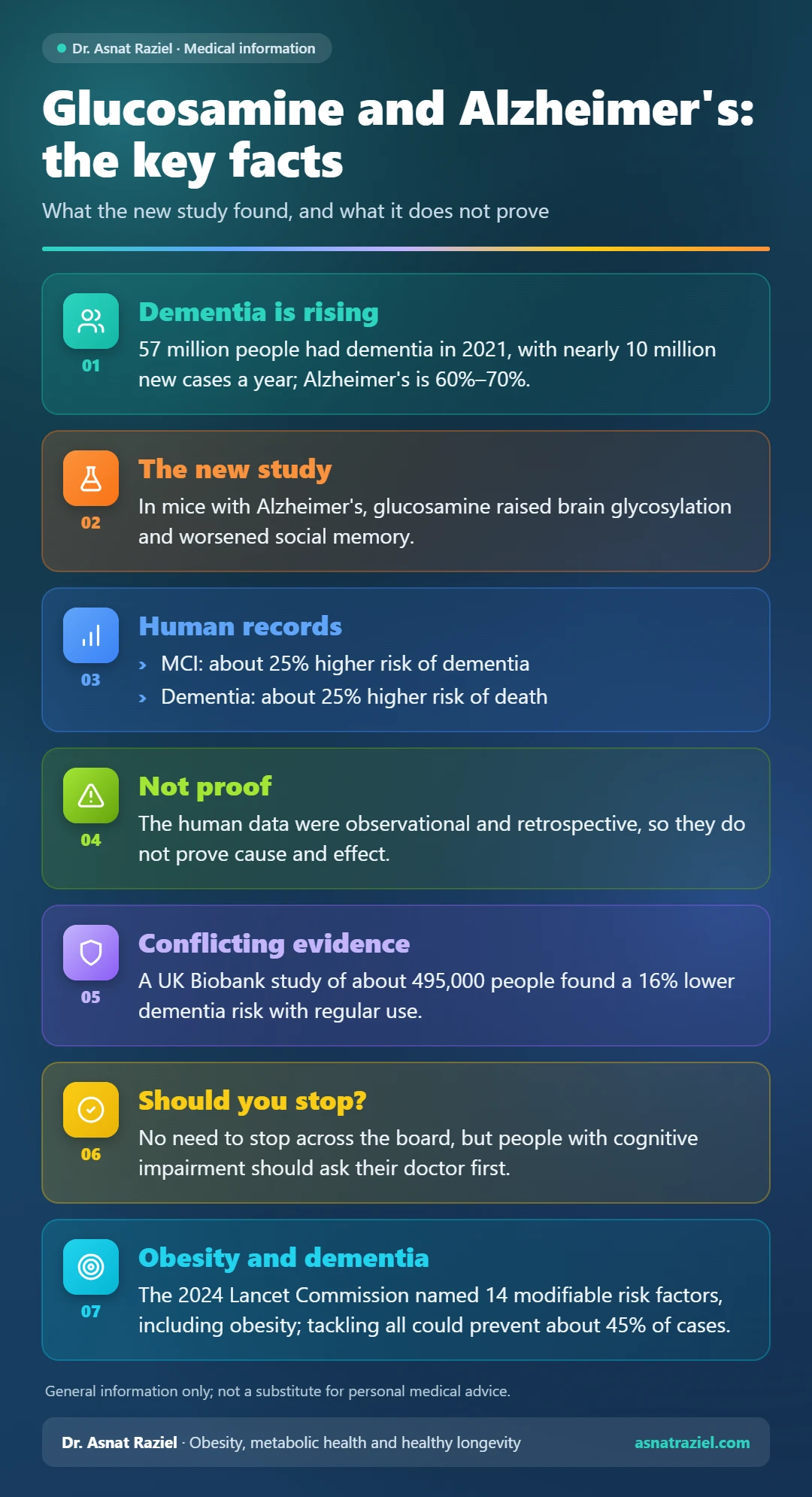
According to the World Health Organization, 57 million people worldwide were living with dementia in 2021. In addition, nearly 10 million new cases appear every year. Alzheimer’s is the most common form and may account for 60%–70% of cases. Alzheimer’s Disease International estimates that by 2050 the number may reach about 139 million.
The trend is clear in Israel too. According to Kol Zchut, the Israeli rights information site (in Hebrew), more than 100,000 people in Israel live with dementia. In June 2026, Israel’s Ministry of Health even warned the Knesset Health Committee that the number of patients is expected to rise significantly in the coming years. The main reason is longer life expectancy and an aging population.
What causes dementia?
Dementia is not one disease but a group of diseases that gradually damage the brain. The most common cause is Alzheimer’s. Alongside it are vascular dementia, dementia with Lewy bodies and frontotemporal dementia.
Age is the strongest risk factor. Today, though, it is clear that dementia involves a combination of genetics, chronic inflammation and damage to blood vessels. Metabolic disorders, oxidative stress and changes in the brain’s immune system also contribute. In the brains of people with Alzheimer’s, two proteins build up: amyloid-beta and tau. Their buildup damages nerve cells and the communication between them, and eventually leads to cell death.
The brain as a metabolic system
One of the most important developments in research is the understanding that Alzheimer’s is not only a neurological disease. It also has a strong metabolic component. Some researchers even call it “type 3 diabetes” because of the disrupted use of glucose in the brain. Nerve cells struggle to use energy, and inflammatory processes begin years before symptoms appear.
This approach explains why obesity, diabetes, fatty liver and metabolic syndrome raise the risk of dementia. I discussed this link at length in my article on Alzheimer’s and obesity.
The big advances: drugs and blood tests
In recent years, regulators have approved drugs that target the removal of amyloid protein from the brain. Lecanemab received full approval in the United States in July 2023. The FDA approved donanemab in July 2024. These drugs are not a cure, but they slowed the rate of decline in the early stages of the disease.
At the same time, diagnosis is undergoing a revolution. In the past, diagnosis relied on clinical assessment, memory tests, imaging and sometimes a lumbar puncture or an expensive PET scan. Today there are blood tests that measure markers such as pTau217, pTau181 and amyloid-beta. In May 2025, the FDA approved the first test of its kind. In October 2025, the agency approved another test for use in primary care. The earlier the diagnosis, the greater the chance of slowing the disease and preserving quality of life.
The new study on glucosamine and Alzheimer’s
This Nature Metabolism study, from the University of Florida, focused on a process called glycosylation. In this process, sugar molecules attach to proteins and change their activity. The researchers found “hyperglycosylation,” meaning abnormal activity of this process, in the brains of people with Alzheimer’s. They argue that it is not just a result of the disease but a factor that speeds it up.
In experiments in mice with Alzheimer’s, glucosamine increased glycosylation in the brain and worsened social memory. Healthy mice, by contrast, showed no harm. The researchers also examined the medical records of 41,884 patients with mild cognitive impairment (MCI) and 24,481 patients with dementia. Among those with MCI, taking glucosamine was associated with an approximately 25% higher risk of progressing to dementia. Among patients with dementia, it was associated with an approximately 25% higher risk of death.
Glucosamine and Alzheimer’s: should you stop the supplement?
At this stage, the question about glucosamine and Alzheimer’s has a clear answer: no. Despite the headlines, this is a preliminary study. Its human component was observational and retrospective, so it does not prove cause and effect. Industry representatives raised criticism: perhaps arthritis, chronic pain and reduced mobility explain part of the link.
Moreover, in 2023 researchers published a large study in BMC Medicine of about 495,000 participants from the UK Biobank. It actually found a 16% lower risk of dementia among people who took glucosamine regularly. So there is no reason to stop the supplement across the board. Still, anyone with cognitive impairment or Alzheimer’s should consult their doctor before using it.
The link between obesity and dementia
The understanding that obesity is a chronic metabolic disease, and not just a matter of weight, keeps growing stronger. Fat tissue, and especially visceral fat around the internal organs, releases inflammatory substances. These damage blood vessels and the nervous system. In addition, obesity raises the risk of diabetes, high blood pressure, sleep apnea and atherosclerosis. All of these are known risk factors for dementia.
The 2024 Lancet Commission identified 14 modifiable risk factors, including obesity. By its estimate, addressing all of them could prevent about 45% of dementia cases. Good sleep and brain health are also closely linked.
Do weight loss drugs protect the brain?
Observational studies raised hopes that GLP-1 drugs would reduce inflammation in the brain and improve its insulin sensitivity. In November 2025, however, a disappointing answer arrived. In the EVOKE and EVOKE+ trials, 3,808 patients with early Alzheimer’s received oral semaglutide or a placebo. The drug did not slow the progression of the disease.
In other words, weight loss drugs are not a treatment for Alzheimer’s. Even so, treating obesity, diabetes and chronic inflammation still reduces known risk factors. That is why metabolic prevention remains an important tool for protecting the brain.
The bottom line on glucosamine and Alzheimer’s
For now, the study on glucosamine and Alzheimer’s does not change the recommendations. It calls for controlled clinical research before anyone draws conclusions. However, it highlights how deep the connection between metabolism and the brain runs. Ultimately, the better we understand the links between sugar, inflammation, obesity and aging, the better we will be able to prevent one of the most challenging diseases of the 21st century.
This article provides general information and is not a substitute for personal medical advice.
References
Hyperglycosylation is a metabolic driver of Alzheimer’s disease
Results of evoke and evoke+ trials show no effect of oral semaglutide on AD progression
FDA approves Roche’s blood test to rule out AD pathology in primary care
Donanemab update: new Alzheimer’s disease treatment approved by the FDA




