By Dr. Asnat Raziel, bariatric surgeon specializing in obesity treatment, metabolic health and healthy longevity; Director of the Multidisciplinary Center for Obesity Treatment, Assia Medical, Assuta Ramat HaChayal, Tel Aviv
Tirzepatide and fatty liver: what the biopsies showed
The link between tirzepatide and fatty liver in its advanced form is the subject of the first controlled trial with repeat liver biopsies. The trial, SYNERGY-NASH, showed that the drug cleared fatty liver inflammation in most patients within a year. In addition, participants lost an average of up to 15.6% of their body weight. This was a phase 2 trial, so it is not yet the basis for formal approval, but it points in an important direction.
This article focuses on the biopsy trial itself. Real-world data, from patients who received the drug in the community, appear in my article on Mounjaro and fatty liver in the real world.
Why fatty liver is such a big challenge
Today, doctors recognize obesity as a treatable chronic disease. Fatty liver disease, by contrast, has remained an especially complex challenge. It develops silently, harms quality of life and can lead to scarring of the liver, cirrhosis and even liver transplantation.
The medical name of the disease has changed in recent years. Instead of NASH, we now use MASH, metabolic dysfunction-associated steatohepatitis. Fibrosis is scarring of the liver tissue, and doctors grade it from F0 to F4. Finally, grade F4 is cirrhosis. A full guide to the disease appears in my article on fatty liver diagnosis and treatment.
The trial: multinational, with biopsies before and after
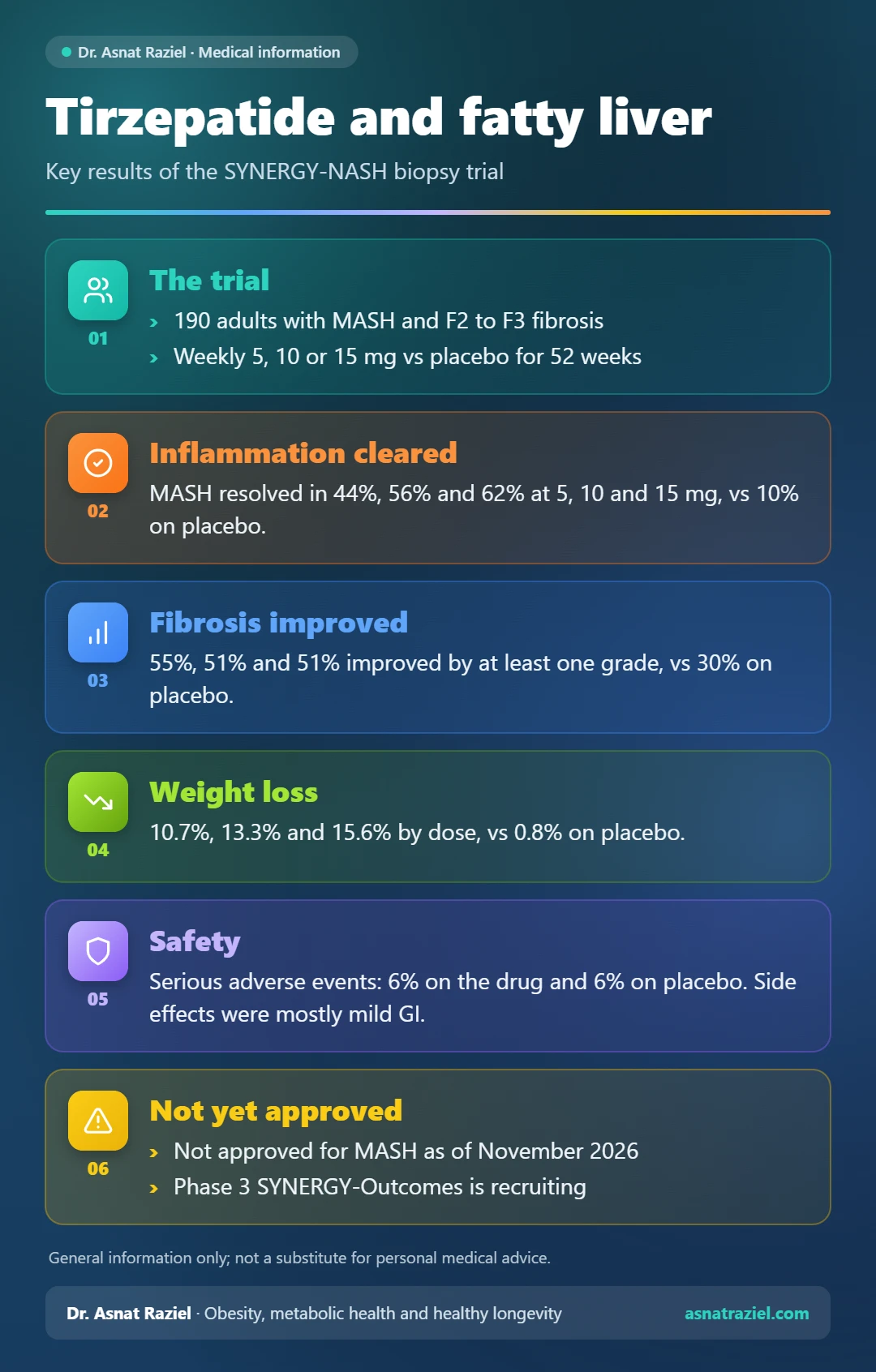
The NEJM published the SYNERGY-NASH trial in June 2024. In total, it enrolled 190 adults aged 18 to 80 with biopsy-confirmed MASH and fibrosis grade F2 or F3. Participants received a weekly injection of Mounjaro (tirzepatide) at 5, 10 or 15 mg, or placebo, for 52 weeks.
Tirzepatide acts on two receptors, GIP and GLP-1. The researchers performed a liver biopsy on every participant at the start and at the end of the trial. This matters, because only a biopsy shows a true change in tissue structure. According to the summary by the American College of Gastroenterology, the trial ran at 130 sites in 10 countries, including Israel.
The participants’ profile is similar to the patients I see in my clinic:
- Average BMI of 36.1.
- 52% with type 2 diabetes.
- Average NAS score of 5.3, a measure of inflammatory activity in the liver.
- 57% with grade F3 fibrosis.
Tirzepatide and fatty liver: the inflammation cleared
The primary endpoint was resolution of MASH without worsening of fibrosis, after 52 weeks. Overall, the results were clear:
- 5 mg: 44%.
- 10 mg: 56%.
- 15 mg: 62%.
- Placebo: 10%.
The difference from placebo was significant at all three doses (p<0.001). In other words, in more than half of patients on the higher doses, the inflammation cleared within a year. By comparison, only one in ten patients on placebo reached that result.
Improvement in fibrosis: a promising trend
An important secondary endpoint was improvement of at least one fibrosis grade, without worsening of inflammation:
- 5 mg: 55%.
- 10 mg: 51%.
- 15 mg: 51%.
- Placebo: 30%.
However, we should read this finding with caution. The trial was small, so it lacked enough statistical power for fibrosis. In addition, healing of liver scarring is a slow process, and it probably takes more than a year. Longer trials will answer this question.
Weight loss: up to 15.6% in a year
The effect on weight was substantial: a loss of 10.7% at 5 mg, 13.3% at 10 mg and 15.6% at 15 mg. In the placebo group, by contrast, the loss was only 0.8%. Double-digit weight loss is one of the most important drivers of improvement in fatty liver. The dual action on GIP and GLP-1 may also help reduce liver fat and improve insulin sensitivity, but the researchers did not design the trial to separate these effects.
Safety: the expected side effects
The most common side effects were gastrointestinal: nausea, diarrhea and reduced appetite. However, most were mild to moderate. Serious adverse events occurred in 6% of the drug groups and 6% of the placebo group. The rate of stopping treatment because of side effects was also the same: 4% in both groups. A full breakdown appears in my article on Mounjaro side effects.
Tirzepatide and fatty liver: what has changed since 2024
The fatty liver field has advanced a great deal since the trial was published. In March 2024, the FDA approved Rezdiffra, the first drug for MASH with moderate to advanced fibrosis. In August 2025, the FDA also approved Wegovy for the same indication, without cirrhosis. The approval relied on the ESSENCE trial, in which the inflammation cleared in 63% of patients on Wegovy, compared with 34% on placebo. I wrote more about it in my article on Wegovy for fatty liver.
By contrast, as of November 2026, the FDA has still not formally approved tirzepatide for treating MASH. In October 2025, the SYNERGY-Outcomes trial began. This phase 3 trial plans to enroll 4,500 participants and is still recruiting. It will test whether tirzepatide and retatrutide prevent serious liver complications, such as progression to cirrhosis, liver transplantation and death. Researchers expect the trial to finish in 2032.
The clinical meaning of tirzepatide and fatty liver data
Three key conclusions emerge from the trial:
1. Not just weight, but the liver too. The clearing of inflammation and the trend in fibrosis point to a real benefit for the liver, alongside the weight loss.
2. The multidisciplinary approach matters. The best results come from combining advanced drugs, bariatric surgery when needed, nutritional support, physical activity and emotional support. A practical protocol appears in my article on fatty liver risk assessment in the clinic.
3. Looking to the future. The trial did not include patients with cirrhosis. Only long-term trials will show whether the drug changes the course of the disease, and not just how the tissue looks.
Bottom line
The data on tirzepatide and fatty liver are impressive: inflammation cleared in up to 62% of patients, a trend toward improvement in fibrosis, double-digit weight loss and safety similar to placebo for serious events. However, this was a one-year phase 2 trial, and regulators have not yet approved the drug for this indication. Ultimately, you and your doctor choose the treatment together, based on the state of your liver, your weight and any related conditions. General information about the drug appears in my complete guide to Mounjaro.
The information in this article is general and does not replace personal medical advice.
References
Tirzepatide for Metabolic Dysfunction-Associated Steatohepatitis with Liver Fibrosis
Tirzepatide Produces NASH Resolution and Decreases Fibrosis: Results from the SYNERGY-NASH Trial
Phase 3 Trial of Semaglutide in Metabolic Dysfunction-Associated Steatohepatitis
FDA Approves First Treatment for Patients with Liver Scarring Due to Fatty Liver Disease
FDA Approves Semaglutide (Wegovy) Injection 2.4 mg for Noncirrhotic MASH
Eli Lilly, the drug’s manufacturer, funded the SYNERGY-NASH trial.