By Dr. Asnat Raziel, bariatric surgeon specializing in obesity treatment, metabolic health and healthy longevity; Director of the Multidisciplinary Center for Obesity Treatment, Assia Medical, Assuta Ramat HaChayal, Tel Aviv
Sun damage to skin: much more than wrinkles
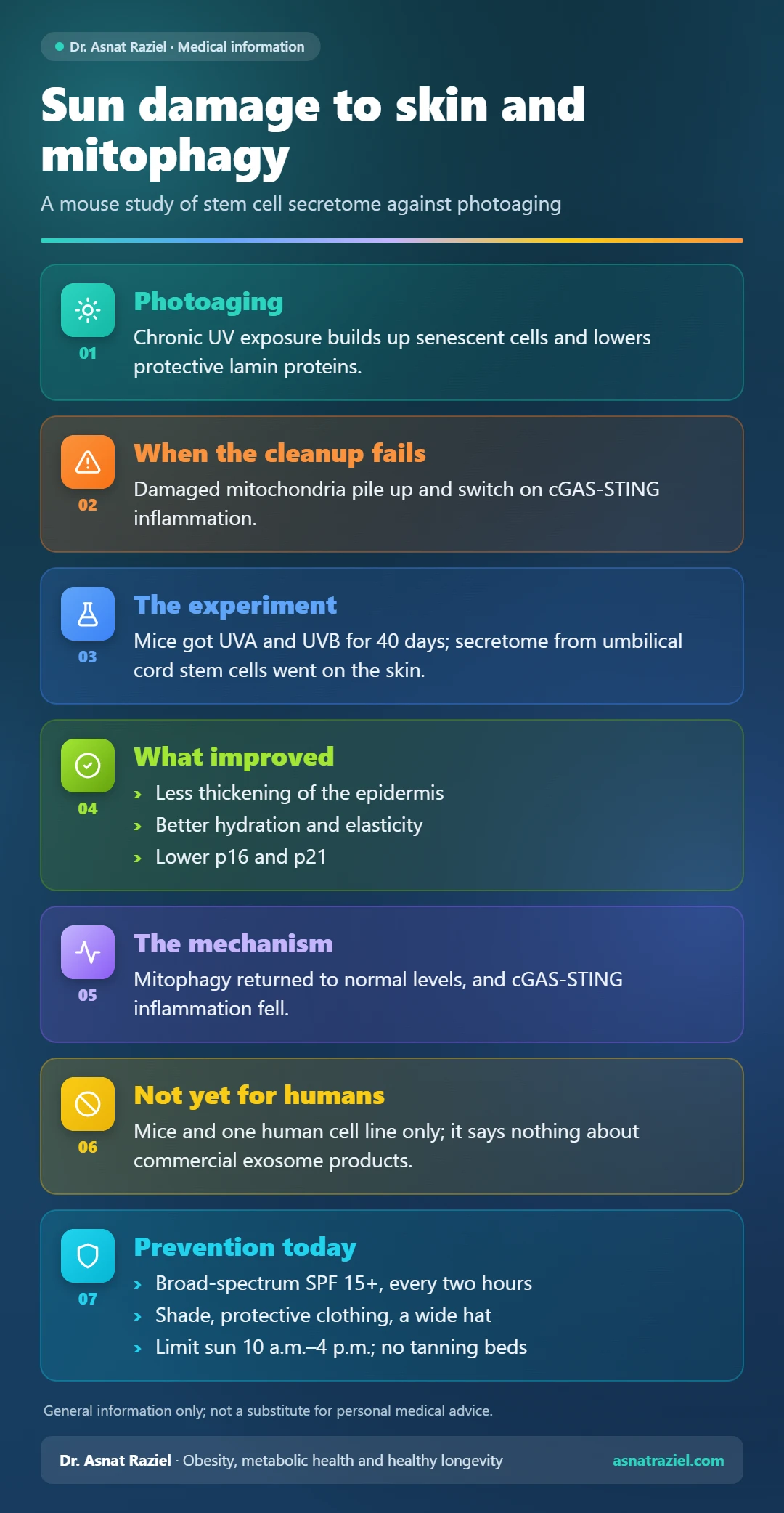
Sun damage to skin is not just about wrinkles. A new study in the journal Aging Cell examined the topic in mice. According to the study, substances secreted by umbilical cord stem cells reduced radiation damage in the skin. A review by the Lifespan Research Institute from September 2026 also described the study.
The researchers’ explanation is especially interesting. The skin cells went back to clearing out their damaged mitochondria. However, it is important to say right away that the study looked at mice and at skin cells in the lab. So it does not prove effectiveness or safety in humans.
What is sun-related skin aging?
Chronic exposure to ultraviolet radiation is the main cause of photoaging. The term describes skin aging caused by the sun, as opposed to the natural aging that comes with the years.
In this process, senescent cells build up in the skin. These are cells that have stopped dividing but do not die. In addition, levels of lamin proteins, which protect DNA, decline. As a review on skin aging describes, the skin becomes thick, wrinkled and rough. Sometimes visible blood vessels appear as well.
Why sun damage to skin is not just a cosmetic issue
The damage can lead to precancerous lesions and to skin cancer. What’s more, existing treatments are limited. Retinoids and antioxidants help to some extent, but they do not undo the damage. Laser treatments can be expensive and painful, and they sometimes cause other side effects. I have written at length about everyday factors that speed up aging, including smoking.
When mitochondria become a source of inflammation
Mitochondria are the cell’s “power plants.” I wrote about their role in my article on mitochondria and aging. When a mitochondrion is damaged, the cell is supposed to identify it, break it down and recycle its parts. This process is called mitophagy, the cell’s “housecleaning.”
When this cleanup fails, damaged mitochondria pile up. They then activate an inflammatory pathway called cGAS-STING. Researchers have shown this link, for example, in a study on atrial fibrillation in diabetes. The pathway increases the production of cytokines, inflammatory proteins such as IL-6 and IL-8. The result is “inflammaging,” a quiet, chronic inflammation linked to age. A similar process is also known in brain aging, and you can read about the genetic side of this pathway in my article on the genetics of longevity.
What is the stem cell secretome?
The researchers did not transplant stem cells. Instead, they used the secretome, the full set of substances that stem cells release into their surroundings, including proteins and exosomes. Exosomes are tiny vesicles that carry signals between cells.
The secretome came from mesenchymal stem cells from human umbilical cords. Earlier studies focused on individual components. For example, extracellular vesicles from stem cells reduced sun damage. This time, the researchers chose the complete secretome in order to examine its full effect.
How did the researchers test sun damage to skin?
First, the researchers shaved patches of skin on mice. Then they exposed these areas to UVA and UVB radiation for 40 days to mimic chronic exposure. They applied the secretome to part of the irradiated skin. At the same time, they irradiated human skin cells from the HaCaT cell line with UVB. They grew some of these cells in the presence of the secretome.
In the treated mice, the researchers saw less thickening of the epidermis, the outer layer of the skin. In addition, hydration and elasticity improved, and less water escaped through the skin barrier. Most of the collagen stayed intact. Two markers of cellular aging, p16 and p21, also declined. The human skin cells showed a similar picture: fewer cells became senescent, and the drop in Lamin B1 was small.
The key finding: mitophagy started working again
As expected, the radiation increased the number of damaged mitochondria and weakened mitophagy. A decrease in the marker LC3B-II and lower levels of the proteins PINK1 and Parkin, which tag mitochondria for removal, showed this. By contrast, the secretome corrected the defect. The mitophagy markers returned to the levels seen in mice that had never been exposed to radiation. At the same time, cGAS-STING activity and cytokine production fell, both in the skin and in the cell cultures.
The researchers also checked whether mitophagy is truly the mechanism. When they gave the secretome together with Mdivi-1, a substance that blocks mitophagy, the secretome did not help. On the other hand, blocking STING with H151 worked much like the secretome. Forcing mitophagy with CCCP had a similar effect too. In other words, the chain is: the secretome activates mitophagy → cGAS-STING-driven inflammation falls → skin damage decreases.
Limitations: not yet a treatment for humans
The experiments included mice and a single line of human skin cells. Human skin is thicker than mouse skin, and it accumulates damage over many years. Therefore, results in a clinical trial may differ. In addition, the whole secretome does not reveal which component is responsible for the effect. The review also does not report any safety data.
This leads to a practical conclusion. The study tells us nothing about commercial products marketed today as “exosomes” or “stem cells.” We should not conclude from it that they are effective or safe.
How can you prevent sun damage to skin today?
Until there are trials in humans, the best protection is prevention. The World Health Organization recommends these steps:
- Broad-spectrum sunscreen, SPF 15 or higher, reapplied every two hours.
- Less time in the sun between 10 a.m. and 4 p.m., especially when the UV index is high.
- Shade, protective clothing and a wide-brimmed hat.
- No tanning beds. Avoiding smoking also protects the skin.
Any new or changing skin lesion calls for a medical checkup. In addition, a plant-rich diet for longevity, physical activity and good sleep all support healthy cells. That is what healthy longevity means: adding years of health, not just years.
The bottom line on sun damage to skin
The study shows that in the skin, as in the heart and the brain, damaged mitochondria fuel age-related inflammation. In mice, getting mitophagy working again broke this chain and reduced sun damage to skin. If researchers identify the active components of the secretome, they may test them in clinical trials. Until then, this is a promising direction, not a treatment.
The information in this article is general and does not replace personal medical advice.
References
Clearing Damaged Mitochondria to Fight Skin Photoaging