By Dr. Asnat Raziel, bariatric surgeon specializing in obesity treatment, metabolic health and healthy longevity; Director of the Multidisciplinary Center for Obesity Treatment, Assia Medical, Assuta Ramat HaChayal, Tel Aviv
The root cause of obesity: why diet alone is not enough
Treating the root cause of obesity starts with a simple insight: obesity is not about a lack of willpower. It is a chronic disease in which the body’s and brain’s regulatory systems work differently. That is why most people who lose weight through diet alone go back to their previous weight. Once we understand the mechanisms, however, we can build treatment that lasts for years.
Treating the root cause of obesity starts with the right diagnosis
Obesity is a condition in which excess fat builds up and harms health. In recent years, the medical approach has changed. An international commission of 58 experts defined clinical obesity as a chronic, systemic disease. According to the commission, the disease harms how organs and tissues work because of excess fat.
In addition, the commission recommends not relying on BMI, or body mass index, alone. Instead, it suggests adding a waist circumference measurement or a similar measure, as well as an assessment of organ function. I have written in detail about overweight and obesity as a disease on this site.
Why the body fights weight loss
A scientific statement from the Endocrine Society describes obesity as a disorder of the system that regulates energy balance. Put simply, the brain “defends” a certain amount of body fat. So when weight goes down, the body increases hunger and slows energy expenditure. For more on the society’s current position, see my article on the Endocrine Society roadmap.
A study published in the NEJM showed this clearly. The researchers followed 50 patients who lost an average of 13.5 kg on a very low-calorie diet. Even a year later, the hunger hormone ghrelin stayed high. At the same time, satiety hormones such as leptin and PYY stayed low, and hunger remained elevated. Therefore, regaining weight is not a personal failure but an expected biological response.
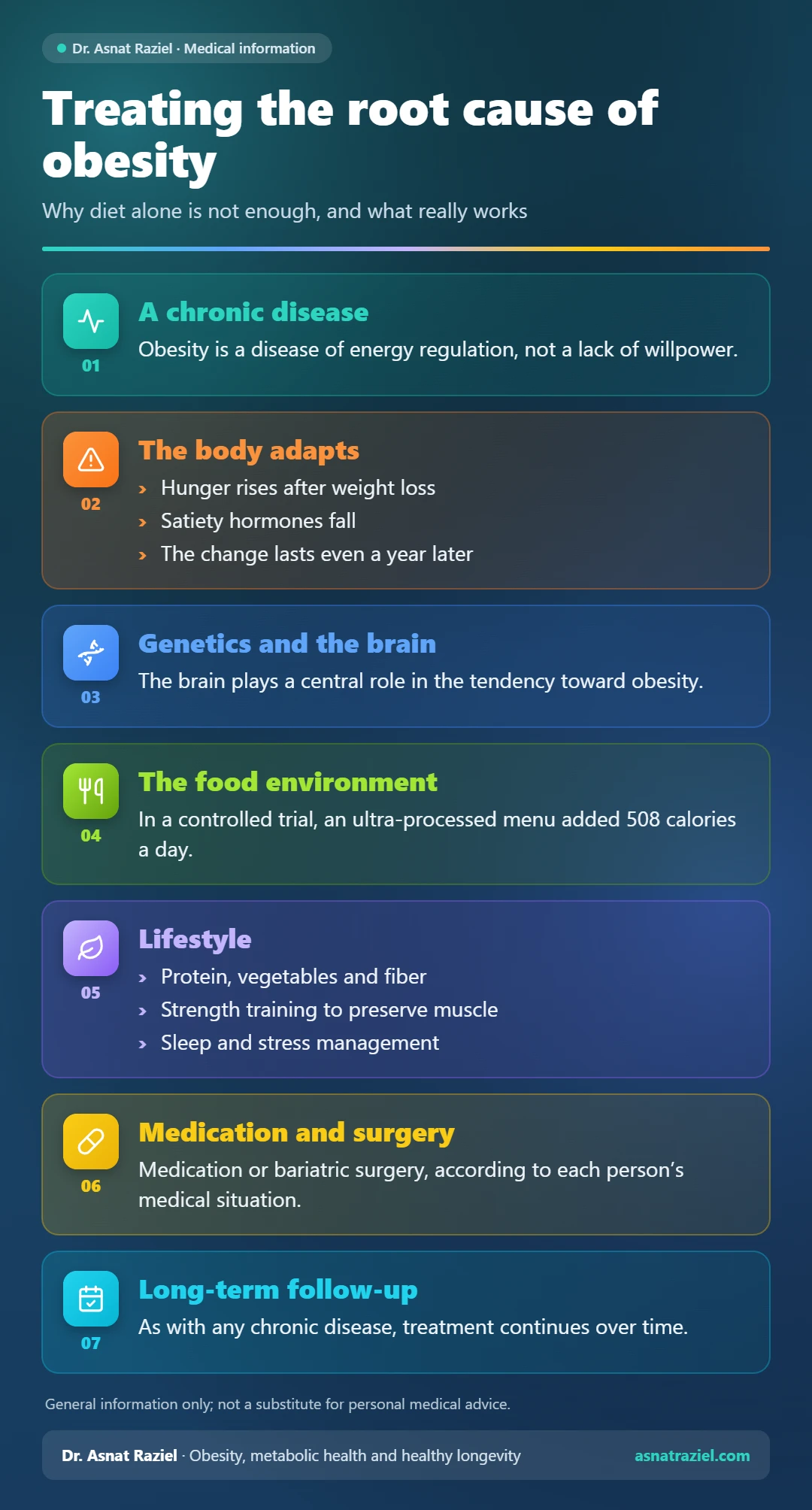
The deeper causes: genetics, the brain and the environment
Genetics and the brain
Large genetic studies point to a central role for the brain in regulating weight. A review in Nature Reviews Genetics explains that both common obesity and rare genetic forms share similar mechanisms in the brain. In other words, some people are born with a strong tendency toward hunger and fat storage. As a result, two people who eat the same food can end up at very different weights.
An ultra-processed food environment
The environment then switches on this tendency. In a controlled trial at the US National Institutes of Health, 20 adults ate as much as they wanted from an ultra-processed menu or an unprocessed menu, for two weeks each. On the ultra-processed menu, they ate 508 more calories a day and gained 0.9 kg. On the unprocessed menu, by contrast, they lost 0.9 kg.
Sleep, stress and food noise
Short sleep and psychological stress also affect appetite hormones. You can read about this in my articles on sleep deprivation and obesity and on stress and obesity. In addition, many people experience food noise, meaning constant thoughts about food, which makes control very difficult. If you are thinking about a supplement for stress, read my article on ashwagandha safety first.
Treating the root cause of obesity: what actually works
Good treatment addresses all of these factors together, not just what is on the plate. First, we find out what drives weight gain in each person: genetics, medications, sleep, stress or eating habits. Then, in our clinic, we build a personal plan for every patient that combines several layers.
Lifestyle: the foundation for the root cause of obesity
A diet rich in protein, vegetables and fiber, and low in ultra-processed food, is the foundation. In addition, physical activity and strength training preserve muscle mass. Finally, enough sleep and stress management complete the picture. I describe the holistic approach to obesity treatment in a separate article.
Obesity medication
Modern medications act directly on the hunger and satiety mechanisms in the brain. According to the US National Institute of Diabetes and Digestive and Kidney Diseases, these drugs are suitable for adults with a BMI of 30 or higher, or 27 or higher with a related condition. After one year, patients who combine medication with lifestyle changes lose 3% to 12% more of their body weight than with lifestyle changes alone. You will find detailed information about the drugs on my page on medications for obesity and metabolic disease.
Bariatric surgery and long-term follow-up
For severe obesity, bariatric surgery is still a very effective treatment. The choice between medication and surgery is personal, and I discuss it in my article on bariatric surgery in the era of new drugs. Either way, every treatment needs long-term follow-up, because the disease is chronic.
Why treating the root cause of obesity takes patience
Like high blood pressure or diabetes, obesity needs ongoing treatment. In most cases, the body keeps defending the higher weight even years later. According to the NIDDK, people who stop medication will probably regain some of the weight. That is why I prefer to talk with my patients about long-term health, not about a “diet” for a few months.
Moreover, success is not measured only in kilograms. Better blood sugar, blood pressure, sleep and daily function are just as important. You will find more in my article on a holistic approach to obesity treatment and a better life.
The bottom line
Treating the root cause of obesity means treating obesity as a chronic disease of energy regulation, not as a weakness. Effective treatment combines lifestyle changes, medication or surgery as needed, and emotional support over time. If you would like to explore your options, you are welcome to contact Dr. Asnat Raziel.
The information in this article is general and does not replace personal medical advice.
Questions and answers
What does treating the root cause of obesity mean?
It is an approach that treats the mechanisms behind obesity, such as hunger regulation in the brain, genetics, environment, sleep and stress. It does not settle for cutting calories in the short term.
Why do I regain the weight after every diet?
After weight loss, the body increases hunger and lowers satiety hormones. Studies show that these changes last even a year after the diet.
Is this approach right for everyone?
Yes. Anyone with excess weight can benefit from understanding the mechanisms and from changing their lifestyle. However, the intensity of treatment depends on health status, related conditions and personal preferences.
Who is a candidate for obesity medication?
Usually adults with a BMI of 30 or higher, or 27 or higher with a related condition such as diabetes or high blood pressure. The decision is made together with a specialist.
Can I stop treatment once I reach my target weight?
Obesity is a chronic disease, so many people regain weight after stopping medication. It is best to plan the next stage of treatment together with your doctor.
References
Definition and diagnostic criteria of clinical obesity
Obesity Pathogenesis: An Endocrine Society Scientific Statement
Long-term persistence of hormonal adaptations to weight loss
The genetics of obesity: from discovery to biology




