By Dr. Asnat Raziel, bariatric surgeon specializing in obesity treatment, metabolic health and healthy longevity; Director of the Multidisciplinary Center for Obesity Treatment, Assia Medical, Assuta Ramat HaChayal, Tel Aviv
Primary prevention of heart disease means acting before the first heart attack, stroke or diagnosis of heart failure, not after it. In this article, I explain why treating obesity belongs at the heart of that effort, what the evidence already shows, and which questions are still open. At the end, you will find practical steps to discuss with your doctor.
Primary prevention of heart disease starts with treating obesity
Preventing heart disease is one of the most important goals in medicine, because cardiovascular disease is the leading cause of death in the Western world. For years, treatment focused on lowering cholesterol, controlling blood pressure and treating diabetes. Today, however, an important truth is becoming clear. Obesity itself is a major risk factor for the heart, and sometimes an independent one. Therefore, treating obesity can change the course of heart disease, sometimes even before it appears.
Obesity is not “just” a mechanical load on the heart
The link between obesity and heart disease does not come only from the physical burden. Fat tissue, especially visceral fat, is an active hormonal organ. It releases inflammatory substances, harms blood vessel function and worsens insulin resistance. I wrote about this in detail in my article on visceral fat.
As a result, a chain of processes begins. Atherosclerosis speeds up, the inner lining of the blood vessels (the endothelium) is damaged, blood pressure rises and blood lipids become abnormal. Over time, the risk of heart attack, stroke, heart failure and heart rhythm disorders goes up. This happens even without diabetes or clear high blood pressure. Today, this broad picture is called cardiovascular-kidney-metabolic syndrome.
Heart failure: the heart disease of obesity
One of the most striking expressions of the link between obesity and the heart is heart failure with preserved ejection fraction (HFpEF). In this condition, the heart muscle contracts well but has trouble filling. The syndrome is becoming more common. It causes shortness of breath, reduced fitness and poor daily function, and it is closely linked to obesity, chronic inflammation and abdominal fat.
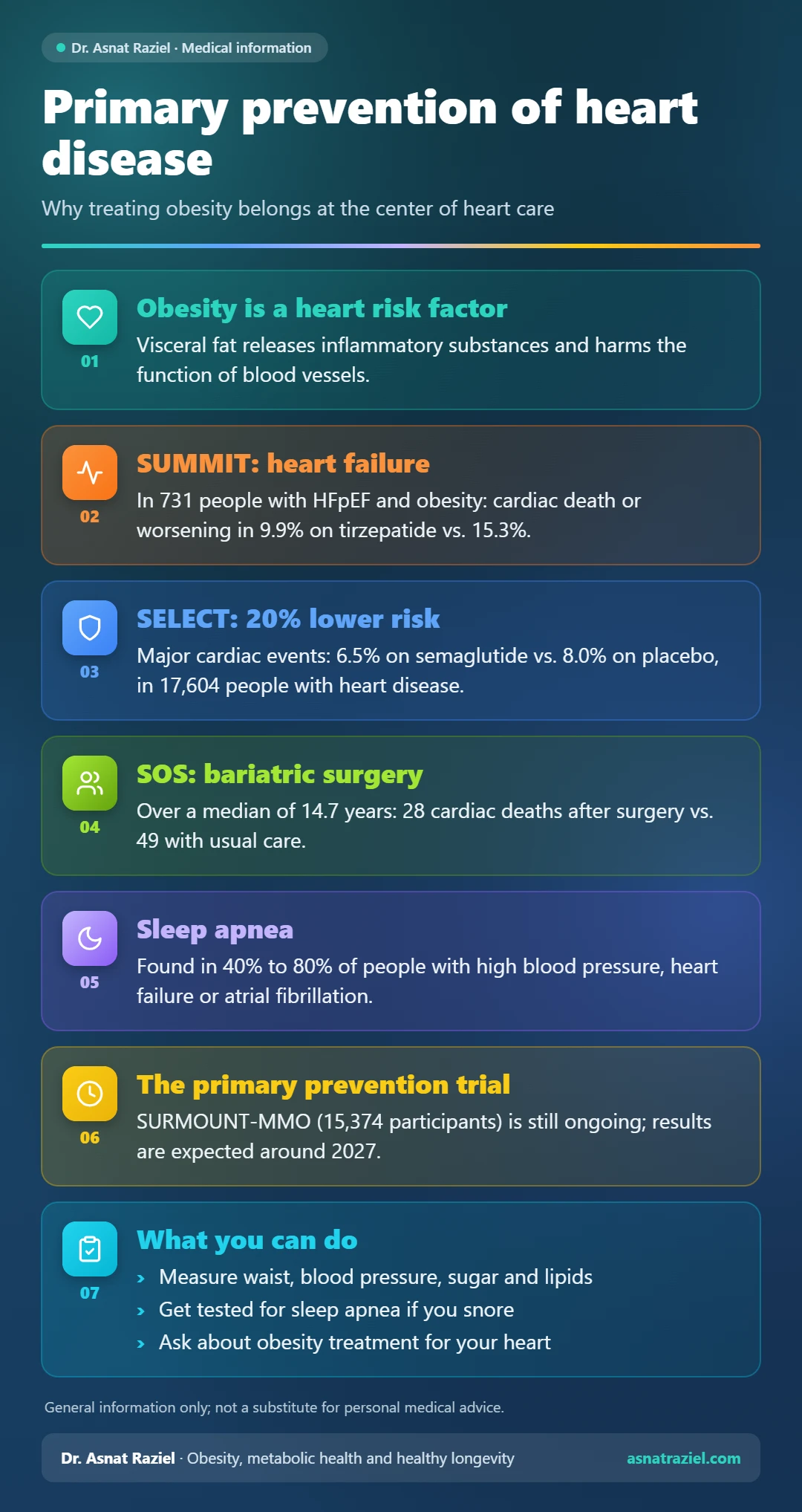
In this condition, weight loss does more than ease symptoms. In the SUMMIT trial, 731 patients with obesity and HFpEF received tirzepatide, the active ingredient in Mounjaro, or placebo. Cardiac death or worsening heart failure occurred in 9.9% of the drug group, compared with 15.3% of the placebo group. In other words, treating obesity also improved the course of the heart disease itself.
What studies have shown so far
In recent years, strong data have accumulated. Effective obesity treatment significantly reduces cardiovascular events. The SELECT trial included 17,604 people with overweight or obesity and existing heart disease, without diabetes. Semaglutide, the active ingredient in Wegovy, lowered the rate of major cardiac events to 6.5%, compared with 8.0% on placebo. That is a 20% reduction in risk.
Following the trial, the FDA approved Wegovy in March 2024 to reduce the risk of heart attack, stroke and cardiac death. It was the first approval of its kind for an obesity drug. You can read more about the trial in my article on the SELECT trial and heart protection.
Bariatric surgery has also shown a benefit. In the Swedish SOS study, researchers followed 2,010 people who had surgery and 2,037 people with obesity who received usual care. Over a median follow-up of 14.7 years, there were 28 cardiovascular deaths among those who had surgery, compared with 49 in the control group. However, this was an observational study, not a randomized trial.
How treating obesity protects the heart
Researchers attribute the effect to a combination of mechanisms. Insulin sensitivity improves, inflammation goes down and blood vessels work much better. In addition, blood pressure falls and the lipid profile improves. Part of the benefit may not depend only on the number of kilograms lost. Still, this question is under study. Together, these mechanisms explain why obesity treatment matters for the primary prevention of heart disease.
Weight loss also has a direct effect on blood pressure. You can read about this in my guide to treating high blood pressure through weight loss.
Sleep apnea: the missing link
Obstructive sleep apnea is a common complication of obesity. It is also an independent risk factor for heart disease, high blood pressure and heart rhythm disorders. According to a scientific statement from the American Heart Association, sleep apnea affects 40% to 80% of patients with high blood pressure, heart failure, coronary heart disease and atrial fibrillation. The repeated pauses in breathing cause drops in oxygen, activation of the sympathetic nervous system and inflammation.
Weight loss often improves sleep apnea and sometimes even makes it disappear. This reduces the nighttime strain on the heart. In this context, tirzepatide, the active ingredient in Mounjaro, has been approved in the United States for sleep apnea under the brand name Zepbound, as I wrote in my article on Mounjaro and sleep apnea.
Primary prevention of heart disease, not only secondary
The medical meaning is clear. Treating obesity is not only supportive care after heart disease has already appeared. It can also be a preventive intervention. In this sense, it is similar to quitting smoking or controlling blood pressure: an early step that changes the course of a life.
It is important to be precise. SELECT tested people who already had heart disease, which is secondary prevention. By contrast, the question of preventing heart disease in people at risk is now being tested in the SURMOUNT-MMO trial. The trial includes 15,374 participants who receive Mounjaro or placebo. As of early November 2026, it is still ongoing, and results are expected only around 2027.
Primary prevention of heart disease: what the evidence covers so far
When you read about heart protection with obesity treatment, it helps to ask who was studied. Each type of evidence answers a different question.
- Secondary prevention: SELECT included people who already had heart disease, and semaglutide lowered major cardiac events from 8.0% to 6.5%.
- Heart failure: SUMMIT included people who already had HFpEF and obesity.
- Surgery: SOS showed fewer cardiovascular deaths after bariatric surgery, but it was an observational study.
- Primary prevention: SURMOUNT-MMO is testing people at risk, and its results are not yet available.
In other words, the case for primary prevention of heart disease through obesity treatment is strong and growing. Even so, the dedicated drug trial in people without heart disease has not yet reported its results. You can find a trial-by-trial overview in my article on what each heart outcome trial of obesity drugs has proven.
A broad view of heart disease prevention
Modern medicine is adopting an integrated cardiometabolic approach. Instead of treating each risk factor separately, it sees obesity as a central crossroads. At this crossroads, blood sugar, lipids, blood pressure, inflammation and heart function all meet. When this crossroads is treated properly, with nutrition, physical activity, medication and sometimes surgery, the effect on heart health is broad and deep. For more on the link itself, see my article on how obesity is changing cardiovascular medicine.
What this means for you
If you have obesity together with heart disease, high blood pressure or diabetes, it is worth asking your doctor about obesity treatment as part of your heart care. First, it is important to measure your waist circumference, blood pressure, blood sugar and blood lipids. Second, if you snore and feel tired during the day, it is worth getting tested for sleep apnea. In addition, the decision about medication or surgery should be personal, based on each person’s medical condition and risk. Taking these steps early is the practical side of primary prevention of heart disease.
Bottom line
The accumulating data are changing the rules of the game. Treating obesity is first-rate heart care, not just a matter of quality of life or appearance. Therefore, primary prevention of heart disease should also include early diagnosis of obesity and tailored treatment. The sooner we recognize this, the more we can prevent heart disease rather than only react to it.
The information in this article is general and does not replace personal medical advice.
References
Semaglutide and Cardiovascular Outcomes in Obesity without Diabetes
Tirzepatide for Heart Failure with Preserved Ejection Fraction and Obesity
Bariatric surgery and long-term cardiovascular events
The SELECT, SUMMIT and SURMOUNT-MMO trials are funded by the drug manufacturers (Novo Nordisk and Eli Lilly).