By Dr. Asnat Raziel, bariatric surgeon specializing in obesity treatment, metabolic health and healthy longevity; Director of the Multidisciplinary Center for Obesity Treatment, Assia Medical, Assuta Ramat HaChayal, Tel Aviv
Heart risk in obesity: far beyond weight
Heart risk in obesity is one of the hottest topics in medicine today. For years, many people viewed obesity as a problem of weight and appearance, or at most as a risk factor for diabetes and high blood pressure. However, the European Congress on Obesity, ECO 2026, held in Istanbul in May 2026, painted a much broader picture.
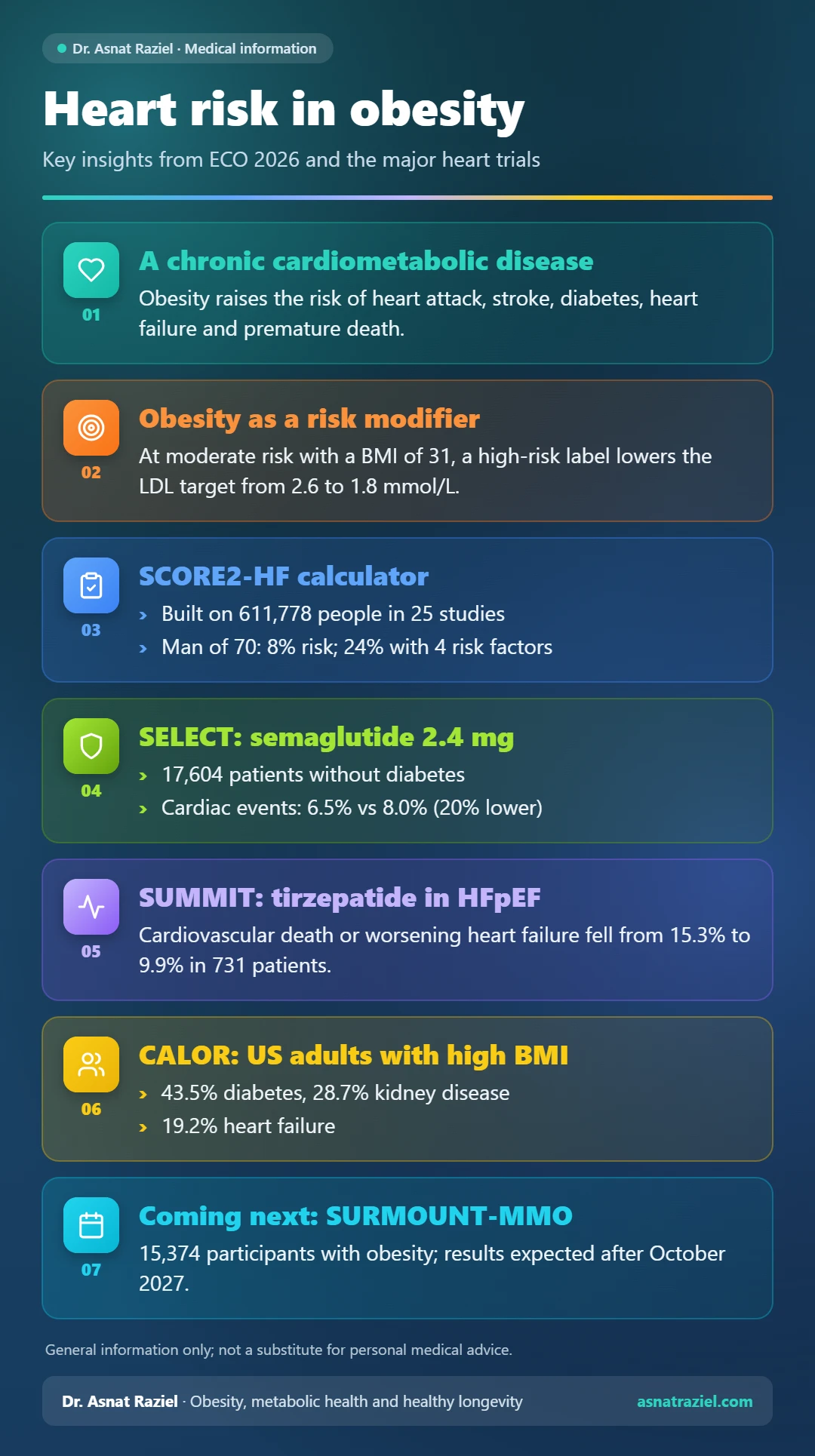
The experts stressed that obesity is not merely a backdrop for other diseases. It is a chronic cardiometabolic disease in its own right. It affects almost every system in the body, and above all the heart and blood vessels. Therefore, the goal of treatment is not just weight loss. The goal is to reduce the risk of heart attack, stroke, diabetes, heart failure and premature death.
How does obesity harm the heart?
Fat tissue is not just an energy store. It is an active organ that releases inflammatory and hormonal substances. These substances affect blood pressure, blood vessel function, insulin sensitivity and the clotting system. In particular, deep abdominal (visceral) fat contributes to heart disease even without diabetes or high blood pressure.
In the past, cardiology focused mainly on cholesterol, smoking and blood pressure. Today, there is growing recognition that obesity itself changes the structure of the heart and the function of the blood vessels. It is linked to atherosclerosis, ischemic heart disease, atrial fibrillation and heart failure. Above all, it is linked to HFpEF, or heart failure with preserved ejection fraction. In this type, the heart contracts normally, but it is stiff and has trouble filling.
Should obesity be part of risk calculators?
One of the key debates focused on this question. Prof. Konstantinos Koskinas from Bern presented the current situation. The 2025 European focused update on blood lipids recommends the SCORE2 and SCORE2-OP calculators. They estimate the 10-year risk of a cardiac event based on age, sex, cholesterol and blood pressure. However, obesity itself is not part of the formula.
For this reason, Koskinas argued that doctors should view obesity as a risk modifier, that is, a factor that changes the level of risk. In an example he presented, two patients received the same score, and both were at moderate risk. One had a normal weight, while the other had a BMI of 31. According to Koskinas, doctors should not treat them the same way. If doctors classify the patient with obesity as high risk, his target for LDL, the “bad” cholesterol, drops from 2.6 to 1.8 mmol/L.
New calculators for heart failure
At the same time, new models for predicting heart failure have emerged. Researchers developed the SCORE2-HF model from data on 611,778 people in 25 studies. It explicitly includes BMI, alongside age, smoking, blood pressure, kidney function and diabetes. For example, in a low-risk region, a 70-year-old man with no risk factors has an 8% risk of heart failure within a decade. By contrast, with four risk factors, including a BMI of 30 or more, the risk reaches 24%.
The SMART2-HF and LIFE-Preserved models also include BMI. In the future, the calculators are expected to include biomarkers, imaging data and perhaps artificial intelligence algorithms as well.
Heart risk in obesity and double counting
A question that often comes up is whether adding BMI to a calculator creates double counting. After all, obesity already affects blood sugar, blood pressure and blood lipids. However, modern statistical models estimate the contribution of each factor separately. In addition, obesity has a direct inflammatory effect on the blood vessels and the heart. In other words, it adds risk beyond the classic factors.
The cardiovascular outcome trial revolution
Cardiovascular outcome trials (CVOTs) were born out of a safety concern. After the rosiglitazone affair, the FDA required proof that diabetes drugs do not raise cardiac risk. Yet in less than a decade, the picture flipped. New studies showed that metabolic drugs reduce cardiac illness and death.
The SELECT trial was a turning point. It included 17,604 patients with heart disease and overweight or obesity, without diabetes. Semaglutide 2.4 mg lowered the rate of cardiac events to 6.5%, compared with 8.0% on placebo (a dummy treatment). That is a 20% risk reduction. I covered this in more detail in my article on the SELECT findings and Wegovy.
Heart risk in obesity: beyond MACE
In the past, the main measure was MACE: heart attack, stroke and death from heart disease. Today, studies also examine quality of life, daily function, sleep apnea, kidney function and heart failure. In the SUMMIT trial, for example, tirzepatide lowered the risk of cardiovascular death or worsening heart failure from 15.3% to 9.9%. This was among 731 patients with HFpEF and obesity. It is also worth reading about the link between obesity and sleep apnea.
The SURPASS-CVOT trial compared tirzepatide head to head with dulaglutide in people with diabetes and heart disease. A major cardiac event occurred in 12.2% versus 13.1%, without significant superiority. Following the trial, the FDA approved Mounjaro to reduce cardiac risk in high-risk patients with diabetes on August 28, 2026.
All eyes are now on the SURMOUNT-MMO trial, which includes 15,374 participants with obesity. It is testing whether tirzepatide reduces illness and death, in both primary and secondary prevention. Researchers do not expect results until after October 2027.
Real-world data
The CALOR study examined millions of patients in the United States and Japan. In the United States, among adults with a high BMI, 43.5% had diabetes and 28.7% had kidney disease. In addition, 19.2% had heart failure. The combination of kidney disease, diabetes and heart failure stood out in particular. I wrote about this link in my article on cardiovascular-kidney-metabolic syndrome.
The differences between the countries are not only biological. They also reflect medical culture and how diagnoses are recorded. For instance, in Japan only 2.3% of people with a high BMI had an official diagnosis of obesity, compared with 70.1% in the United States.
The bottom line: heart risk in obesity and the future of cardiology
The message that echoed through the congress is clear. Obesity is not a matter of willpower. It is a chronic biological disease that affects the heart, the blood vessels, the kidneys, the muscles and the brain. In the future, treatment will be based on a personal assessment of heart risk in obesity and on identifying at-risk patients in time. It will combine medication, nutrition, physical activity and digital monitoring.
Ultimately, obesity medicine is changing cardiology itself. In the past, cardiologists treated the heart after it was damaged. Today, they understand that treating obesity may prevent heart disease before it even appears.
The information in this article is general and does not replace personal medical advice.
References
Focused Update of the 2019 ESC/EAS Guidelines for the management of dyslipidaemias
Semaglutide and Cardiovascular Outcomes in Obesity without Diabetes
Tirzepatide for Heart Failure with Preserved Ejection Fraction and Obesity
Cardiovascular Outcomes with Tirzepatide versus Dulaglutide in Type 2 Diabetes
Trends in Diagnosing Obesity: The CALOR Study
The SELECT, SUMMIT and SURPASS-CVOT trials were funded by Novo Nordisk and Eli Lilly. The CALOR study was funded by AstraZeneca.




