By Dr. Asnat Raziel, bariatric surgeon specializing in obesity treatment, metabolic health and healthy longevity; Director of the Multidisciplinary Center for Obesity Treatment, Assia Medical, Assuta Ramat HaChayal, Tel Aviv
A negative paternity test after fertility treatment: what was reported?
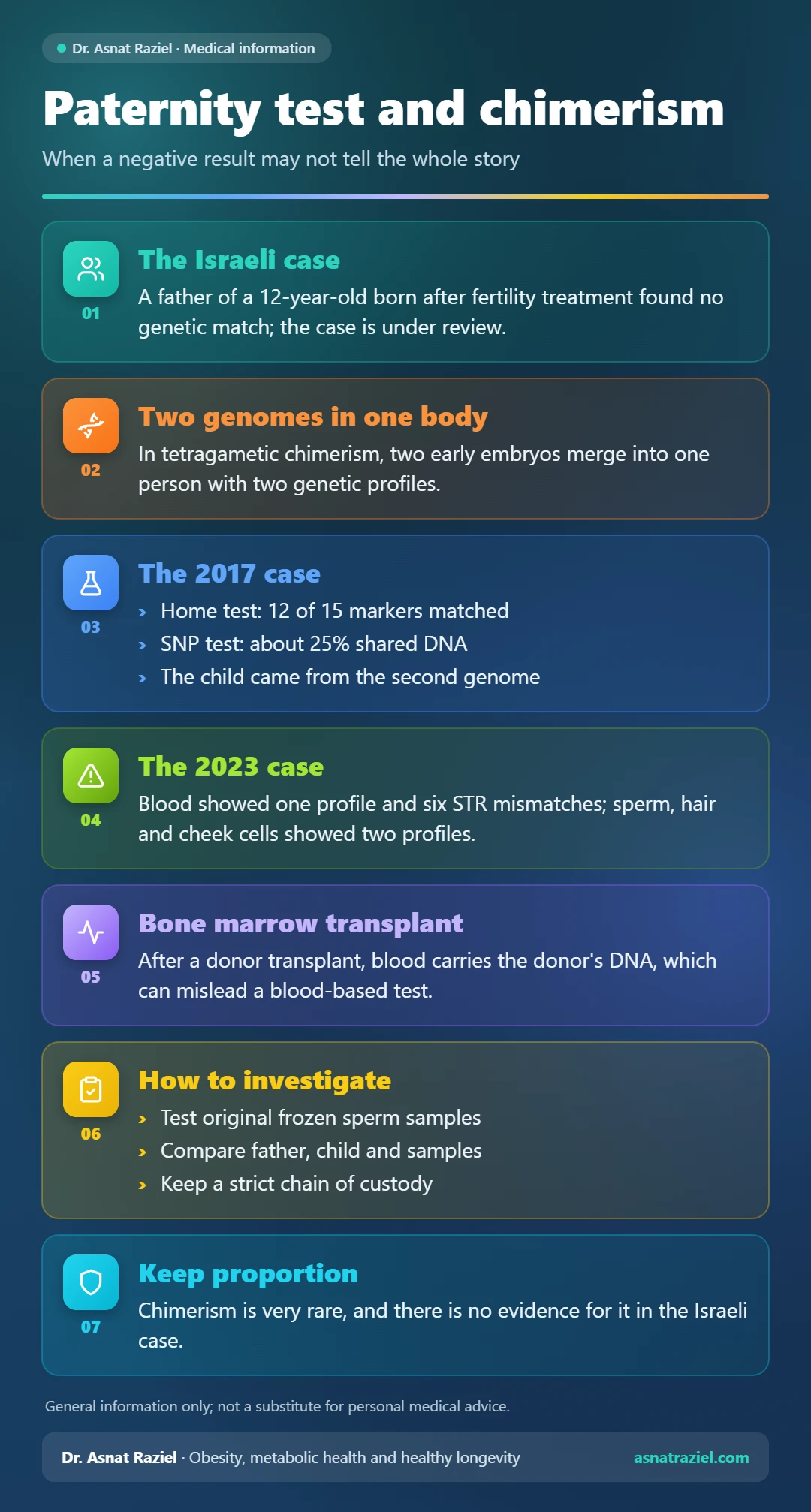
A paternity test recently done by the father of a 12-year-old boy showed, according to the report, that there is no genetic match between them. The boy was born after fertility treatment. The obvious question is whether a sperm sample was switched. However, science also knows another, rare explanation: chimerism, a condition in which one person carries two different genetic profiles in their body.
Imagine for a moment a father who has raised his son for 12 years. He remembers the day of the birth, the first steps and thousands of small moments of family life. And then comes a result that shakes his world: there is no genetic match between them.
On October 21, 2026, Hila Alroy reported the case on Channel 13 News in Israel. According to the report, the treatment began about 13 years ago. The father gave a sperm sample in Cleveland, in the United States. From there, the sample went to Hadassah hospital in Jerusalem, and later to Assuta Rishon LeZion, where the IVF treatment took place.
Assuta reported the incident to Israel’s Ministry of Health and began reviewing the case. The Ministry of Health also said it is examining the details of the case as part of a thorough professional review.
Of course, the possibility of an error in fertility treatment calls for a careful investigation. Still, before concluding that a switch took place, it is worth knowing about an almost unbelievable phenomenon. Sometimes the DNA that shows up in the father’s test is not the DNA he passed on to his child.
The man who found he was his son’s “uncle”
In 2017, researchers published an unusual case report in the Journal of Assisted Reproduction and Genetics. A 34-year-old man and his wife were struggling with fertility problems. They conceived their second son through intrauterine insemination (IUI), in which sperm is placed directly into the uterus.
After the birth, a mismatch in blood types came to light. The baby had blood type AB+, while the father had A+ and the mother A-. So the couple went back to the clinic, and the clinic carried out an internal review. According to the review, the father was the only white man who gave a sperm sample at the clinic that day.
Next, the couple ordered a home test. It ruled out his paternity, even though 12 of 15 markers matched. A further legal test, at another lab, ruled it out again. This time, 11 of 15 markers matched.
A deeper paternity test changed the picture
At this point, the couple turned to researchers. The researchers used a SNP test (single nucleotide polymorphism, a variation at a single point in the DNA sequence) that examined more than 700,000 markers. The result was surprising: the man and the child shared about 25% of their DNA. In other words, it was a pattern that fits the relationship between an uncle and a nephew.
But the man had no brother who could have been the father. So the researchers raised a surprising hypothesis. Perhaps the genetic “brother” lived inside the father’s own body?
Tests of blood, sperm, hair, skin and the lining of the cheek confirmed the hypothesis. The man carried two different genomes in his body. In the sperm, the “secondary” genome made up about 10% of the sample, and it was this genome that produced the child. In the end, the tests confirmed his paternity and ruled out the suspicion of a sperm switch at the clinic.
Chimerism: two genetic stories in one body
Usually, one egg fuses with one sperm, and an embryo with a unique genetic makeup begins to develop. The cells divide, and the whole body develops from that same starting point. But nature also has other scenarios.
Rarely, two sperm cells fertilize two different eggs, and two embryos begin to develop, as with non-identical twins. At a very early stage, the two groups of cells may merge. From there, only one embryo goes on to develop. The result is one person with two cell populations that differ genetically from each other.
This phenomenon is called tetragametic chimerism (chimerism from four sex cells). The name refers to the two eggs and the two sperm cells that contributed to forming the body. According to the figures the researchers cite, about one in eight single-baby pregnancies starts as a non-identical twin pregnancy. Even so, no one knows how many of them end in a chimera.
What chimerism does to paternity test results
In a chimera, the blood cells may carry mainly one genetic profile. At the same time, some of the skin, cheek lining or sperm cells may carry another profile, or a mix of both. As a result, a paternity test from blood or a cheek swab may test the genetic “body” that did not pass its DNA to the child.
The test itself can be technically perfect. However, its interpretation will mislead, because it assumes that all of the body’s tissues share the same genetic profile. Most chimeras do not know about their condition, so this assumption is almost always correct. Almost.
In 2023 it happened again: six mismatches and one father
Another case report, published in 2023 in the European Journal of Medical Genetics, reinforced the picture. This time, the case involved a surrogacy process that began at a fertility clinic. The first test compared a swab from the child’s cheek with a blood sample from the father.
The result showed a mismatch in six STR genetic markers (short tandem repeats, the standard markers in paternity tests). In a routine test, such a finding leads to excluding paternity. But the researchers did not stop there.
They tested the sperm sample used for fertilization, as well as the father’s cheek lining, hair follicles, nails and earwax. All of these tissues showed a mix of two genetic profiles. In all 24 informative markers, the genetic variants that the child had to inherit from his father were present.
By contrast, the blood showed only one profile. So it was precisely the blood test, where the investigation began, that misled the lab.
Could it be that there was no error in Israel either?
Scientifically, the answer is yes. But it is important to keep things in proportion. Tetragametic chimerism is a very rare condition. There are currently no good data on how common it is, because most chimeras live their whole lives without knowing it.
Moreover, there is no public evidence that the father in the Israeli case is a chimera. The Channel 13 report also did not detail the genetic markers, the testing method or the extent of the mismatch. Therefore, it is impossible to say that chimerism is a likely explanation in this case.
On the other hand, there are much simpler biological explanations. For example, a sample identification error, switched test tubes, a problem with freezing and thawing, or the use of another man’s sperm. Precisely because the consequences for the family and for the medical institutions are so serious, all the possibilities must be checked systematically.
Not every negative paternity test proves a sperm mix-up
Other situations can also confuse the interpretation. A new mutation, for example, can create a mismatch in a single marker. However, such a mutation usually does not explain a mismatch in many markers.
In addition, a bone marrow transplant from a donor can also mislead. After such a transplant, the blood cells carry the donor’s DNA, while other tissues keep the original DNA. Researchers from Toronto described such a case back in 1999. Tests of red blood cells first ruled out the paternity of a man who had previously had a bone marrow transplant. Only after the team learned about the transplant and tested cells from the cheek lining did the tests confirm his paternity.
The original sperm samples: the key to the investigation
One of the most important steps in such an investigation is testing original sperm samples that remain frozen, if they still exist. Comparing the DNA of the father, of the child and of the sperm samples can answer several critical questions.
First, if the DNA in the sperm sample differs from that in the father’s current sample, a sample switch, an old identification error or chimerism should be considered. Second, if the sperm sample matches the father but not the child, the fertilization and embryo-handling stages should also be examined. Finally, if the sperm sample shows a genetic population that differs from the one in the father’s blood or cheek lining, a dedicated workup for chimerism is worth considering.
However, it is not always possible to extract reliable DNA from an old sample. Even a good result will not necessarily show which sample was actually used many years ago. That is why experts in forensic genetics and fertility medicine should lead the investigation, while carefully keeping the chain of custody of the samples.
Paternity tests in Israel: the legal side
In Israel, such a test is subject to the law. According to the Ministry of Health, a paternity or family relationship test requires an order from a family court or an authorized religious court. It cannot be done without an order, even when all parties agree. The results go only to the court that issued the order.
Interestingly, the test in Israel relies on at least 15 STR markers, usually from a sample of the lining of the mouth. This is exactly the method that, in the 2017 case, did not detect the father’s second genome. Of course, this tells us nothing about the current case.
Genetic fatherhood and fatherhood in life
Beyond genetics and questions of medical responsibility, there is a particularly sensitive human story here. A genetic result is not just a line of data. It can shake a child’s sense of identity, the relationship between partners and a whole family’s trust in the medical system.
That is why it is important to distinguish between genetic fatherhood and fatherhood in real life. Parents build a bond over years, out of love, responsibility, presence and shared memories. No lab result erases all of these. By the same token, a family facing a genetic mismatch deserves a reliable, thorough and sensitive scientific investigation, without hasty conclusions.
So can a paternity test be wrong?
Not exactly. A DNA test identifies the genetic material in the sample with great accuracy. The crucial question is whether the sample represents the DNA that passed to the child. In the vast majority of cases, a properly performed paternity test gives a clear and reliable answer.
But the studies on chimerism teach us that even in a field of almost absolute certainty, there are exceptions. The question of how much of our life is written in our genes has occupied science for many years, and the link between genetics and longevity is more complex than it seems. The story of Maria Branyas, who lived to 117, also showed that one body can hold different biological processes at the same time.
Sometimes the man who looks genetically like the child’s uncle is actually his father. Sometimes two DNA populations live in one body. And sometimes, to understand the truth, you need to check not only the genes, but also which tissue they came from.
The bottom line
In the Israeli case, the truth has not yet come to light. Perhaps an error occurred in the fertility process, and perhaps the investigation will reveal another explanation. As of today, there is no evidence that points specifically to chimerism in this case. Still, a negative paternity test after fertility treatment justifies a thorough investigation before any conclusion.
Genetics tells a remarkably precise story. To understand it correctly, you sometimes also need to know which questions we have not yet asked.
This article is intended for medical and scientific education only. The phenomena described are based on the medical literature and do not determine the cause of the mismatch in the Israeli case. The information is general and is not personal medical or legal advice.
Disclosure: the author has no involvement in or connection to the case described.
Sources
Paternity pseudo-exclusion caused by tetragametic chimerism in a gestational surrogacy case
Parentage testing implications of male fertility after allogeneic bone marrow transplantation