By Dr. Asnat Raziel, bariatric surgeon specializing in obesity treatment, metabolic health and healthy longevity; Director of the Multidisciplinary Center for Obesity Treatment, Assia Medical, Assuta Ramat HaChayal, Tel Aviv
Obesity drugs and heart attack risk: what has changed in recent years
How obesity drugs affect heart attack risk is one of the hottest topics in medicine today. Wegovy, with the active ingredient semaglutide, and Mounjaro, with the active ingredient tirzepatide, have changed obesity treatment. They reduce appetite, increase fullness and lead to major weight loss. Yet the news is much broader: both also reduce the risk of heart attack and stroke.
After all, heart disease is the leading cause of death in the Western world. So any drug that treats weight and also protects the heart is a game changer. In this article, I go through the evidence on obesity drugs and heart attack trial by trial, including new data from 2025 and 2026, and explain who it applies to.
How Wegovy and Mounjaro work
To begin with, both drugs belong to the incretin family, hormones the gut releases after a meal. They act on the fullness centers in the brain and create an early feeling of being full. In effect, they signal to the body that it has already had enough food. Specifically, Wegovy mimics only the hormone GLP-1. This hormone slows stomach emptying, increases fullness and improves insulin release.
Mounjaro, by contrast, works through a dual mechanism. It activates both GLP-1 and GIP, another hormone that affects appetite and metabolism. In the SURMOUNT-5 head-to-head trial, Mounjaro led to an average weight loss of 20.2% after 72 weeks. In the same trial, Wegovy led to 13.7% weight loss, an impressive result in its own right. A full comparison of the two appears in the article the difference between Mounjaro and Wegovy.
Wegovy and the heart: the SELECT trial
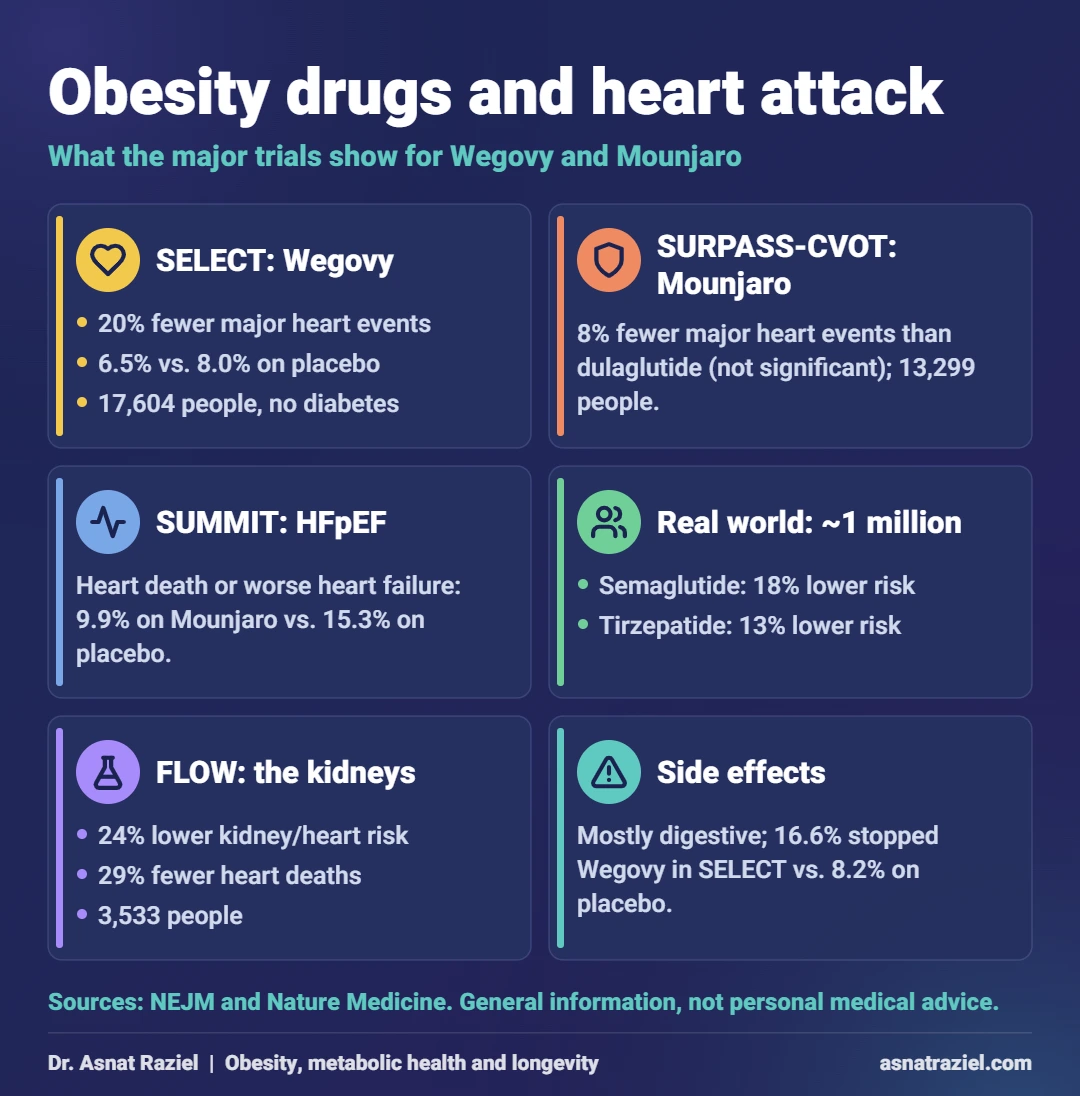
The first proof came in 2023. The SELECT trial included 17,604 people aged 45 and older with overweight or obesity and existing heart disease, without diabetes. Participants received Wegovy 2.4 mg a week or a placebo, meaning a dummy treatment. After an average follow-up of 39.8 months, a major heart event occurred in 6.5% of patients on Wegovy. In the placebo group, by contrast, it occurred in 8.0%. In other words, the risk dropped by 20%.
A major heart event includes death from heart causes, heart attack or stroke. Following the trial, the FDA (the US Food and Drug Administration) approved Wegovy in March 2024 to reduce this risk. Indeed, it was the first approval of its kind for an obesity drug. You will find more about the trial in the article Wegovy protects the heart.
What the trials showed for Mounjaro and the heart
For years, a large heart trial of Mounjaro was missing. The SURPASS-CVOT trial filled that gap at the end of 2025. It included 13,299 people with type 2 diabetes and cardiovascular disease. The researchers compared Mounjaro with dulaglutide, an older GLP-1 drug with proven heart protection. After a median follow-up of about four years, the rate of major heart events was 8% lower with Mounjaro. The difference did not reach statistical significance. In other words, Mounjaro protected the heart at least as well as a drug that had already proven itself.
Following the trial, the FDA approved Mounjaro in August 2026 to reduce major heart events in adults with type 2 diabetes at high risk. In addition, the SUMMIT trial tested Mounjaro in 731 patients with obesity and heart failure with preserved ejection fraction (HFpEF). This is a condition in which the heart muscle contracts well but has trouble filling. Heart-related death or worsening heart failure occurred in 9.9% of patients on Mounjaro, compared with 15.3% on placebo. You can read more in the article on Mounjaro and heart disease prevention.
Obesity drugs and heart attack in the real world
In November 2025, the journal Nature Medicine published a large real-world study. The researchers analyzed data on nearly one million adults with type 2 diabetes. Semaglutide reduced the combined risk of heart attack or stroke by 18% compared with sitagliptin. Sitagliptin is a diabetes drug with a neutral effect on the heart. Tirzepatide, for its part, reduced the risk of heart attack, stroke or death by 13% compared with dulaglutide.
And what happened in a direct comparison of the two drugs? The differences in heart protection were small. The researchers also saw that the benefit appeared early. Therefore, they believe the protection does not depend on weight loss alone. Possible mechanisms include reduced inflammation, better blood pressure control, improved blood fats and a direct effect on blood vessels.
The kidneys benefit too: the FLOW trial
In fact, the heart and the kidneys are closely linked. The FLOW trial enrolled 3,533 people with type 2 diabetes and chronic kidney disease. They received semaglutide 1.0 mg a week or a placebo. The risk of a major kidney event, or of death from kidney or heart causes, fell by 24%. Moreover, the risk of death from heart causes fell by 29%. The bigger picture is explained in the article on the link between the heart, the kidneys and metabolism.
Side effects: what you should know
Alongside their effectiveness, it is important to know the side effects. Most of them stem from how the drugs work: slower stomach emptying and greater fullness. In the first weeks, many patients experience nausea, bloating, heartburn, constipation or diarrhea. According to SURMOUNT-5, most symptoms were mild to moderate and appeared mainly while the dose was being increased.
Small portions, eating slowly and avoiding fatty food help a lot. Still, some patients stop treatment. In SELECT, for example, 16.6% stopped Wegovy because of side effects, compared with 8.2% on placebo. There are also rare risks: pancreatitis and gallbladder problems. Rapid weight loss raises the risk of gallstones, so it is important to tell your doctor about severe abdominal pain.
Who benefits: obesity drugs, heart attack risk and stroke
The data on obesity drugs and heart attack risk are especially relevant to three groups. First, people with obesity or overweight and existing heart disease, even without diabetes. Second, people with type 2 diabetes at high heart risk. Third, patients with obesity and heart failure with preserved ejection fraction. In each of these situations, the choice between the drugs depends on the evidence base, tolerability, price and personal goals.
It is important to remember that the drug does not stand alone. A balanced diet, physical activity, good sleep and treating high blood pressure and blood fats remain the foundation. In addition, close medical follow-up makes it possible to adjust the dose and spot side effects early.
Bottom line on obesity drugs and heart attack risk
Wegovy and Mounjaro are much more than weight-loss drugs. They lower weight, improve blood sugar control and change the relationship with food. What is more, it is now clear that these obesity drugs lower heart attack risk: both reduce major heart events. So there is no need to pick a drug that is only “good for the heart.” The right decision is made with a doctor, according to each person’s medical situation. Before starting treatment, it is also worth reading what to know before you start.
Even after a successful procedure, tiny vessels can stay blocked. Learn more about no-reflow after a heart attack.
The information in this article is general and does not replace personal medical advice.
References
Semaglutide and Cardiovascular Outcomes in Obesity without Diabetes
Cardiovascular Outcomes with Tirzepatide versus Dulaglutide in Type 2 Diabetes
Tirzepatide for Heart Failure with Preserved Ejection Fraction and Obesity
Effects of Semaglutide on Chronic Kidney Disease in Patients with Type 2 Diabetes
Tirzepatide as Compared with Semaglutide for the Treatment of Obesity
The SELECT and FLOW trials were funded by Novo Nordisk. The SURPASS-CVOT, SUMMIT and SURMOUNT-5 trials were funded by Eli Lilly.