By Dr. Asnat Raziel, bariatric surgeon specializing in obesity treatment, metabolic health and healthy longevity; Director of the Multidisciplinary Center for Obesity Treatment, Assia Medical, Assuta Ramat HaChayal, Tel Aviv
Mounjaro nausea: what to know in advance
Mounjaro nausea is the side effect my patients ask about most, and easing it starts even before the first injection. Most patients experience some side effect, mainly nausea, diarrhea or constipation. However, in most cases these effects are mild to moderate and appear mainly during the weeks of dose increases. When you know what to expect and what to do, you can get through this period safely and continue treatment.
In this article, I focus on the digestive side of things. I explain what the data show, how to ease nausea and the other gut symptoms, and when to see a doctor without waiting.
How Mounjaro works and why side effects appear
Mounjaro is the brand name of tirzepatide. It is a weekly injection that mimics two natural gut hormones: GLP-1 and GIP. These hormones increase fullness, reduce appetite and slow stomach emptying. In other words, food stays in the stomach longer.
This slowdown is part of the reason the drug works. On the other hand, it is also the main reason for nausea, a feeling of fullness and heartburn. That is why a patient who eats a large or fatty meal feels the effect especially quickly. For this reason, the drug always starts at a low dose and increases gradually.
How common is Mounjaro nausea? What the research shows
The best data come from the SURMOUNT-1 trial, which included 2,539 adults with obesity or overweight. According to the FDA prescribing information (under its US brand name for weight management, Zepbound), these are the rates in the obesity trials:
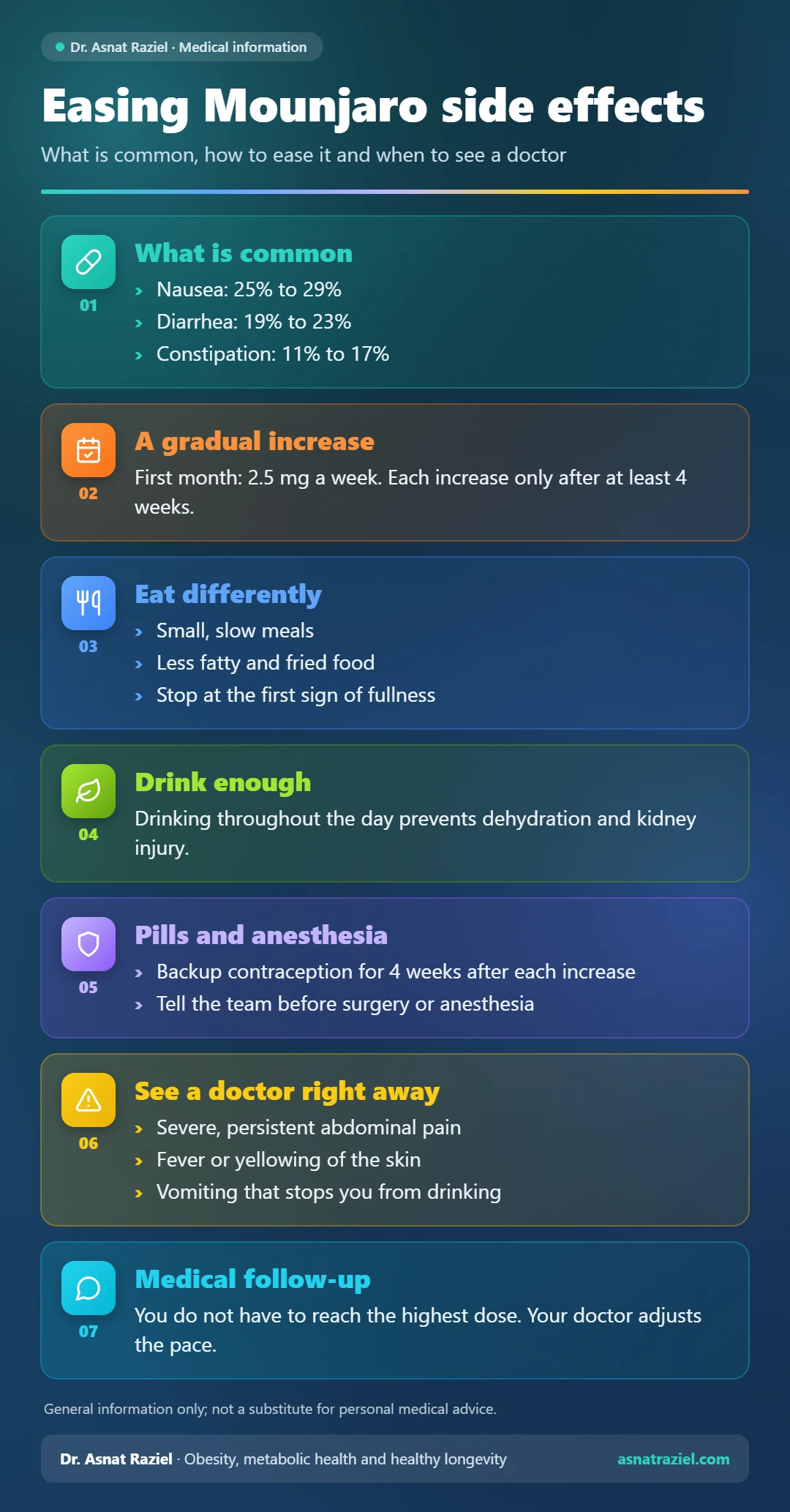
- Nausea: 25% to 29% of patients, compared with 8% in the placebo group.
- Diarrhea: 19% to 23%, compared with 8% in the placebo group.
- Constipation: 11% to 17%, compared with 5%.
- Vomiting: 8% to 13%, compared with 2%.
- Injection-site reactions: 6% to 8%, compared with 2%.
- Hair loss: 4% to 5%, compared with 1%.
Put simply, out of 100 patients, about 25 to 29 will experience nausea. Most side effects were mild to moderate, and they appeared mainly while the dose was going up. In addition, only a minority stopped treatment because of them: 4.3% to 7.1% of patients, compared with 2.6% on placebo.
Easing Mounjaro nausea and other digestive symptoms
Nausea and fullness
The most important rule is to eat less at a time. Eat small meals, slowly, and stop at the first sign of fullness. In addition, it helps to cut back on fatty, fried or very spicy food. In our clinic, we also recommend not lying down right after eating. If the nausea is strong, your doctor may recommend an anti-nausea medication for a short period.
Diarrhea and constipation
Both are common, and sometimes the same patient has each at different times. For constipation, drinking enough, eating vegetables and legumes, and moving every day help a great deal. With diarrhea, on the other hand, it is better to choose simple foods and to make sure you get enough fluids and salts. Also, check with your doctor before you take laxatives or anti-diarrhea medication on a regular basis.
Vomiting and the risk of dehydration
Repeated vomiting is not just unpleasant. It can cause dehydration and, according to the prescribing information, it can also harm kidney function. That is why it is important to drink throughout the day, even when you are not thirsty. If you cannot keep fluids down for 24 hours, see a doctor.
A simple daily routine against Mounjaro nausea
Here is how I suggest turning these tips into a daily routine, especially in the days after each injection and in the weeks of dose increases:
- Plan small meals, eat slowly and stop at the first sign of fullness.
- Keep fatty, fried and very spicy foods to a minimum.
- Stay upright after eating rather than lying down.
- Sip fluids throughout the day, even when you are not thirsty.
- If nausea is strong, ask your doctor about a short course of anti-nausea medication, or about staying longer on your current dose.
For a look at why so many patients keep going even when their body pushes back, see my article on how patients cope with GLP-1 nausea. For the full list of Mounjaro side effects, including the rare ones, read my complete guide to Mounjaro side effects.
Dose increases that keep Mounjaro nausea in check
According to the prescribing information, treatment starts at 2.5 mg once a week for 4 weeks. This dose is meant only for adjustment, not for long-term treatment. After that, the dose goes up to 5 mg, and then in steps of 2.5 mg, with at least 4 weeks on each dose. The maximum dose is 15 mg a week.
It is important to know that you do not have to reach the highest dose. 5, 10 and 15 mg are all approved treatment doses. So if your current dose works well and the side effects are hard, you can stay on it or wait longer before the next increase. You and your doctor make this decision together.
And what if you miss an injection? If up to 4 days have passed, inject as soon as possible. If more than 4 days have passed, skip it and continue on your usual day.
Other side effects: hair, fatigue and the injection site
Hair loss occurs in about 4% to 5% of patients. It is usually linked to rapid weight loss rather than to the drug itself, and it fades gradually. I covered this in detail in my article on hair loss on GLP-1 drugs. Fatigue is also common, especially when you eat too little. That is why it is important to keep protein at every meal and to get good sleep, which also supports brain health.
At the injection site, redness, itching or mild swelling may appear. Rotating the injection site every week, between the abdomen, thigh and upper arm, reduces this.
When to see a doctor
Most side effects can be managed at home. However, some signs require immediate medical attention or a visit to the emergency room:
- Severe, persistent abdominal pain, sometimes spreading to the back, with vomiting. This may signal pancreatitis.
- Pain in the upper right abdomen, fever or yellowing of the skin. These may signal a gallbladder problem.
- Vomiting or diarrhea that keeps you from holding down fluids.
- Swelling in the neck, difficulty swallowing or persistent hoarseness.
- An allergic reaction: a widespread rash, facial swelling or difficulty breathing.
It is also important to know that in rat studies the drug caused thyroid tumors. We do not know whether this is relevant to humans. Still, people with a personal or family history of medullary thyroid cancer (MTC) or MEN2 syndrome will not receive the drug.
It helps to keep things in proportion. In the trials, pancreatitis occurred in 0.2% of patients, exactly as in the placebo group. Gallstones occurred in 1.1%, compared with 1% on placebo. By contrast, gallbladder inflammation occurred in 0.7%, compared with 0.2%. You can read more in my article on gallstones on GLP-1 drugs.
Special situations
Birth control pills
Mounjaro may reduce the effectiveness of the pill. That is why the prescribing information recommends switching to a non-pill method, or adding a barrier method such as a condom. This applies for 4 weeks after starting treatment and for 4 weeks after each dose increase.
Before surgery, gastroscopy or anesthesia
Because the stomach empties slowly, there is a risk of inhaling stomach contents into the lungs during anesthesia. Tell the medical team in advance that you are taking Mounjaro.
Diabetes and insulin treatment
Mounjaro alone rarely causes low blood sugar. However, the risk rises when it is combined with insulin or a sulfonylurea. For example, in a study of people with diabetes, low blood sugar occurred in 10.3% of those taking a sulfonylurea, compared with 2.1% of those who were not. Therefore, your doctor may lower the dose of these drugs.
Living with Mounjaro over time
After the adjustment months, most patients feel much better. At this stage, the goal changes: to preserve muscle, balanced nutrition and healthy habits. First, eat protein at every meal and do strength training two to three times a week. Second, keep up regular follow-up with your doctor and blood tests as needed. Finally, a healthy lifestyle alongside the medication improves both the results and how you feel.
If you are weighing up different medications, it is also worth reading about the full range of medications for obesity and metabolic disease.
The bottom line
Mounjaro side effects are common, but mostly mild and temporary. Easing Mounjaro nausea and the other digestive effects rests on three principles: slow dose increases, eating small amounts and drinking enough. In addition, it is important to know the warning signs and to see a doctor in time. With the right support, most patients manage to continue treatment and enjoy the results. If you have questions about treatment, you can book a consultation with Dr. Asnat Raziel.
The information in this article is general and does not replace personal medical advice.
Frequently asked questions
How long does Mounjaro nausea last?
For most patients, nausea appears in the days after the injection and during the weeks of dose increases. After that, it usually eases.
Does easing Mounjaro nausea require lowering the dose?
Not always. Sometimes changing your eating habits is enough. If the side effects are severe, your doctor can keep you on the current dose or delay the next increase.
What should I do if I miss an injection?
If up to 4 days have passed, inject as soon as possible. If more time has passed, skip it and continue on your usual day.
Does Mounjaro affect mood?
In January 2026, the FDA asked to remove the warning about suicidal thoughts from the labels, after it found no increased risk. Even so, any change in mood warrants a conversation with your doctor.
References
Tirzepatide Once Weekly for the Treatment of Obesity