By Dr. Asnat Raziel, bariatric surgeon specializing in obesity treatment, metabolic health and healthy longevity; Director of the Multidisciplinary Center for Obesity Treatment, Assia Medical, Assuta Ramat HaChayal, Tel Aviv
Dana lost 18 kg, and then the hair loss started
GLP-1 hair loss is a complaint I often hear from people on weight-loss injections. Dana, for example, has been taking a drug from the incretin family for eight months. She lost 18 kg, stabilized and greatly improved her metabolic health. But then she noticed another change: her hair grew thinner, and every morning she found amounts of hair on her brush that she had never seen before.
Almost everyone who treats obesity today knows this phenomenon. The use of semaglutide and tirzepatide keeps growing, and so does the number of reports. This raises an interesting question in the age of longevity medicine. GLP-1 drugs improve metabolic markers and reduce cardiovascular risk in certain populations. Do they also support hair longevity, the long-term health of the hair, or do they actually harm it?
The new study: a 3.252-fold higher risk of GLP-1 hair loss
A meta-analysis published in 2026 in Diabetes Research and Clinical Practice strengthens the link. The researchers, Cheng and Chang from Taiwan, included nine interventional studies: seven randomized trials and two non-randomized studies. In total, these included 4,114 patients who received GLP-1 drugs.
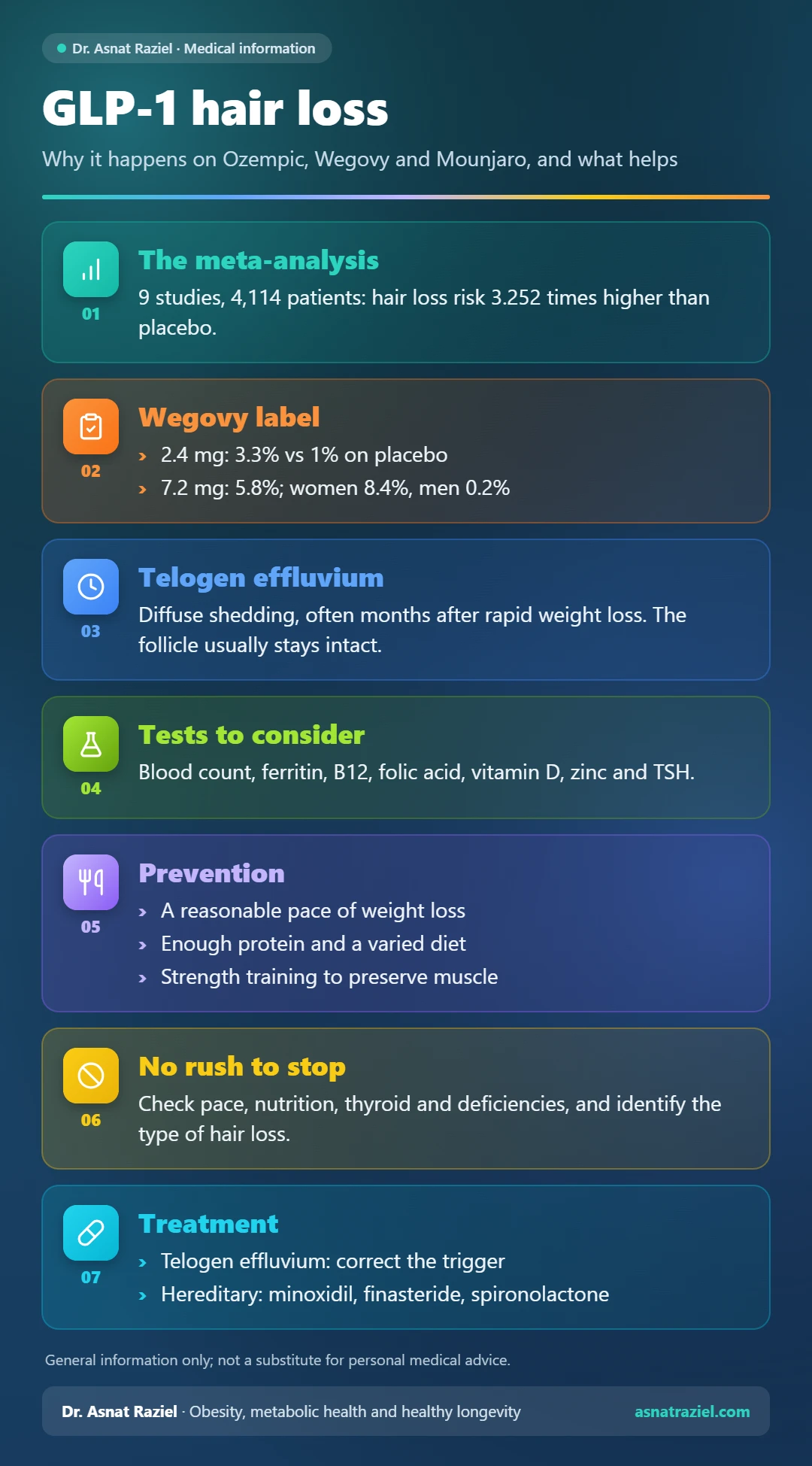
In the pooled analysis, the risk of hair loss in patients on GLP-1 drugs was 3.252 times higher than with placebo. When the researchers looked only at randomized trials in people with overweight or obesity, the ratio rose to 3.587. In addition, the overall rate of hair loss events was 3.9%.
However, it’s important to be precise. The finding shows an association, not necessarily that the drug itself causes hair loss. The study does not explain what lies behind the link. The possibilities are a direct effect on the hair follicle, the rapid weight loss, too little protein and micronutrients, or a combination of these.
What does the official Wegovy label say?
According to the updated US Wegovy label, hair loss was reported in 3.3% of patients on the 2.4 mg dose, compared with 1% on placebo. In women, the rate was 4% versus 2%.
On the new 7.2 mg dose, approved in the United States in March 2026, the rate rose to 5.8%. In women it reached 8.4%, compared with only 0.2% in men. The label states explicitly that the hair loss events were associated with weight loss. You’ll find a broad review of other effects in my article on Wegovy side effects.
In addition, a 2026 systematic review found that the strongest signals were with semaglutide and tirzepatide. The most common diagnoses were telogen effluvium and androgenetic alopecia, the hereditary, hormone-driven form of hair loss. With semaglutide, there appeared to be a dose relationship: doses below 2 mg a week barely appeared in the reports. Here, too, women stood out with a higher rate.
The likely mechanism: telogen effluvium
The hair follicle has a fixed life cycle. Anagen is the growth phase, catagen is the transition phase and telogen is the resting phase. Rapid weight loss is a known trigger for telogen effluvium. This is diffuse shedding across the whole scalp, without scarring, in which many follicles enter the resting phase at the same time.
The shedding doesn’t always appear during the weight loss itself. Sometimes several months pass between the metabolic event and the hair loss, so patients don’t always connect the two. This also explains why the phenomenon is familiar after crash diets and after bariatric surgery. The good news: according to a review of telogen effluvium, the follicle usually stays intact. So once the trigger passes, the hair usually grows back. There’s more on this in my article on the risks of rapid weight loss.
Does the drug act directly on the follicle?
This is still an open question. The link may run through the pace of weight loss, calorie restriction, low protein intake and changes in micronutrients. Even so, a direct or indirect drug mechanism can’t be ruled out. Recent reviews agree that the existing data do not separate the effect of the drug from the effect of the weight loss.
On the other hand, there are even rare reports of hair growth during treatment. Another systematic review included 626,894 patients with reported hair outcomes. Of these, 1.6% reported hair loss, and only 52 reported regrowth. In other words, there is currently no basis for calling these drugs a hair treatment. Then again, there is also no basis yet for seeing them as toxic to the follicle.
GLP-1 hair loss, protein and micronutrients
The hair follicle is a highly metabolically active tissue. That’s why sharp calorie restriction, too little protein and nutritional deficiencies can cause hair loss. With substantial weight loss, it’s important to check not only how many kilograms were lost. We also need to look at what happened to body composition and nutrition. You’ll find a practical guide in my article on protein intake during weight loss.
Depending on the clinical picture, tests to consider include a blood count, ferritin and iron markers, B12, folic acid, vitamin D, zinc and TSH, a thyroid function test. However, there is no justification for giving every patient iron, zinc, biotin or “Hair, Skin & Nails” supplements. A review on diet and hair loss points out that treating a proven deficiency is not the same as taking supplements unnecessarily. Some supplements in high doses may even worsen hair loss.
Not all GLP-1 hair loss is telogen effluvium
A common mistake is to blame all hair loss after starting a GLP-1 drug on weight loss. Telogen effluvium can unmask hereditary hair loss that was already there but wasn’t noticeable before. So when shedding goes on for a long time, it’s worth getting checked. Other signs include a widening center part, a receding hairline or hairs that keep getting finer. In these situations, an examination by a dermatologist is important, including trichoscopy, a magnified examination of the scalp. The diagnosis determines the treatment.
What can you do from the start of treatment?
Prevention doesn’t depend on a particular hair supplement, but on the quality of the weight loss. A reasonable pace, enough protein, a varied diet and strength training to preserve muscle are part of any modern drug treatment. In addition, you don’t always need to reach the maximum dose. If a low dose achieves good hunger control and a satisfactory rate of weight loss, you can stay on it. It’s also worth reading about how to preserve muscle during weight loss.
When hair loss begins, there’s no need to stop the drug. First, we check the pace of weight loss, nutrition, underlying conditions, other medications, the thyroid and possible deficiencies. At the same time, we identify the type of hair loss.
Current treatments for hair loss
In telogen effluvium, the basis is identifying and correcting the trigger. In many cases, the hair recovers on its own once things stabilize. By contrast, when there is also hereditary hair loss, the toolbox is broader.
Topical minoxidil is one of the best-established treatments. In recent years, low-dose oral minoxidil has also been used more and more, under medical supervision. For men, finasteride can be considered. In women, options include spironolactone and hormonal treatments, depending on age, underlying conditions and pregnancy plans. This is also what the consensus statement of the Spanish Academy of Dermatology recommends. In addition, PRP, microneedling, low-level laser therapy and hair transplants are available in Israel. The level of evidence differs between these treatments, so the type of hair loss determines the choice.
Hair longevity: the next generation is on its way
Research in the field is moving from treating hair loss to trying to preserve the follicle over time. One of the most advanced drugs is clascoterone 5% solution, which locally blocks the androgen receptor. Two phase 3 trials enrolled 1,465 men. In the 12-month data, those who continued treatment achieved a 2.39-fold greater improvement in hair count than those who switched to a solution without the active ingredient. The company plans to submit an application for FDA approval in early 2027.
Another direction is VDPHL01, an extended-release minoxidil pill. In a phase 2/3 trial in 519 men, hair count rose after six months by 30.3 hairs per square centimeter with once-daily dosing. With twice-daily dosing, the increase was 33.0, compared with 7.3 on placebo. In 2026, phase 2 data in women were also published: an increase of 22.7 to 23.3 hairs per square centimeter, and 88.9% to 90.0% reported improved coverage. These treatments are still in development, but they show the direction: not only stopping hair loss, but preserving the follicle. There’s more on this topic in my article on hair aging.
The bottom line on GLP-1 hair loss
Hair loss during GLP-1 treatment is neither imaginary nor anecdotal. The new meta-analysis shows a clear increase in reported risk. However, there is no proof that the main mechanism is direct damage to the follicle by the drug. For many people, the likely explanation is rapid weight loss with dietary change, which leads to telogen effluvium. In others, the shedding unmasks existing hereditary hair loss.
So the practical approach is clear. We don’t rush to stop an effective obesity treatment. Instead, we diagnose the type of hair loss, check for reversible causes, make sure protein intake and nutrition are adequate, and treat in a targeted way. Ultimately, this is the real connection between obesity medicine and hair longevity: improving metabolic health without neglecting muscle, nutrition and the hair follicle.
The information in this article is general and does not replace personal medical advice.
References
Glucagon-like peptide-1 receptor agonists and hair loss: A systematic review and meta-analysis
WEGOVY (semaglutide) – Prescribing Information
Telogen Effluvium – a review of the science and current obstacles
Effects of GLP-1 Receptor Agonists on Hair Loss and Regrowth: A Systematic Review
Diet and hair loss: effects of nutrient deficiency and supplement use
Cosmo Pharmaceuticals Reports Positive 12-Month Safety Data for Clascoterone 5% in Male AGA
Oral VDPHL01 Delivers Rapid, Robust Hair Growth in Phase 2/3 Trial for Male Pattern Hair Loss




