By Dr. Asnat Raziel, bariatric surgeon specializing in obesity treatment, metabolic health and healthy longevity; Director of the Multidisciplinary Center for Obesity Treatment, Assia Medical, Assuta Ramat HaChayal, Tel Aviv
Hair longevity: your hair ages too
Hair longevity is a new field that aims to keep hair healthy for years. It is not only facial skin that ages. Hair follicles also go through biological aging, and this affects the density, thickness, color and quality of the hair. The field is moving from treating hair loss that has already happened to a preventive approach. The goal is a scalp, follicles and hair fibers that work well throughout life. At the same time, the new research also helps separate solid science from marketing promises.
What exactly is hair longevity?
Today, the longevity world is less focused on how many years we will live. Instead, it asks how we can stay functional throughout life. Now the same principle is reaching hair. Articles in the beauty press, for example in Vogue Arabia, describe a shift from cosmetic repair of damaged hair to early care of the scalp, the follicle and the hair fiber.
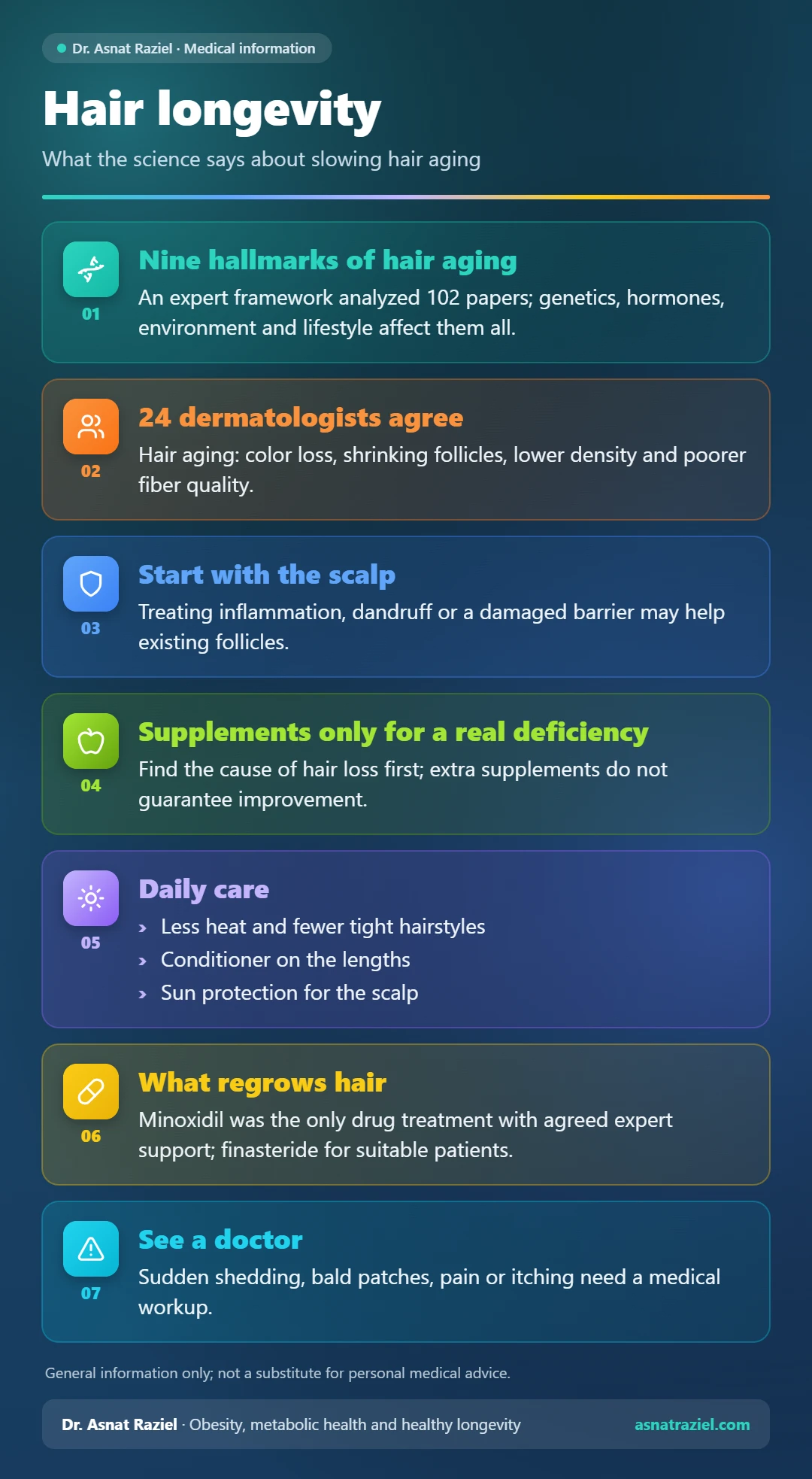
The goal is not a hair that lives forever, nor a promise that there will be no shedding. In other words, the idea is to protect the environment that hair grows from. In 2026, an international expert group published an integrative framework for hair longevity. The researchers analyzed 102 papers and defined nine hallmarks of hair aging. According to them, genetics, hormones, environment and lifestyle affect all of them.
Hair is an organ that renews itself again and again
The hair follicle is a remarkable biological structure. Throughout life, it repeats a cycle of growth, regression and rest. The growth phase, anagen, sometimes lasts for years. It is followed by a short regression phase, catagen. Finally comes telogen, the resting phase, at the end of which the hair falls out and a new cycle begins.
At the heart of this ability are the follicle’s stem cells. A recent review of hair follicle stem cell markers describes how these markers change with age. Changes in the cells and in their supporting environment may weaken the follicle’s ability to renew itself.
How does hair age?
We tend to think that hair ages when it turns gray or falls out. However, the process is much broader. A 2026 expert consensus brought together 24 dermatologists from Europe. They defined hair aging as a combination of color loss, gradual shrinking of follicles, lower density and damage to fiber quality. As a result, hair may become thin, dry and brittle over the years.
At the same time, external aging also takes place. A hair fiber that has already left the scalp cannot repair itself like living tissue. Sunlight, heat, dyeing, bleaching, straightening, pollution and friction cause damage that builds up over the years.
The same mechanisms age the body and the hair
One of the most interesting findings is the overlap between body aging and follicle aging. A 2026 review in Experimental Gerontology describes oxidative stress, DNA damage, chronic low-grade inflammation and stem cell exhaustion. In other words, the follicle is not an isolated unit. It is affected by the same processes we know from the science of skin aging. Similarly, mitochondria and aging are linked to the function of all tissues.
Aging cells may affect hair growth
Cellular senescence is one of the central topics in longevity science. Senescent cells have stopped dividing normally, but they remain in the tissue and release substances that affect their surroundings. A review of cellular senescence and androgenetic alopecia suggests a possible link between oxidative stress, aging of dermal papilla cells and stem cells, and baldness. This is a fascinating direction. Even so, there is currently no proven, approved senolytic treatment that “rejuvenates” hair follicles in humans.
Hair longevity starts with the scalp
One important change in thinking is the shift from the hair itself to the environment where it forms. The follicle sits inside the skin, and blood vessels, immune cells, fibroblasts, sebaceous glands and the extracellular matrix all affect it. A review of the follicle environment suggests that scalp aging and follicle aging progress together.
A healthy scalp does not guarantee new hair growth. But treating inflammation, dandruff, irritation or a damaged skin barrier may create a better environment for existing follicles.
Hair longevity and antioxidants
Oxidative stress is one of the mechanisms of hair aging. So it is no surprise that the cosmetics industry focuses on antioxidants. In a 24-week randomized, double-blind, placebo-controlled trial, participants used a shampoo and a scalp product with antioxidant and barrier-supporting ingredients. Compared with placebo, shedding decreased, hair counts rose and scalp condition improved. It is worth knowing that the cosmetics company that made the product funded the study.
That said, not every serum labeled “antioxidants” extends the life of your hair. Its effectiveness depends on the ingredients, concentrations and formulation, and on the quality of research on the product itself.
Nutrition and hair: more supplements are not necessarily better
Hair is a very metabolically active tissue, so nutritional deficiencies can harm it. For example, iron deficiency and low protein intake may contribute to hair loss in some people. A review of a holistic approach to hair longevity brings nutrition, metabolism, stress, scalp health and related diseases into one model.
But that is a long way from a lengthy list of hair longevity supplements. A supplement may help when there is a true deficiency. On the other hand, taking it needlessly does not guarantee improvement and is sometimes even harmful. Therefore, with significant hair loss, it is better to find the cause first rather than automatically start biotin, iron or other supplements. People on weight loss injections can also read about hair loss during weight loss.
Sleep, stress and metabolic health
The hair longevity approach widens the picture beyond the scalp. Illness, hormonal changes, nutrition, medications and major physical stress affect the hair cycle and can cause shedding. That is why reviews in this field propose a model in which hair health is tied to the health of the whole body. A balanced diet, physical activity, good sleep, treating underlying conditions and managing stress are not a cure for baldness. However, they are part of the environment in which the follicle works. If you are taking a weight loss drug, see my article on hair loss on Ozempic, Wegovy and Mounjaro.
A hair longevity routine: daily care matters too
Much of the damage to existing hair is cumulative damage to the hair fiber. Constant high heat, repeated bleaching, straightening, tight hairstyles and friction all increase breakage. Thus, the daily routine can be fairly simple:
- Wash according to your scalp’s needs.
- Use conditioner on the lengths of your hair.
- Limit unnecessary heat exposure.
- Avoid chronic pulling and tight hairstyles.
- Protect exposed areas of the scalp from the sun.
So what can actually regrow hair?
Here it is important to separate cosmetic longevity from medical treatment of hair loss. In the expert consensus, minoxidil was the only drug treatment with agreed support. In contrast, new treatments that target follicle aging still need more research. It is worth knowing that a commercial company funded the consensus.
For androgenetic alopecia, there are other medical options. A recent review of androgenetic alopecia treatments proposes an algorithm for choosing treatment by severity. For example, doctors choose finasteride only for suitable patients, based on sex, age, diagnosis, other conditions and fertility plans. Bottom line: hair longevity does not replace a medical diagnosis. Vichy Laboratories has also published a talk on hair longevity for those who want to dig deeper.
Peptides and future treatments
One intriguing area is the development of compounds that act directly on the follicle environment. In 2026, a preclinical study of a cell-penetrating peptide called DualPep-ALO was published. The researchers tested it in cells and in samples of human scalp tissue. The peptide reduced inflammatory markers, restored antioxidant enzymes and elongated the follicles, similar to minoxidil. The results are interesting, but only human trials will show whether the peptide is effective and safe. You can read about the broader direction of this field in the article on peptides in medicine.
In addition, another 2026 study examined a topical product that combines finasteride and peptides. In mice, it promoted hair growth at a level similar to or higher than 5% minoxidil, using about 40 times less finasteride than the oral dose. Here too, this is a promising technology, and not yet a clinical treatment for routine use.
When does hair loss need a medical workup?
Sudden shedding, significant thinning, bald patches, pain, inflammation or unusual itching of the scalp all call for an exam. They should not be blamed automatically on aging. The cause may be androgenetic alopecia, a nutritional deficiency, a hormonal disorder, an autoimmune disease, a medication, an acute illness or physical stress. In such cases, the right diagnosis matters far more than the newest serum.
Bottom line: does hair longevity really work?
In a sense, yes, but not the way it is sometimes marketed to us. We cannot stop time, and we cannot cancel out our genetics. Still, we can reduce cumulative damage to the fiber, treat scalp problems, identify deficiencies and diseases, and start medical treatment when there is real hair loss. The field’s key innovation is a change in mindset. Rather than waiting until the hair thins, we protect the scalp, follicle and fiber throughout life.
As with the body’s biological age, the goal here is not eternal youth. Instead, the goal is function, quality and resilience over time, with a clear line between evidence-based care and a product that has adopted the magic word “longevity.”
The information in this article is general and does not replace personal medical advice.
References
Why Hair Longevity is Beauty’s Next Obsession (Vogue Arabia)
A novel framework for integrative hair longevity management
An updated guide to hair follicle stem cell markers and changes in their expression with aging
Co-regulatory mechanisms of skin and hair aging
Hair Longevity – Evidence for a Multifactorial Holistic Approach to Managing Hair Aging Changes
Cellular Senescence: Ageing and Androgenetic Alopecia
Getting under the skin of hair aging: the impact of the hair follicle environment
Topical Carrier-Free Delivery of Finasteride and Peptides for Enhanced Hair Growth
Olistic funded the consensus, and Procter & Gamble conducted the antioxidant trial.




