By Dr. Asnat Raziel, bariatric surgeon specializing in obesity treatment, metabolic health and healthy longevity; Director of the Multidisciplinary Center for Obesity Treatment, Assia Medical, Assuta Ramat HaChayal, Tel Aviv
These are the obesity treatment questions I hear most often in my clinic: fifty of them, from the risks of medication to its benefits, and from body image to the emotional side of weight loss. Here are my answers, honest and at eye level, with everything you need to know.
Obesity treatment questions about medication and safety
1. Aren’t obesity drugs dangerous?
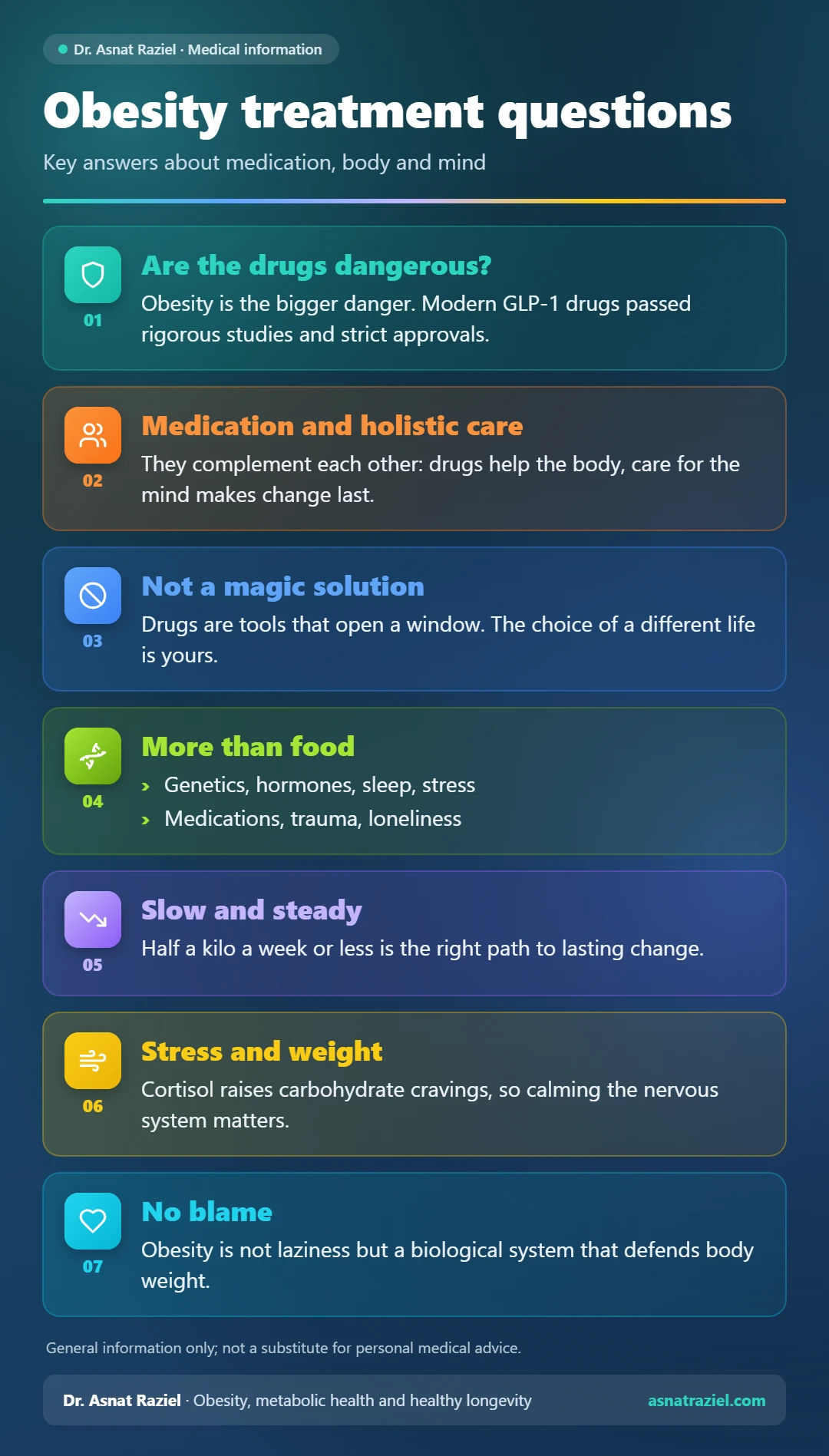
Actually, it is obesity that is dangerous. It is a major risk factor for diabetes, heart disease, fatty liver, fertility problems, chronic inflammation and cancer. Modern drugs such as GLP-1 agonists have gone through rigorous studies that proved their effectiveness and safety, and they have received strict regulatory approvals.
In the head-to-head trial of Mounjaro versus Wegovy, as reported by the Israeli daily Israel Hayom (in Hebrew), the main side effects were digestive, such as nausea and diarrhea.
The real risk is not treating. When drugs are used as part of a complete treatment process, with medical, nutritional and emotional support, they do more than help with weight loss. They also improve overall health and extend life. Recent studies point to a significant drop in the risk of cardiovascular disease, better insulin resistance measures and even a beneficial effect on the liver.
There is a tendency to think of drugs as a “shortcut” or a magic solution, but the opposite is true. Drugs are a bridge that helps patients break the cycle of failure and start real change. When they are given thoughtfully, as part of a broad look at the patient and not as the only solution, they can turn the process from impossible into achievable and sustainable.
2. How does drug treatment fit with a holistic approach? Isn’t that a contradiction?
Not only is it not a contradiction, it is a complement. Good drug treatment works on the body. However, without attention to the mind and spirit, the change will not last. A woman who spent years learning to hide herself, to undervalue herself or to eat so as not to feel will not heal from an injection alone.
The holistic approach asks what this person really needs: touch, belonging, sleep, movement, hope, boundaries. The drug is just one of the tools. Real healing happens when we treat the whole person, not just the kilograms.
Drug treatment for obesity is like a ladder someone hands you when you are trying to climb an especially smooth wall. It does not cancel the need to climb, but it gives you a real starting point. Modern drugs are based on a deep understanding of the biology of hunger, the brain’s responses to food and hormonal regulation. These are areas you cannot overcome with willpower alone.
For drug treatment to succeed, we need to understand that we are dealing with a whole person, not just a weight. This is where the holistic approach comes in. What makes someone eat at night? How does she relate to her body? What did she go through in childhood? Where does she put herself in her list of priorities? By addressing both body and mind, we can build deep change that lasts over time, and not just another painful diet that fails.
3. You are a doctor who treats obesity. Why do you deal with the mind and spirit at all?
Because body and mind are not two separate parts; they are one system. I am a doctor who believes in science, but I also know the power of touch, of listening and of a change in perspective. In obesity medicine, if we do not also address the emotional wounds, we miss the heart of the disease.
Real health includes sleep, calm, a sense of meaning, relationships and self-love. If I want to heal, and not just measure BMI, I cannot afford to ignore the mind. This is not a departure from medicine; it is an expansion of it.
Body image, first steps and the emotional side
4. What do you think of today’s beauty ideal?
The current beauty ideal hurts almost all of us. It reduces women to sizes, filters and illusion. It does not really aim for health. Instead, it breeds guilt, judgment and constant comparison.
I believe in beauty that comes from vitality, presence and a sparkle in the eyes. Beauty is born from loving yourself, not from fighting yourself. Obesity treatment should not be a journey toward a “perfect body”. Rather, it should be a return home, to a healthy and compassionate body.
5. Should every woman aim to be thin?
Not at all. Not every woman needs to be thin, but every woman deserves to feel good in her body: to get up without pain, breathe easily, sleep well and live with energy. Sometimes that requires weight loss, but not out of self-hatred.
The goal is not to make the body smaller but to make the quality of life bigger. When that is the focus, change happens not out of war but out of choice, freedom and love.
6. What is the first thing you tell someone who wants to lose weight?
First of all, that I am here with you. You are not alone, and you do not need to prove to me that you are serious. You have nothing to be ashamed of, and you do not need to “start a diet before the appointment”.
I want to understand your story, your body and the life experiences that brought you here. Only from there can we build a plan that truly suits you, one you can live with rather than suffer through.
7. How can obesity treatment change a life? Do you have an example?
Not a week goes by without a tear in my eye. I have seen women go back to hiking with their grandchildren, climb stairs without gasping, stop taking insulin, go on a first date after a decade, and look in the mirror and say, “I love who I see.”
Weight is only a symptom. When we truly treat it, the body is freed, and the mind blossoms too. The change is not only in the number; it is in self-worth, identity and hope.
8. What do you do when someone has already tried everything against obesity and nothing worked?
I believe her. She will not hear “you didn’t stick with it” from me, and I do not doubt her pain. Instead, I listen and look deeper. Perhaps there is a hormonal disorder, perhaps metabolic resistance, perhaps a trauma that no one has talked about and that sabotages every attempt.
Then I invite her to try again, but not in the same way. Not with a harsh diet or with shame. Instead, with a gentle, scientific, holistic approach that recognizes the load she carries and the power she has to change, this time for real.
9. How important is the environment in the weight loss process?
The environment is critical. Women do not gain weight in a vacuum. A stressful workplace, a critical partner or dismissive friends can all sabotage any process. On the other hand, a kind word, a hug or a partner on the journey can lift you up when you break.
In treatment, I sometimes start not with a change in diet but by creating a supportive circle: a friend, a group, an empowering WhatsApp group. Because when someone believes in you, you start believing in yourself too.
10. Is it even possible to lose weight without focusing only on food?
Absolutely, and it is even a good idea. Obesity stems from much more than unhealthy eating. Sometimes weight loss actually begins with regular sleep, gentle movement, less stress or a deep emotional conversation.
When we focus only on food, we miss the root of the problem. When we widen the view, we get weight loss that is stable, balanced and respectful. Less calorie counting, more listening inward.
11. What do you think is the biggest barrier for women with excess weight?
The belief that it is their fault. Most of the women who come to me have already despaired, not of their bodies but of the judgment: from those around them, from doctors and from themselves. They carry years of failures, but no one taught them that it is not just a matter of willpower.
The biggest barrier is not the weight but the shame. The moment a woman understands that she has a right to healing, that not everything depends on her and that she can ask for help without apologizing, that is where real weight loss begins, from the inside out.
12. In obesity treatment you use both medication and conversation. What do you really think works?
The combination. Medication without conversation is like an engine without a steering wheel: you may move, but you will lose direction. Conversation without medication is sometimes simply not enough. When we combine the two, the body gets support and the mind opens up to change.
The magic happens when a woman starts to feel different: less hungry, less tired, less overwhelmed. Then she has room to think, to ask and to choose differently. It is not a question of either-or. It is medicine of both-and.
13. Do you need emotional therapy to lose weight?
Not always, but often yes. Food is often a solution, not the problem. It helps us forget, calm down or feel something. When we treat only the eating, without understanding what it is trying to solve, the change does not last.
Emotional therapy does not have to mean years of deep psychology. Sometimes it is simply an eye-level conversation, an acknowledgment of the pain and the identification of patterns. When we address the emotion, there is a real chance of healing, not just a temporary diet.
14. What do you wish for a patient who starts a process with you?
I wish for her to stop fighting herself. May she turn this path from a journey of struggle into a journey of healing, curiosity and compassion. And may she learn to listen to her body not as an enemy but as a guide.
I wish for her not only to lose weight but to gain self-worth, courage and the life she wants to live. And I hope she does not do it alone, but with a supportive, professional hand that reminds her at every stage: you can do this.
15. What is the most moving thing a patient has said to you after treatment?
“You didn’t just save my health; you saved my motherhood.” She was a young woman who suffered from chronic fatigue, had trouble lifting her children and felt enormous frustration. She did not want to be thin; she wanted to get back to life.
When her body was freed, she started to smile, laugh and play. This is not just weight loss; it is a return to herself. To me, there is nothing more moving than the moment a woman looks at herself and says, “I’m breathing again.”
Obesity treatment questions about myths and facts
16. Is obesity only about food?
Not at all. Food is only a symptom. Obesity stems from a combination of genetics, medical history, habits, trauma, hormones, sleep, stress and medications, and very often loneliness too.
Trying to reduce all of this to “overeating” misses the depth of the problem, and therefore the solution as well. Real obesity treatment must be broader than the menu and must see the whole person.
17. Are obesity drugs a magic solution?
No. There is no magic; there are tools. Good drugs are like opening a window in a house that has been closed for years. They help the body do what it already wanted to do: calm down, regulate and let go of the excess. But they do not change your life on their own.
If a woman takes a drug such as Mounjaro but keeps fighting her body, sleeps two hours a night and carries guilt and loneliness, she will feel relief, but not healing. The drug helps, but the choice of a different life is yours.
18. Don’t people who gain weight simply not try hard enough?
What a painful mistake. The women who come to me have usually tried ten times harder than anyone. They have tried diets, fasting, sports, supplements and shame, only to discover that it does not work.
Obesity is not the result of laziness. Rather, it comes from a powerful biological system that defends body weight. Instead of blaming, it is time to understand. And then, to offer empathetic, professional, science-based treatment. No more blame, only partnership.
19. Can you lose weight without touching the mind?
You can, but it usually does not last. When a woman ignores the pain, the emptiness and her self-image, she may lose weight, but her suffering will grow.
Outer change needs to come together with inner change. Not deep psychotherapy, but a pause, listening and respect for the process. When someone gets thinner only on the outside, she may stay hungry on the inside.
20. Isn’t depression unrelated to obesity?
It is very much related. Obesity can lead to depression, and depression can lead to obesity. It is a circular system, both biological and emotional. Often, food is self-medication: for quiet, for numbness, for comfort.
In obesity treatment, if we do not also identify depression, we miss the root. And when a woman receives real treatment, sometimes the first thing that heals is not the body at all, but the sadness, the feeling of being stuck and the hopelessness. From there, everything starts to change.
21. Is obesity in children a phase that will pass?
Not always. Some children do grow taller and their weight balances out. In some cases, however, obesity gets worse over time and predicts obesity in adolescence and adulthood as well. What is even more worrying is not only the weight but the feelings it creates: shame, social exclusion and a lower self-image.
The earlier we intervene, with a gentle approach, without blame, and with an emphasis on activity, family nutrition and emotional support, the sooner we can stop the cycle before it becomes a chronic problem. It will not “pass on its own”, but it is not fate either.
22. Is genetics in obesity just an excuse?
Not at all. Genetics is part of the story, neither an excuse nor a verdict. Some people are born with a system that reacts more strongly to hunger, fat and stress. But that does not mean they are helpless. It means we need to understand their biology and tailor a response to it.
The great news of recent years is that medicine knows how to work around “genetic fate” with drugs, personal guidance, changes in habits and a supportive environment. Instead of fighting genetics, we can work with it.
23. Is everyone with excess weight unhealthy?
Not true. Some people with excess weight are completely healthy, physically and mentally. On the other hand, some people of normal weight suffer from serious metabolic diseases.
It is important to say, though, that the higher the excess weight, especially with belly fat, the higher the risk of disease. That is why we do not judge by numbers alone. Health is measured as a whole: blood pressure, sleep, blood sugar, emotional state and general function. Most important of all is quality of life.
24. Doesn’t hormonal treatment affect weight?
Hormonal treatment can certainly have an effect, for better or worse. Birth control pills, fertility treatments, menopause and an underactive thyroid all change metabolism, the feeling of hunger and fullness and sometimes fat storage too.
When weight changes, it is important to check the hormonal background, not just the menu. And there is good news too: today there are treatments that balance hormones and make weight loss easier, without suffering and without feeling that your body is “betraying” you.
25. If it is not a kilo a week, does that mean it is not working?
The opposite is true. Weight loss that is too fast is not only hard to maintain; it can also harm muscle mass, metabolism and mental health. Slow, steady weight loss of half a kilo a week, or even less, is the right path to lasting change.
Success is not measured in kilograms but in the ability to keep going, feel good and stay active. This is not a competition; it is a life process. Every kilogram you lose is the result of courage, consistency and choosing yourself.
26. Isn’t a holistic approach just mysticism?
No. Holistic care is not a spiritual buzzword. It is a medical worldview that understands that a person is much more than a number on a blood test. It means combining body and mind, medication and conversation, movement and relationships.
A holistic approach is not the opposite of science; it is science with compassion. It allows us to treat the root and not just the symptom, and to understand why someone binge eats, not only what she ate. And when we treat a person as a whole, wonderful things happen.
Fears, setbacks and starting medication
27. What do you tell a patient who is afraid of obesity medication?
First of all, I listen to the fear. It is natural and understandable. I ask what exactly she is afraid of. Side effects? Addiction? Dependence? Then I explain patiently, with facts and without pressure.
I tell her the drug is a tool, not a life sentence. If we use it correctly, with attention and close medical follow-up, it can help her not only lose weight but also take back control of her life. The choice is always hers. I am here to guide, not to force.
28. What will you do if someone stops losing weight despite treatment?
I will investigate, not blame, because the body does not always respond the way we expected. Perhaps the dose is not right, the body has developed tolerance, or there is a hormonal, emotional or environmental reason that no one took into account.
Together, we will understand what is happening and adjust course. Sometimes we will switch drugs, add movement or deepen the conversation. Every deviation from the path is an opportunity to fine-tune. I do not give up on any patient, even when the road is stubborn.
29. How do you combine obesity treatment with the rest of life? Doesn’t it take over everything?
Quite the opposite. The right treatment does not take over; it sets you free. It gives you more energy, more headspace and fewer intrusive thoughts about food.
I do not want anyone to live around a diet; I want her to live. Good treatment does not pull you in. Instead, it brings you back to the world: to your family, your work and yourself.
30. What is your most important tip for someone who has already given up?
Do not start another diet; start a conversation. About what you are going through, what you have tried, what hurt, what works for you and what no longer does.
Women who have given up are usually brave women who tried for too long on their own. The moment they get a supportive hand, the right plan and a personal fit, they remember their own strength. My tip? Give yourself one more chance, but this time, in a different way.
31. Do you need to lose weight to be loved?
No. True love is not given in exchange for weight; it is not a contract or a prize. At the same time, when a woman loses weight, she often allows herself to love and be loved. Not because she changed, but because she suddenly believes she deserves it.
The goal of treatment is not to “win a relationship”. Rather, it is to restore your relationship with yourself, and everything else then comes from a healthy, loving place.
32. Why do I gain weight precisely when I am stressed?
Stress affects the brain just like hunger does. It activates hormones such as cortisol, which increase cravings for carbohydrates and weaken regulation. Sometimes it even slows weight loss despite a healthy diet.
To really lose weight, you also need to calm the nervous system. That means not only what you eat, but also how you breathe, when you rest and whether you have a safe place in your life.
33. Do you have to exercise to lose weight?
You do not have to, but it is worth it. Physical activity does more than burn calories. It strengthens muscles, improves mood, protects metabolism and helps maintain weight loss over time.
But movement is not a punishment. It does not have to be a gym. It can be dancing, walking, yoga or anything that feels good to you. Slowly and gradually, it adds up and brings the body back to natural movement.
34. Why is it hard for me to keep the results over time?
Because your body does not want to give up weight easily; it sees it as a matter of survival. After weight loss, the brain raises hunger and lowers calorie burning. It is not your fault; it is biology.
That is why, in the right treatment, we do not only lose weight; we also learn how to maintain it. We do this with supportive medication, professional guidance and small changes that take root, not harsh rules that come crashing down.
35. Can obesity treatment strengthen self-confidence?
Definitely. Not because weight determines your worth, but because a process of healing, change and new habits builds renewed belief in yourself.
When a woman manages to regain control, feel good in her body and stop apologizing for who she is, her self-confidence is not “built”; it is simply rediscovered.
36. When should you start drug treatment for obesity?
When you feel you have exhausted all the other ways on your own, and something inside your body keeps pulling you back to a place that no longer suits you.
Drugs are not a quick fix, but they can free you from the daily struggle and make room for real change. The right time to start is when you feel ready for help and no longer want to do everything alone. You can read more in my guide to weight loss medications.
Obesity treatment questions from everyday life
37. Does a change in diet always have to be drastic?
Not at all. Small, daily, thoughtful changes are the ones that last. When someone changes everything in one day, it usually ends in frustration.
I believe in gentle change: start by eating breakfast, add one vegetable a day and notice when you are truly hungry. It adds up, and it works.
38. Why am I hungry even when I am full?
Because hunger is not only physical. It is emotional, mental and often biochemical too. When the brain is confused, when sleep is poor or when there is an emotional gap, eating comes to fill a hole left by something else.
Together, we learn to listen to this hunger and understand what it really wants. Then you can start to choose, and not just react.
39. Should I tell my family about the treatment?
It depends. If your family is supportive, sharing can be a tremendous source of strength. But if there is shame, judgment or a lack of understanding, it is better to wait or to share with other people who can hold it.
The key is choice. Who gives you strength? Who makes you feel small? You do not owe anyone an explanation, but you do deserve support, a hug and someone to have your back.
40. Is obesity treatment a one-time thing or an ongoing process?
It is a process. Not only because the body changes gradually, but because it is a journey of self-discovery. Sometimes there are pauses, drops, rises and adjustments.
But that does not mean failure; it means you are in a real process. One that does not end when you reach a goal, but continues once you have turned the path into life itself.
41. Is it possible to lose weight at 50 and beyond?
Of course. It may be a little slower, because metabolism changes over the years and there is sometimes a hormonal or medical background. However, it is entirely possible.
Many women manage to lose weight precisely at this age, out of maturity, understanding and a real desire to take care of themselves after years of caring for others. Treatment is tailored to age, abilities and health status, but healing has no expiration date.
42. Is it okay to make mistakes along the way?
It is okay, and even expected. A real process of change includes ups and downs, falls and lessons. Whoever does not make mistakes does not move.
I always tell my patients: the fall is not the problem; what matters is how you choose to get up. The secret is not perfection but gentle persistence, flexibility and the belief that this is part of the journey.
43. Why do I feel guilty after every meal?
Because for years we were taught that food is the enemy, a calorie is a sin and a snack is a failure. This guilt is not natural; we learn it.
In treatment, we take the guilt apart and reconnect eating with pleasure, nourishment and compassion. Food is not a test; it is part of life. You deserve to eat without judging yourself for every bite.
44. Do I have to weigh myself all the time to see results?
Not at all. Weight is just one measure, and not always the most accurate one. Sometimes the body changes even without a drop in the numbers: measurements, energy, sleep and a sense of control.
Some patients even give up the scale completely and focus on how they feel. And I am there to remind them: you are not a number; you are a story.
45. Should I want to lose weight, or simply learn to accept myself?
Both answers are right, and they do not contradict each other. True self-acceptance does not mean giving up. It means starting from a place of respect.
If you choose to lose weight because you want to feel good, breathe deeply and move freely, that is a process of self-love. Not out of hatred for the body, but out of a desire to live in it better.
46. Does all excess weight require medical treatment?
Not necessarily. Medical treatment is needed when there is an effect on health, quality of life or daily function. If you live well, are healthy and at peace with yourself, there is no need to intervene.
But if you are suffering, physically or emotionally, you deserve help. And no matter what your weight is, you do not need to suffer in order to “earn” treatment.
47. Why do I lose weight and then stop, again and again?
Because the body tries to hold on to what it knows. It is an ancient survival mechanism, not your failure. Add stress, old habits or an unsupportive environment, and it is very easy to get stuck.
In treatment, we build a process that prepares you for the plateaus too, not only for the drops. This is not just a question of willpower; it is a question of a smart, precise support system.
48. What helps you keep going?
Persistence does not come from motivation; it comes from habit. And to build a habit, the path has to feel good: tasty food, good conversation, realistic goals and a sense of success.
When the process fits your life, and not the other way around, you are not “trying hard to stick with it”; you are simply living differently. That is exactly what we build together.
49. Does every doctor understand obesity?
Unfortunately not. Obesity is a specialized field, with science, physiology, medications and emotional care that require broad, up-to-date knowledge. Many doctors still see it only as a matter of “eating wrong”.
This is changing, thanks to a community of doctors who specialize in obesity treatment, like me. And my dream? That every doctor will learn to see the whole person, not just the BMI.
50. What do you think of the phrase “just pull yourself together”?
I think it is wrong and hurtful. It assumes that if a woman has excess weight, she must not be doing enough, not trying and not in control. And that is simply not true.
I meet brave, dedicated, smart women who do not succeed despite all their efforts. I do not tell them “try harder”. Instead, I tell them: “Let’s understand you, and find a new way.”