By Dr. Asnat Raziel, bariatric surgeon specializing in obesity treatment, metabolic health and healthy longevity; Director of the Multidisciplinary Center for Obesity Treatment, Assia Medical, Assuta Ramat HaChayal, Tel Aviv
Eloralintide and food noise: a new study from ObesityWeek
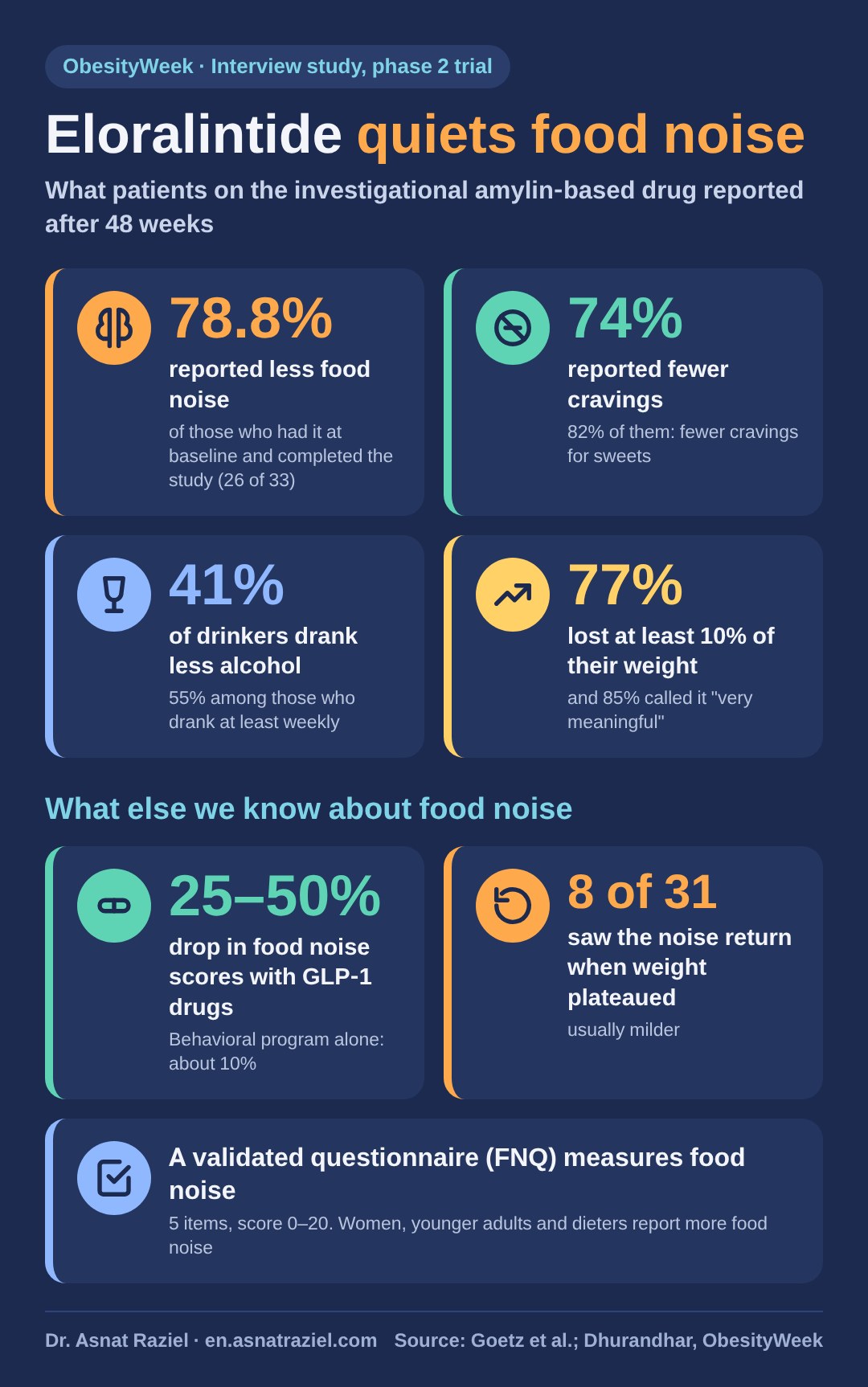
Eloralintide is a new investigational drug from the amylin family, given as a once-weekly injection. At ObesityWeek, researchers presented an interview study with participants in the phase 2 trial of eloralintide. The study looked beyond the kilograms lost and asked what changed in people’s minds. Among patients who had “food noise” at the start and completed the study, 78.8% reported an improvement. 74% reported fewer cravings, mostly for sweets, and 41% of those who drank alcohol said they drank less.
Food noise means persistent, intrusive thoughts about food that keep going even without hunger. I wrote in detail about its definitions, the questionnaires and what GLP-1 drugs do to it in my article on food noise at ObesityWeek. This time, the same question is asked about a drug that works through a different mechanism.
What is eloralintide?
Amylin is a hormone released by the pancreas together with insulin, and it helps create the feeling of fullness. Eloralintide selectively activates the amylin receptor. The phase 2 trial, published in The Lancet, enrolled 263 adults with obesity or overweight. All had at least one weight-related condition, and none had type 2 diabetes. After 48 weeks, average weight loss ranged from 9.5% to 20.1% depending on the dose, compared with 0.4% on placebo. The most common side effects were gastrointestinal symptoms and fatigue, mostly mild to moderate and more frequent at higher doses. The drug is now in phase 3 trials and is not yet available. I covered all amylin-based drugs in my article on amylin-based drugs, and the combination with Mounjaro in my article on eloralintide and tirzepatide.
How the interview study worked
As part of the trial, about 100 of the 263 participants (101 at baseline) took part in in-depth interviews. The researchers interviewed them at three time points: before treatment, after week 2 and at the end, after week 48. Participants received different doses of eloralintide (1 to 9 mg) or placebo, and did not know which. At each interview, the researchers reminded them of their earlier answers to limit recall bias. Note that food noise was identified from the interviews themselves, not with a validated questionnaire.
Most interviewees were women (74%), with an average age of about 48. Average weight was 109.5 kg, and average BMI was 38.8. Their background will sound familiar to anyone who treats obesity:
- All of them (100%) had tried to lose weight before, and 43% had been trying for ten years or more.
- 95% had tried dieting and 90% had tried exercise.
- 84% had regained weight after earlier attempts.
- 64% said they would be satisfied with treatment only if they lost at least 10% of their weight, and half wanted to lose 15% to 25%.
The results through patients’ eyes
Among the 69 participants who received eloralintide and completed the exit interview:
- 77% lost at least 10% of their body weight by week 48.
- 85% described their weight loss as “very meaningful”.
- 87% said they reached the goal they had set for themselves.
Eloralintide and food noise: the thoughts quiet down
At baseline, 55% of interviewees (55 of 101) described food noise, such as constant thoughts about food and obsessing over it. Among patients on eloralintide who had food noise and completed the study, 78.8% (26 of 33) reported an improvement. Interestingly, ten more participants who had not described food noise at the start said at the end that their food thoughts had eased. One participant put it this way: “It doesn’t consume my thoughts throughout the day, like it used to.”
Fewer cravings, especially for sweets
At baseline, 80% of interviewees reported food cravings in the past month. The most common craving was for sweet foods (80%), followed by salty foods (43%) and carbohydrates (33%). At the end of the study:
- 74% (51 of 69) of patients on eloralintide reported fewer cravings, and 82% of them reported fewer cravings for sweets in particular.
- 23% reported no change.
- 10% (7 participants) reported different or more cravings. But for five of them, the new cravings were for healthier choices.
Eloralintide and alcohol: less urge to drink
74% of patients on eloralintide (51 of 69) drank alcohol at baseline. At the end, 41% of them said they drank less, describing a lower “urge”, “craving” or “desire” to drink. 53% reported no change, and 6% (three participants) said they drank more. The effect stood out among people who drank at least once a week: 55% of them said they drank less. Among those who drank less often, the rate was 23%. None of the 18 participants who did not drink at baseline started drinking.
Why might this happen?
The researchers suggest that amylin affects not only fullness but also the brain’s reward pathway. That same pathway is involved in reactions to food cues, alcohol and addictive substances. So one mechanism may explain both the quieter food thoughts and the lower urge to drink. I explain the mechanism in my article on amylin and obesity.
Important limitations
- This is a qualitative study based on participants’ own reports in interviews, not on a validated questionnaire or an objective measure.
- The data presented do not include a full numerical comparison with the placebo group, and each subgroup is small.
- The study took place only in the US, and most of the researchers work for Eli Lilly, the drug’s maker.
- With GLP-1 drugs, food noise returns in some patients when weight plateaus. We do not yet know what will happen with long-term eloralintide treatment.
What you can do today
Eloralintide is still in trials, but food noise is not your fate, and effective tools exist today:
- Name it: the Food Noise Questionnaire (FNQ) is a short, validated five-item questionnaire. Ask your doctor or dietitian about it. It is a good start for a conversation and a way to track change.
- Existing drugs: semaglutide, tirzepatide and the oral pill Foundayo. In many patients they reduce food noise as well as weight. Your doctor will help you choose.
- Combining medication with behavioral and nutrition support reduces food noise more than behavioral support alone.
- If the noise returns when your weight plateaus, that is not failure. It is the time to step up support, not to stop treatment on your own.
- Enough sleep, regular meals with protein and awareness of alcohol all help regulate hunger and fullness.
Bottom line: eloralintide and food noise
In this interview study, patients on eloralintide described fewer intrusive thoughts about food, fewer sweet cravings and less urge to drink alcohol. The findings point to an effect of amylin on the brain’s reward pathways. The data still rest on self-report and need confirmation in controlled studies. But the direction is encouraging: obesity treatment is no longer only about kilograms, but also about quiet in the mind. Meanwhile, existing tools already help many patients.
The information in this article is general and is not a substitute for personal medical advice.
References
Lilly: eloralintide Phase 2 results
What Is Food Noise? A Conceptual Model of Food Cue Reactivity. Nutrients. 2023
Food noise: Conceptual, methodological, and ethical considerations. Appetite. 2026
This article is based on the poster The Impact of Eloralintide on Food Noise, Food Cravings, and Alcohol Consumption for People With Obesity: a Qualitative Study of Phase 2 Trial Participants (Goetz I, Liberato A, Coskun T, Kanu C, Lee CJ, Mather K, Karn H), presented at ObesityWeek, and the data were checked against the original study.