By Dr. Asnat Raziel, bariatric surgeon specializing in obesity treatment, metabolic health and healthy longevity; Director of the Multidisciplinary Center for Obesity Treatment, Assia Medical, Assuta Ramat HaChayal, Tel Aviv
Continuing obesity treatment after Wegovy or Mounjaro
Continuing obesity treatment after Wegovy or Mounjaro is one of the most common questions in my clinic. A new Cleveland Clinic study of more than 20,000 patients gives a clear answer. People who kept up some form of treatment held on to substantial weight loss. In contrast, people who stopped all treatment kept only 4% weight loss.
The good news is that there are several good ways to keep going. Every path that continued treatment did much better than stopping. So the real question is not “continue or stop”, but which way of continuing suits you.
What the study looked at
Hamlet Gasoyan, PhD, led the Cleveland Clinic study. Ali Aminian, MD, director of its Bariatric and Metabolic Institute, also took part. The study appeared in eClinicalMedicine and was presented at ObesityWeek near Washington, D.C.
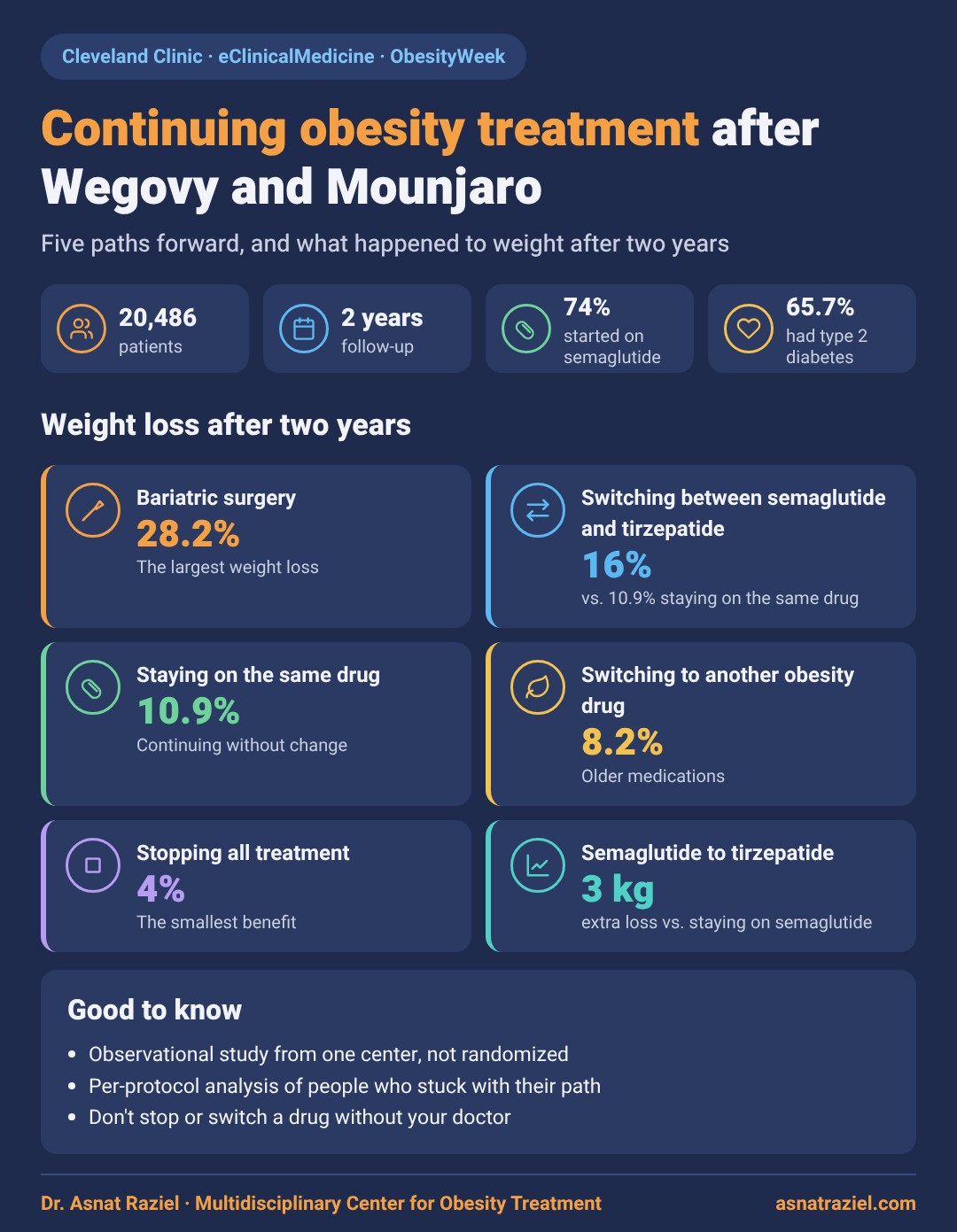
The researchers analyzed the health records of 20,486 patients with obesity or type 2 diabetes. All of them took semaglutide (Wegovy, Ozempic) or tirzepatide (Mounjaro). The average age was 56.7, and 63% were women. In addition, 68% had high blood pressure, and 65.7% had type 2 diabetes. Most participants, 15,154 (74%), started on semaglutide, and the rest, 5,332 (26%), on tirzepatide. All had taken their first drug for at least three months. They started treatment between 2021 and 2023 and were followed through the end of 2025.
The team used a method called target trial emulation, which mimics a controlled trial using real-world data. They compared five ways forward and tracked weight for two years:
- Staying on the same drug.
- Switching between semaglutide and tirzepatide.
- Switching to another obesity medication.
- Bariatric surgery.
- Stopping all treatment.
The results: continuing obesity treatment beats stopping
After two years, the differences between the groups were large. These figures come from the per-protocol analysis, which includes people who stuck with the path they chose:
Bariatric surgery: 28.2% weight loss.
Switching between semaglutide and tirzepatide: 16% weight loss.
Staying on the same drug: 10.9% weight loss.
Switching to another obesity medication: 8.2% weight loss.
Stopping all treatment: only 4% weight loss.
HbA1c (average blood sugar over the past three months) and blood pressure followed a similar pattern. In people with diabetes, surgery brought the greatest improvement in blood sugar.
Switching between the drugs: which direction?
One of the most interesting findings concerns the direction of the switch. Semaglutide starters who switched to tirzepatide lost about 3 kg more than those who stayed. On the other hand, for tirzepatide starters, staying on it beat switching by 4.5 kg.
In other words, moving from Wegovy to Mounjaro may add weight loss, while switching the other way usually costs some effectiveness. I wrote in detail about choosing the starting dose in my article on switching from Wegovy to Mounjaro.
Why continuing obesity treatment matters so much
Obesity is a chronic disease. The medications quiet appetite and “food noise”, but only for as long as you take them. As a result, when you stop, the body tends to drift back to its previous weight. On this topic, I have written about stopping GLP-1 drugs without regaining weight.
What’s more, 11% of US adults now use GLP-1 drugs for weight loss. Two years ago it was 3%, according to a Gallup survey the researchers cited. So the question of what comes next now affects millions of people.
More findings from the study
Although bariatric surgery brought the largest weight loss, few people choose it. According to Dr. Gasoyan, only about 1% of those who stop have surgery within a year.
During dose escalation, the two drugs were equally safe. Emergency visits were similar. So were pancreatitis, gallbladder disease, bowel obstruction and gastroparesis. However, an emergency visit in the first 90 days made stopping 1.8 times more likely. That is why close support in the first months of treatment matters.
Next, the team plans a decision aid. It will help each patient choose the next step by expected benefits and risks. Dr. Maria Daniela Hurtado Andrade of Mayo Clinic moderated the session. In her view, the study allows more personalized advice and realistic expectations.
Limitations of the study
This is an observational study from a single medical center, not a trial in which patients were randomly assigned. So people who chose surgery or a switch may differ from those who stopped, for example in motivation or access to care. In addition, unmeasured factors may have influenced the results. Examples include cost, insurance coverage and compounded drugs. Further studies are needed to confirm the findings.
A controlled trial testing this exact question is already underway. The GLP1 Transition trial compares different ways to maintain weight after stopping semaglutide or tirzepatide.
What you can do today
Don’t stop on your own
First, don’t stop a medication without talking to your doctor. If the reason is side effects, cost or a weight plateau, there is almost always an alternative. In Israel, Wegovy and Mounjaro injections are available by prescription. In addition, the Wegovy pill and the Foundayo pill are available through the Form 29C pathway. You can read more in my guide to Foundayo treatment.
Consider surgery when needed
People who did not respond well enough to medication, or who cannot stay on it, can consider bariatric surgery. In the study, it brought the largest weight loss. Read more about bariatric surgery after GLP-1 drugs.
Build habits that last
- A Mediterranean diet with protein at every meal, vegetables, legumes and little processed food.
- Strength training two to three times a week, plus 150 minutes of aerobic activity.
- Seven hours of sleep a night, and treatment for sleep apnea when needed.
- Managing stress and emotional eating, with professional support.
- Regular weigh-ins and blood tests: glucose, HbA1c and blood lipids.
At our center, continuing obesity treatment is a team effort: a dietitian, a psychologist, an exercise professional and a physician. Together, we tailor the right mix of nutrition, movement, medication and, when appropriate, surgery for each patient.
The bottom line on continuing obesity treatment
The Cleveland Clinic study shows that stopping treatment is the choice with the smallest benefit. By contrast, each of the other four paths maintained meaningful weight loss. Ultimately, continuing obesity treatment in a personalized way is the key to results that last.
The information in this article is general and does not replace personal medical advice.
Sources
After a GLP-1: Which Exit Strategy Keeps the Weight Off?