By Dr. Asnat Raziel, bariatric surgeon specializing in obesity treatment, metabolic health and healthy longevity; Director of the Multidisciplinary Center for Obesity Treatment, Assia Medical, Assuta Ramat HaChayal, Tel Aviv
The gut microbiome after bariatric surgery: what the POWER trial found
The gut microbiome after bariatric surgery changes, and that change may be linked to how well muscle is preserved. That is the main finding of a new study from the POWER trial, published in Medicine & Science in Sports & Exercise, the journal of the American College of Sports Medicine (ACSM). I am proud to be one of its authors.
This is the first randomized trial to examine how exercise affects gut bacteria after bariatric surgery. Ariela Goldenshluger and Prof. Yftach Gepner of Tel Aviv University led the study, together with surgeons and physicians from Assuta and other hospitals.
What the microbiome is, and why it matters
The microbiome is the community of bacteria living in our gut. Today, in fact, we understand that it works almost like a metabolic organ. It affects how we use energy, inflammation in the body and blood sugar control.
Bariatric surgery changes the anatomy of the digestive tract, the diet and body weight. Therefore, it is no surprise that the microbiome changes too. The open question was different: is that change linked to body composition after surgery? And does exercise influence it?
The POWER trial: exercise after surgery
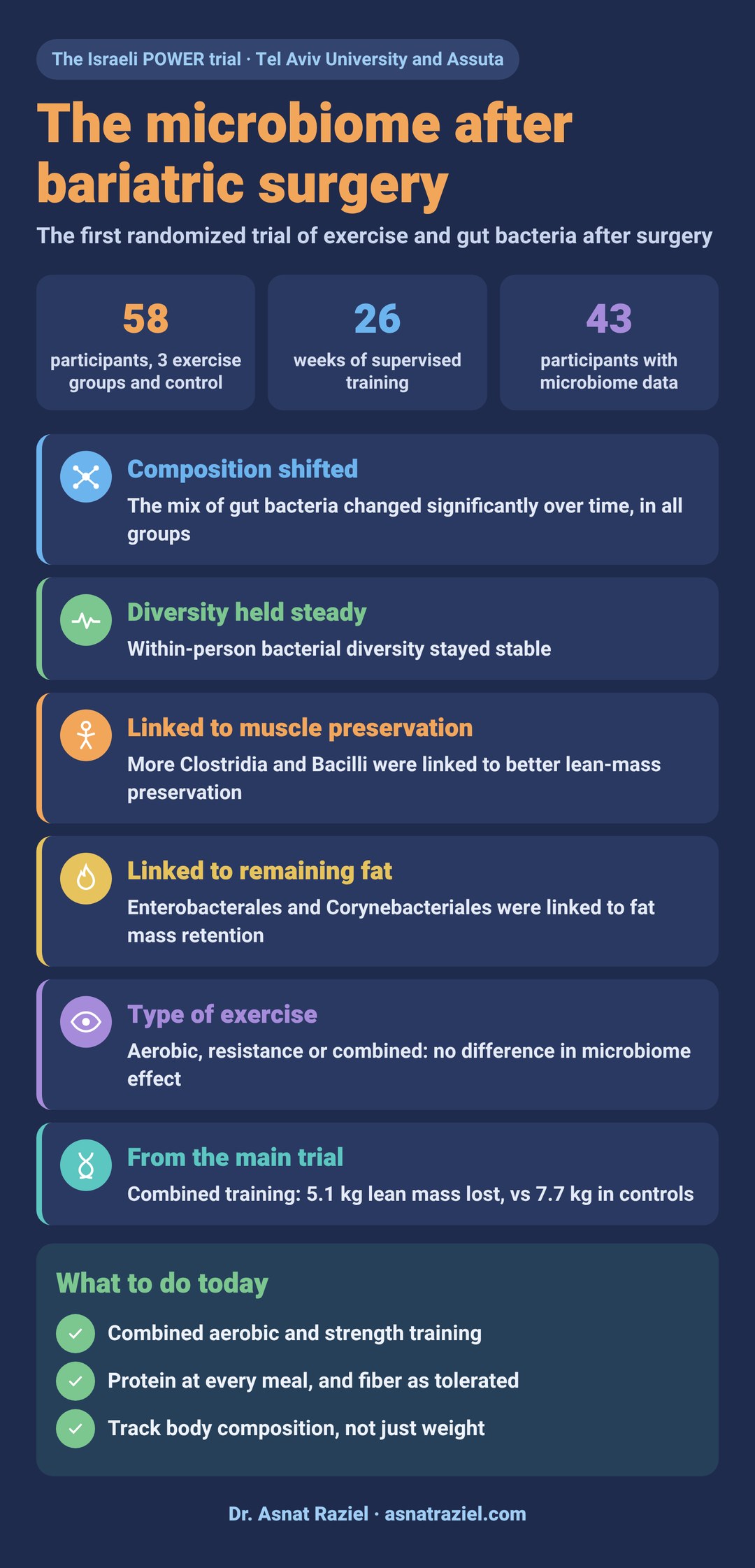
The POWER trial enrolled 58 adults who had bariatric surgery. The researchers randomly assigned them to four groups for 26 weeks:
- Aerobic training
- Resistance training
- Combined aerobic and resistance training
- A control group with no training program
Trainers supervised the sessions three times a week. In addition, the team measured body composition with DXA, a precise scan that separates fat, muscle and bone. They also analyzed gut bacteria from stool samples at the start and the end of the study.
We published the trial’s main results this year. In short, combined training preserved more lean mass: participants in that group lost 5.1 kg of lean mass, versus 7.7 kg in the control group. Aerobic training, meanwhile, best limited bone loss at the hip.
Microbiome after bariatric surgery: the findings
The team had microbiome data for 43 participants. Seventy percent were women, the average age was 42, and the average BMI before surgery was 41.7.
First, the diversity of bacteria within each participant stayed stable in all groups. However, the overall composition shifted significantly over time. In other words, after surgery the gut is home to a different mix of bacteria.
By the end of the study, three groups of bacteria had increased: Proteobacteria, Bacteroidota and Desulfobacterota. At the same time, Actinobacteria decreased, while Firmicutes stayed stable.
The link to muscle and fat
This is the most interesting part. Higher levels of bacteria from the Clostridia and Bacilli groups went along with better preservation of lean mass. By contrast, bacteria from the Enterobacterales and Corynebacteriales groups went along with fat that remained in the body.
However, the type of exercise did not change the microbiome differently between groups. The shift in bacteria was similar with aerobic, resistance and combined training, and in the control group.
What this study means
The findings suggest that the microbiome after bariatric surgery may be part of the body’s metabolic adaptation. Gut bacteria may influence what happens to muscle and fat, not only digestion. Still, this is a new direction, and it is too early to draw treatment recommendations from it.
It is important to be precise. This is a study abstract, and the number of participants is small. These are statistical associations, not proof that a given bacterium protects muscle. The researchers also looked at bacterial composition, not function. Therefore, we need more studies, for example to test whether targeted training and nutrition can improve the microbiome and recovery.
Another study from the same trial looked at metabolism. Resting metabolic rate fell by 17% after surgery, and part of that drop came from smaller liver and kidney volumes.
What to do today after bariatric surgery
Even without a final answer on the microbiome, the practical advice is clear:
- Combined exercise: aerobic and strength training, starting in the first months after surgery, as guided by your care team.
- Protein at every meal: it is essential for preserving muscle. For example, in the main trial, handgrip strength rose with higher protein intake.
- A fiber-rich diet: vegetables, legumes and whole grains, as tolerated at each stage.
- Track body composition: not just weight. It is worth knowing how much muscle you have kept.
The bottom line on the microbiome after bariatric surgery
In summary, surgery changes gut bacteria, and some of those changes are linked to muscle preservation and to remaining fat. Exercise did not change the microbiome on its own, but it is still the most important tool for protecting muscle and bone. I am glad to be part of the team studying these questions, and I look forward to the next stage. Read more about combining medication and surgery and about a personal nutrition plan.
This article is general information and does not replace personal medical advice.
References
Exercise Modalities to Preserve Muscle Mass and Bone Health After Metabolic Bariatric Surgery
The Binational Science Foundation (BSF), the Israel Science Foundation (ISF) and the Recanati Foundation funded the study.