By Dr. Asnat Raziel, bariatric surgeon specializing in obesity treatment, metabolic health and healthy longevity; Director of the Multidisciplinary Center for Obesity Treatment, Assia Medical, Assuta Ramat HaChayal, Tel Aviv
Waist circumference and BMI: what the new study found
Your waist circumference tells you something about your health that BMI alone misses. That is the message of a huge study published on November 11, 2026, in Nature. The researchers looked at 844,108 adults from China, the UK, the US and Spain. They found that BMI gets it wrong in both directions. And only obesity confirmed by a waist measurement was linked to a higher risk of death.
This is important news. So it is worth understanding the new definition, what it says about you, and what you can do today.
The new definition: clinical vs preclinical obesity
In January 2025, an international commission of The Lancet Diabetes & Endocrinology published a new definition of obesity. Under it, BMI is only a first screening tool. To confirm excess body fat, you add another measure, such as your waist size or your waist-to-height ratio.
The commission also separates two states. Clinical obesity is an active disease: excess fat is already harming how an organ works, or how you function day to day. Preclinical obesity means excess fat with a higher risk, but your organs still work well. I wrote about this in detail in my article on clinical obesity as a systemic disease.
Waist circumference and BMI in four large cohorts
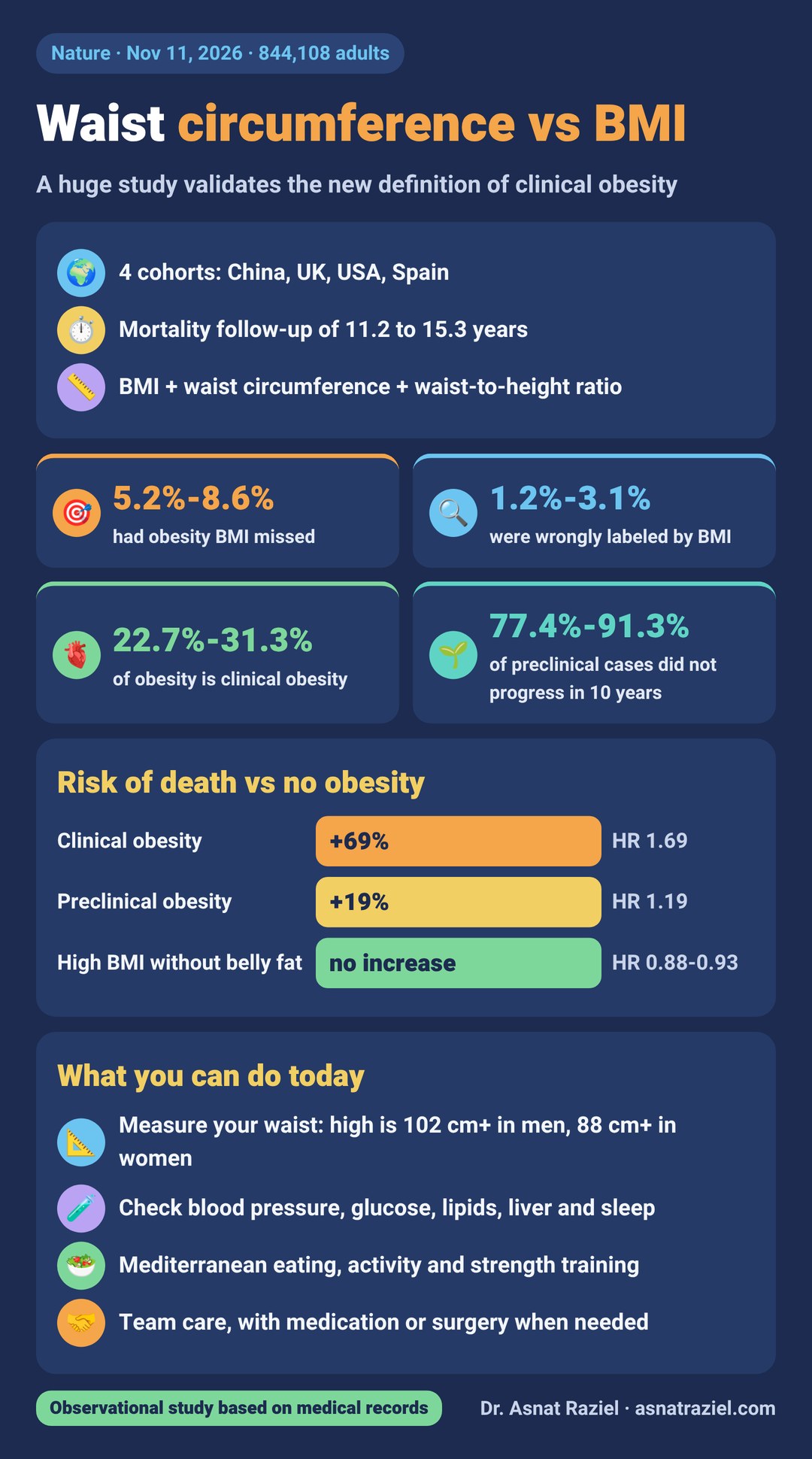
The researchers, led by Prof. An Pan in China and Prof. Francesco Rubino in London, analyzed four large cohorts: Kailuan in China (137,795 people), the UK Biobank (436,203), All of Us in the US (218,841) and SIDIAP in Spain (51,269). Mortality follow-up ran for a median of 11.2 to 15.3 years.
They compared a diagnosis based on BMI alone with a combined diagnosis. In the combined approach, for example, a person with a BMI of 25 to 29.9 counted as having obesity only if both waist size and waist-to-height ratio were high. With a BMI over 30, one of the two was enough.
Waist circumference reveals what BMI misses
The results are clear. First, BMI alone wrongly labeled 1.2% to 3.1% of participants as having obesity. At the same time, it missed obesity in 5.2% to 8.6% – people with an “overweight” BMI but with obesity-level belly fat.
As a result, obesity prevalence rose only slightly, by 3.3% to 7.4%. In other words, the new definition does not inflate the numbers. It simply does a better job of finding the people who are truly at risk.
What your waist says about life expectancy
The most striking finding concerns mortality. People with a high BMI but without excess belly fat were not at higher risk. In fact, their risk was slightly lower (HR 0.88 in the overweight range and 0.93 in the obesity range). But when excess fat was confirmed by a waist measurement, the risk went up.
The big gap appeared between the two types of obesity. Clinical obesity raised the risk of death by 69% (HR 1.69). Preclinical obesity added only a modest 19% (HR 1.19). The link between clinical obesity and mortality was especially strong in women and in people under 60.
How many people live with clinical obesity
Clinical obesity made up 22.7% to 31.3% of all obesity cases. In the general population, it affected 5.6% to 10.9% of people. To avoid blaming every disease on obesity, the researchers used a statistical method that estimates how much organ damage is due to excess fat.
What about preclinical obesity? Here the news is encouraging. Between 77.4% and 91.3% of people with preclinical obesity did not progress to clinical obesity over ten years.
A high waist circumference: what it means for you
The meaning is twofold. On one hand, a number on the scale does not tell the whole story. On the other hand, preclinical obesity is not a “cosmetic” issue. It calls for active prevention, and sometimes medication too.
The researchers stress that the distinction is not meant to withhold treatment. Like prediabetes, it helps set how urgent and how intensive care should be. One important limitation: this is an observational study based on medical records, not on a uniform clinical exam.
What you can do today
Measure your waist circumference at home
Measure in the morning, standing, at the level of your navel, at the end of a normal breath out. In the study, a high waist was 102 cm or more in men and 88 cm or more in women. Also, divide your waist by your height. In the study, the risk of death started to rise at a ratio of around 0.55.
Check how your organs are working
If your measurements are high, check your blood pressure, fasting glucose and HbA1c (your average blood sugar over the past three months), and blood lipids. It is also worth checking for fatty liver with the FIB-4 score, and paying attention to snoring, sleep apnea and knee pain.
Lifestyle steps that shrink belly fat
A Mediterranean diet rich in vegetables, legumes and fish, with little processed food, reduces visceral fat. In addition, 150 minutes a week of aerobic activity and strength training twice a week protect your muscle. Seven hours of sleep and stress management complete the picture.
Team-based care when needed
At our center, care is built around the person: a dietitian, a psychologist and an exercise professional. When needed, we add medication. In Israel, Wegovy and Mounjaro are available today, and Foundayo and the Wegovy pill are available through the Form 29c route. You can read more about availability and coverage in my article on new weight loss injections in Israel. In severe clinical obesity, bariatric surgery remains the most effective and durable treatment.
The bottom line
Waist circumference is a simple, cheap and quick measurement, and it adds important information to BMI. The new study shows that combining them, together with a check of organ function, better identifies who needs urgent care. So at your next doctor’s visit, ask to have your waist measured too.
The information in this article is general and does not replace personal medical advice.
References
Validation of clinical and preclinical obesity across global cohorts
Definition and diagnostic criteria of clinical obesity
New clinical definition outperforms BMI in diagnosing obesity