By Dr. Asnat Raziel, bariatric surgeon specializing in obesity treatment, metabolic health and healthy longevity; Director of the Multidisciplinary Center for Obesity Treatment, Assia Medical, Assuta Ramat HaChayal, Tel Aviv
Migraine diet: what do the trials say?
A migraine diet is a topic that interests many people with recurring attacks, and Dr. Michael Greger devoted a whole section of his talks to it. Greger, a physician and founder of NutritionFacts.org, gave the keynote “How Not to Hurt” at the LM2026 Lifestyle Medicine Conference in Orlando. In this article I gathered the studies he presents on food and migraine. I also checked each of them at the source.
Migraine is not just a headache. It comes in attacks of throbbing pain, sometimes with nausea, sensitivity to light and noise and visual disturbances. Most patients rely on medication. But many also look for ways to reduce the number of attacks.
Migraine diet: does fat on the plate matter?
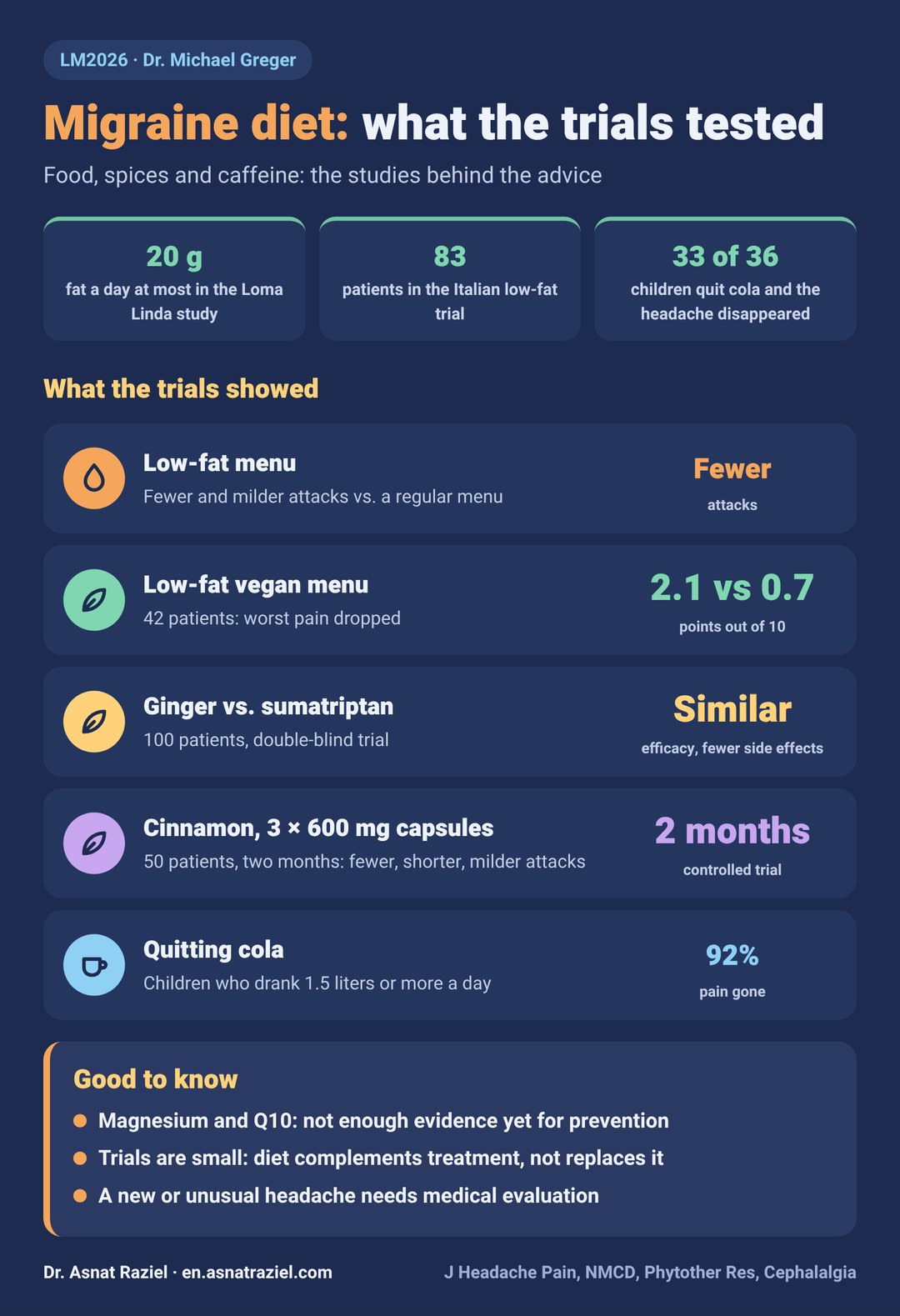
One of the central ideas Greger presents is the link between dietary fat and migraine. In a study from Loma Linda University, 54 people with migraine limited their fat intake to 20 grams a day at most. Average intake fell from about 66 grams to about 28 grams a day. After the change, headache frequency, intensity, duration and medication use all dropped. However, the study had no control group.
That is why an Italian trial matters more. There, 83 patients went through two three-month periods: a low-fat diet and a diet with normal fat. During the low-fat period, patients had fewer and milder attacks. The researchers also found that patients with obesity had more attacks.
A plant-based migraine diet
A research group from Washington tested a low-fat vegan menu in a controlled crossover trial. Forty-two adults with migraine went through a period of dietary change and a period of placebo supplement. During the diet period, the worst pain fell by 2.1 points on a 10-point scale. That compares with only 0.7 during placebo. On the other hand, attack frequency did not change significantly. So the diet eased the pain, but did not prevent attacks.
In my view, a menu rich in vegetables, legumes and whole grains suits most people, migraine or not. It is very close to the Mediterranean diet I recommend in my clinic.
Spices in a migraine diet: ginger and cinnamon
Ginger versus a migraine drug
In a double-blind trial, 100 people with migraine received ginger powder or sumatriptan, a common drug for attacks. Two hours later, pain intensity fell similarly in both groups. Ginger caused fewer side effects. In the talk, Greger noted that the dose was about an eighth of a teaspoon of ground ginger. In each group, 44% of patients were pain-free within two hours.
Cinnamon to prevent attacks
Another controlled trial gave 50 people with migraine three 600 mg capsules of cinnamon a day, or placebo capsules, for two months. The cinnamon group had fewer, milder and shorter attacks. Inflammatory markers in the blood also dropped. According to Greger, pain in the cinnamon group fell from 8 to 2.3 on a 10-point scale. In the placebo group, it fell only from 8 to 7.
Cola and caffeine: a surprise from Israel
An Israeli study from Meir Medical Center in Kfar Saba described 36 children and teens with daily headaches. All of them drank at least a liter and a half of cola a day. After gradual withdrawal from cola, the headaches disappeared completely in 33 of them. This is a case series, not a controlled trial. But the message is clear: large amounts of caffeine may cause headaches. Sudden withdrawal may make them worse.
What about magnesium and supplements?
Magnesium and coenzyme Q10 supplements are very popular among people with migraine. However, a systematic review of 18 trials found insufficient evidence that they prevent migraine in adults. So I do not recommend them as a first treatment. And certainly not instead of treatment planned with your doctor.
Weight, sleep and stress
A migraine diet is only part of the picture. In the Italian study, patients with obesity had about 25 attacks during follow-up on average. That compares with about 16 in patients of normal weight. Irregular sleep and stress are also well-known triggers. Read more about healthy sleep and about the link between stress and obesity.
Dr. Greger explains: video
Migraine diet: practical steps
Cut down on fat: choose whole, plant foods, and eat less fried and processed food.
Add spices: ginger and cinnamon are safe in most cases in normal food amounts.
Watch your caffeine: cut down gradually if you drink a lot of coffee or cola.
Keep a diary: write down attacks, food, sleep and stress, to find your personal triggers.
Talk to your doctor: especially before high-dose supplements, and if you take blood thinners.
For more foods tested against pain, read the article on Dr. Greger’s keynote.
Bottom line
The studies on food and migraine are small, but encouraging. A low-fat, plant-rich menu, ginger, cinnamon and less caffeine are safe steps worth trying. In the end, a migraine diet complements medical treatment and does not replace it. If a new, unusually severe or different headache appears, see a doctor.
This article provides general information and is not personal medical advice. Do not stop or change medication without consulting your physician.
References
Nutrition intervention for migraine: a randomized crossover trial
Low-lipid diet reduces frequency and severity of acute migraine attacks
The influence of a low-fat diet on incidence and severity of migraine headaches
Caffeine-induced headache in children and adolescents
Vitamins and Minerals for Migraine Prophylaxis: A Systematic Review and Meta-analysis
Friday Favorites: Foods that Help Headache and Migraine Relief