By Dr. Asnat Raziel, bariatric surgeon specializing in obesity treatment, metabolic health and healthy longevity; Director of the Multidisciplinary Center for Obesity Treatment, Assia Medical, Assuta Ramat HaChayal, Tel Aviv
The fasting-mimicking diet: fasting with food, for longevity
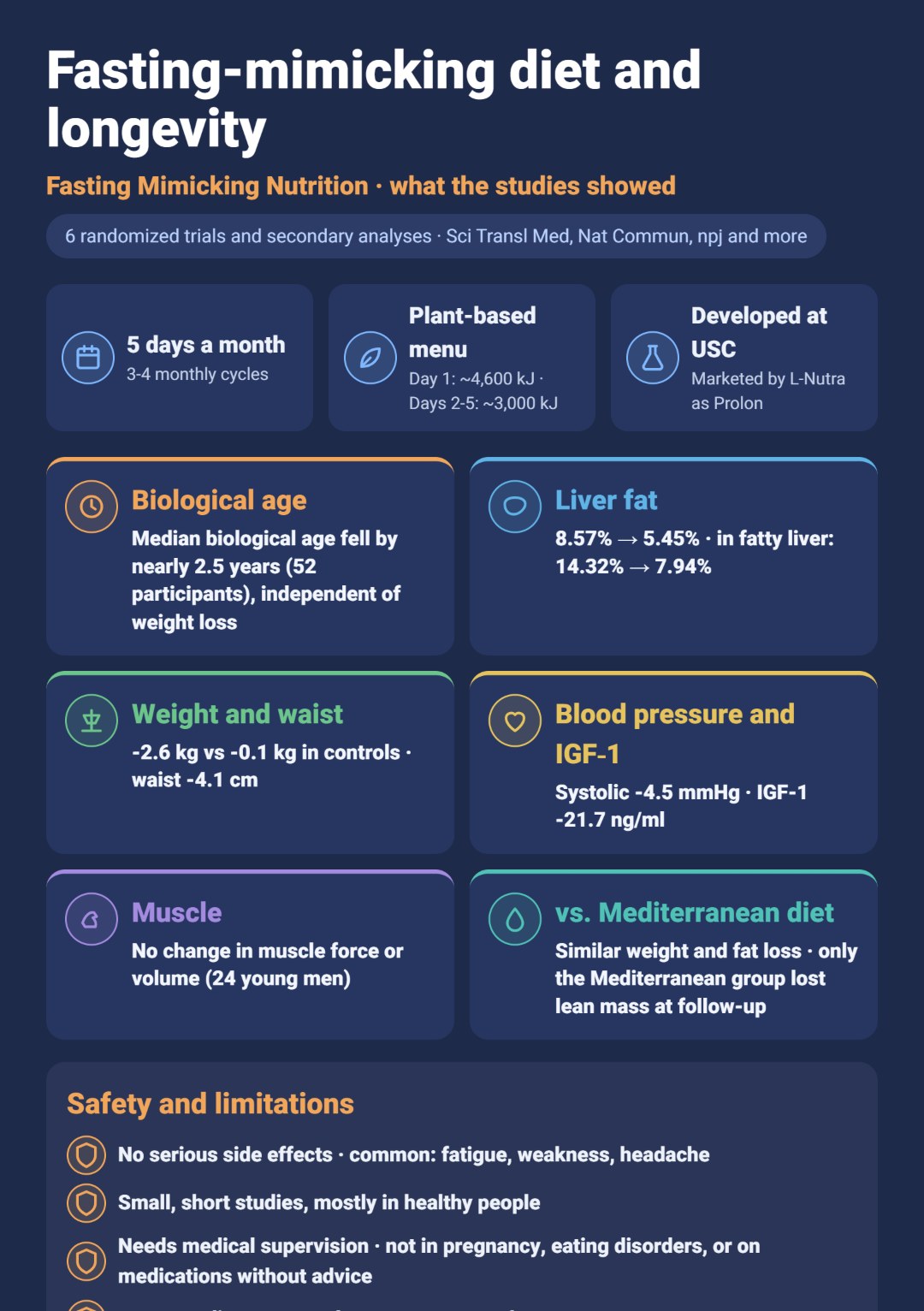
A fasting-mimicking diet is a short, five-day monthly nutrition program designed to trigger fasting-like responses in the body. Unlike a water fast, you eat small, measured portions of plant-based food. For longevity medicine, the key question is simple: do these cycles slow aging? A study in Nature Communications found that three cycles were linked to a drop of about 2.5 years in median biological age.
This week I am attending the American College of Lifestyle Medicine (ACLM) conference in Orlando. L-Nutra is holding a seminar on fasting-mimicking nutrition in lifestyle medicine there. So I wanted to summarize the studies the company presents, what they actually showed, and what we still don’t know.
What is Fasting Mimicking Nutrition, and where did it come from?
Fasting Mimicking Nutrition describes eating that is low in calories, sugar and protein and rich in unsaturated fats. The concept was developed at the Longevity Institute of the University of Southern California (USC), led by Prof. Valter Longo. Later, L-Nutra received the rights to market the program. Its flagship product is called Prolon.
L-Nutra also runs a professional arm for healthcare providers. It offers physicians and dietitians structured programs for obesity, hypertension, prediabetes and type 2 diabetes, with dietitian coaching and physician oversight. In addition, the company sells five-day kits for healthy, prevention-minded people. At the conference, the seminar speaker is Dr. William Hsu, the company’s Chief Medical Officer, who previously spent 20 years at Harvard’s Joslin Diabetes Center.
What do you eat during the five days?
According to the randomized trial published in Science Translational Medicine, day 1 provides about 4,600 kJ, roughly 1,100 calories. It is 11% protein, 46% fat and 43% carbohydrate. Days 2 to 5, by contrast, provide about 3,000 kJ a day, roughly 720 calories, with 9% protein, 44% fat and 47% carbohydrate.
The kit includes vegetable soups, energy bars, drinks, chip snacks, tea and a supplement rich in vitamins, minerals and essential fatty acids. Each day is boxed separately, so you choose when to eat without dipping into the next day’s food by mistake. After the five days, you return to your normal diet, and the next cycle starts about 25 days later.
Why the fasting-mimicking diet matters for longevity medicine
Prolonged fasting temporarily lowers glucose and IGF-1. IGF-1, insulin-like growth factor 1, is a growth-promoting hormone, and research has linked high levels to aging and cancer. At the same time, the body makes more ketone bodies and switches on cellular protection mechanisms. In mice, cycles of this diet extended healthspan, the years lived in good health and function.
However, a multi-day water fast is hard to do and may worsen nutritional deficiencies. That is why the researchers built a menu that provides food and micronutrients while still mimicking the hormonal changes of fasting. If you are interested in related approaches, I have also written about intermittent fasting and the biological clock.
The fasting-mimicking diet and biological age
The most important finding for longevity was published in 2024. A secondary analysis of blood samples from two trials looked at markers of biological age before and after three cycles. The researchers used a validated formula that predicts disease and death.
In 52 participants, median biological age fell by nearly 2.5 years. Moreover, weight loss alone did not explain the drop. In a second, separate trial with 34 participants, the researchers saw nearly identical results. The ratio of lymphoid to myeloid blood cells also rose, a sign of a younger immune system. If you want to dig deeper, I have also covered a large study that tested 51 interventions to slow aging.
Fatty liver and insulin resistance
In the same study, MRI showed less fat in the liver. The hepatic fat fraction fell from 8.57% to 5.45%. In five participants with fatty liver, it fell from 14.32% to 7.94%, a drop of nearly half. Likewise, in participants with prediabetes, the insulin resistance index HOMA-IR fell from 1.473 to 1.209.
Keep in mind that these groups were very small, so these are early findings. I have written in detail about proven treatment options in my clinical protocol for metabolic fatty liver.
The first randomized trial: weight, blood pressure and IGF-1
The trial that launched the field enrolled 100 healthy adults aged 20 to 70. Half kept their usual diet, and the rest did three monthly cycles. In total, 71 participants completed three cycles.
In the diet group, participants lost an average of 2.6 kg, compared with 0.1 kg in the control group. Waist circumference dropped by 4.1 cm, and systolic blood pressure by 4.5 mmHg. IGF-1 also fell by 21.7 ng/ml. On the other hand, fasting glucose, blood lipids and the inflammation marker CRP did not change significantly compared with controls.
A further post hoc analysis showed the benefit was greatest in people at risk. For example, in participants with fasting glucose above 99 mg/dl, glucose fell by 11.8 mg/dl. Similarly, in participants with CRP above 1 mg/L, it fell by 1.6 mg/L.
Fasting-mimicking diet versus a Mediterranean diet
A randomized trial in people with hypertension and excess weight compared four monthly cycles with four months of a continuous Mediterranean diet. Both approaches produced similar reductions in weight, waist circumference, BMI, fat mass, total cholesterol and leptin. At the end of the intervention, no measure differed significantly between the groups.
Still, there were small differences. Only the fasting group saw lower HbA1c, the average blood sugar over three months, and lower IGF-1. During follow-up, the Mediterranean group also lost lean mass, while the fasting group did not. In addition, the vascular function index RHI fell in the fasting group, and the researchers note it can be read in two opposite ways.
Does fasting cost you muscle?
Preserving muscle is a central goal of healthy longevity. A randomized trial in 24 young, active men tested this directly. After the first cycle, they lost an average of 2.6 kg. Yet muscle force, muscle volume and maximal thigh contraction strength did not change.
In other words, in healthy young men the diet did not impair muscle function. The researchers stress, however, that it still needs testing in groups at risk of muscle loss, such as older adults and people with obesity and sarcopenia. In the meantime, it makes sense to combine strength training and enough protein on the days between cycles.
Skin, mood and an intermittent fasting bar
A randomized trial in 45 healthy women aged 35 to 60 followed their skin for 71 days. Three cycles increased facial skin hydration at day 11 and day 71. Skin texture held steady, while skin roughness rose in the control group. The women also reported feeling happier and more confident.
Another study tested a 200-calorie bar for intermittent fasting. After a 15-hour overnight fast, the bar did not interrupt ketosis compared with continuing a water fast. So the researchers suggest it as a tool to make time-restricted eating easier.
Study limitations and conflicts of interest
First, most studies were small and short, lasting three to four months. Second, the biological age and liver data come from a secondary, exploratory analysis, not the trial’s primary aim. Third, in the first trial 25% of participants on the diet dropped out, compared with 10% of controls. Sticking with it takes commitment.
Also, some studies were run by researchers who work at L-Nutra, and others with Prof. Longo, in whose lab the program was developed. The numbers on the company’s websites, such as dozens of clinical trials, are figures the company itself publishes. That is why it is worth reading the studies themselves, not just the marketing.
Safety: who the fasting-mimicking diet may suit, and who should avoid it
In the first trial, no serious side effects were reported. The most common were fatigue, weakness and headache, mostly mild. Blood tests showed no harm to liver or kidney function. That said, the trials mainly enrolled healthy people and excluded pregnant or breastfeeding women and people with chronic disease.
The researchers themselves write that a multi-day fast requires supervision, ideally by a professional familiar with it. Safety above age 70 has not been studied enough. If you take medications, especially for blood sugar or blood pressure, talk to your doctor before you start. A fasting-mimicking diet is also not suitable for anyone with a current or past eating disorder.
The bottom line
The fasting-mimicking diet is one of the most studied nutrition approaches in longevity medicine. In small trials, three to four cycles improved weight, blood pressure, IGF-1 and liver fat, and were linked to lower biological age, without harming muscle function. Still, we lack large, long trials that look at disease and death. Ultimately, it is an interesting tool to fold into a longevity diet, exercise and good sleep, not a replacement for them.
This article is general information and not personal medical advice. Talk to your doctor before making major changes to your diet.
References
Some of the studies were funded or conducted by researchers from L-Nutra, which markets Prolon.