By Dr. Asnat Raziel, bariatric surgeon specializing in obesity treatment, metabolic health and healthy longevity; Director of the Multidisciplinary Center for Obesity Treatment, Assia Medical, Assuta Ramat HaChayal, Tel Aviv
The US Food and Drug Administration (FDA) has approved the orforglipron pill for obesity, and it joins the new generation of obesity medications. What makes this new oral treatment different, and could it one day replace injections?
In recent years, we have grown used to thinking about obesity treatment in terms of needles. Ozempic, Wegovy and Mounjaro have transformed medicine, leading to substantial weight loss and improvements in metabolic disease. But now the FDA has approved orforglipron, sold under the brand name Foundayo. A new player has entered the market, and it challenges the most basic assumption of all: maybe injections are not a must.
It is the first GLP-1 pill that is not a peptide but a small molecule. This structure allows simple dosing, with no fasting, water or timing restrictions. It is a paradigm shift that may affect not only effectiveness, but above all adherence to treatment and the number of patients who choose to start it.
The orforglipron pill: from complex biotechnology to everyday convenience
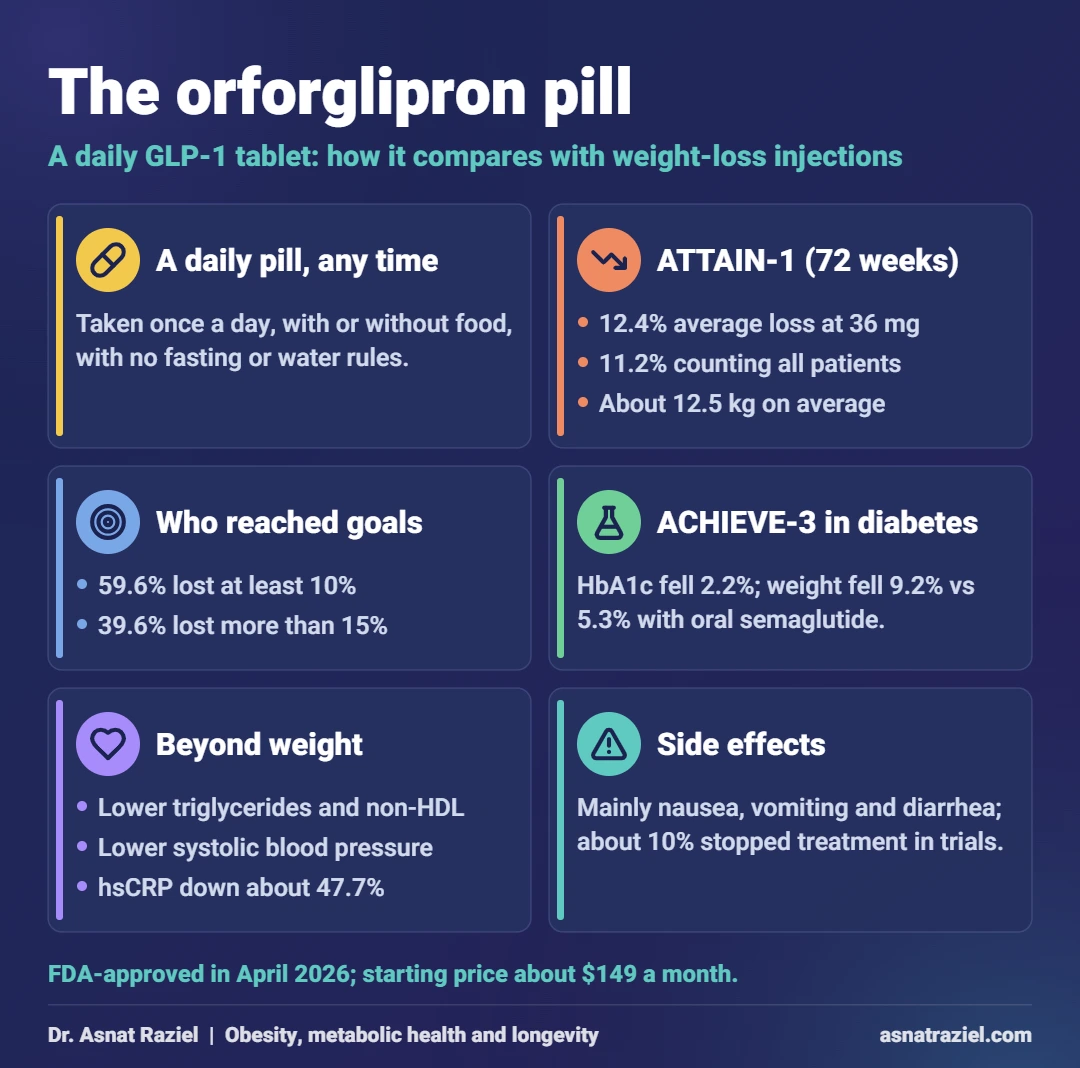
What makes orforglipron unique is not only how it works, but its format. Drugs such as oral semaglutide require strict conditions to be absorbed. By contrast, orforglipron can be taken at any time of day, with or without food.
The clinical meaning is profound. In the past, patients had to adapt their lives to the medication; now the medication adapts to their lifestyle. For many patients, especially those who fear injections or find it hard to stay on treatment, this change could be decisive.
Market data support this. Today, about 80% of obesity treatments are injections. However, forecasts suggest that pills could capture about 20% of the market by the end of the decade.
The orforglipron pill in clinical trials: weight loss and metabolic effects
The key data come from Phase 3 trials, led by the ATTAIN-1 trial, published in the NEJM. In this 72-week trial, the average weight loss was about 12.4% of body weight at the highest dose (36 mg). That is about 12.5 kg on average among patients who stayed on treatment, an analysis known as the efficacy estimand. A second analysis included all patients, including those who did not complete or stopped treatment. In this analysis, known as the treatment-regimen estimand, the researchers found a loss of 11.2%.
Beyond the average, it is important to look at the spread of responses: about 59.6% of patients lost at least 10% of their weight. About 39.6% lost more than 15%. These figures place the drug in the category of clinically meaningful weight loss. However, the results are slightly lower than those of powerful injections such as tirzepatide.
The ACHIEVE-3 trial, which included people with diabetes, also showed a clear metabolic benefit. Participants achieved a 2.2% drop in HbA1c alongside weight loss of about 9.2%, compared with only 5.3% on oral semaglutide. In other words, orforglipron is not only a weight-loss drug but a broad metabolic tool.
Beyond weight: effects on cardiometabolic health
One of the most important aspects of GLP-1 medications is their effect beyond weight itself. Here, too, orforglipron shows interesting data. The trials found lower triglycerides and non-HDL cholesterol, lower systolic blood pressure and a marked drop in inflammation markers, including hsCRP by about 47.7%.
This means the drug acts not only on appetite but on a whole set of mechanisms linked to the metabolic syndrome. It is part of a broader shift in thinking: obesity is not just excess weight but a systemic disease.
Orforglipron pill vs. GLP-1 injections
This raises the central question. Is the pill a replacement for injections or an addition to them? The data show that weight loss with orforglipron is around 12-15%. That is slightly lower than with treatments such as Mounjaro or Wegovy at high doses, which can reach 15-20% or even more.
But this gap is not necessarily a drawback. Quite the opposite. It defines the drug’s place as a first-line treatment for patients at the start of their journey, or as a solution for patients who do not want injections. The drug also allows weight maintenance after an intensive treatment phase. It may well be that this combination of good efficacy and high convenience makes it one of the most widely used medications.
Safety and side effects of the orforglipron pill
The safety profile is similar to other drugs in the family. The main side effects involve the digestive system: nausea, vomiting and diarrhea. About 10% of patients stopped treatment in the trials, a rate similar to other drugs in the class.
As with other GLP-1 medications, there is a warning about a potential risk of medullary thyroid tumors, so patients need a careful medical assessment.
Availability, cost and market impact
The US Food and Drug Administration approved the orforglipron pill for obesity in April 2026, and the manufacturer is launching it immediately. The starting price is about $149 a month, and it can be higher at the higher doses.
The economic meaning is no less important than the clinical one. A pill that is simple to manufacture and ship could lower costs and widen access, especially in countries where the logistics of injectable treatment are difficult.
In Israel, for example, Ynetnews reported that the orforglipron pill reached Israeli pharmacies in September 2026. It is not in the health basket yet, so patients buy it privately with a prescription.
Market expectations are high. Forecasts point to sales of billions of dollars in the coming years and to a change in the structure of the obesity drug market.
Where is this heading?
Orforglipron is not just another drug. It represents a deep change in how we think about obesity treatment. The move from injections to pills recalls earlier revolutions in medicine, in which convenience and access mattered as much as efficacy. In the future we may see models that combine treatments: patients will start with an oral treatment and, if needed, move on to more advanced treatments.
The most important message is that obesity treatment keeps evolving rapidly, with a growing range of tools. There is no single solution that fits everyone. Instead, there is a broad treatment arsenal that allows truly personalized care.
Summary
Orforglipron opens a new era in which obesity treatment can be simpler, more accessible and perhaps also more acceptable to patients.
It does not replace the most powerful medications, but it may reach a much wider audience. And in chronic diseases like obesity, access is sometimes what makes the biggest difference.
The following video (in Hebrew) explains more about the orforglipron pill for obesity:
Questions and answers about the orforglipron pill (Foundayo)
What is orforglipron, and what makes it special?
Orforglipron is an oral GLP-1 receptor agonist for the treatment of obesity. Unlike other drugs in the class, which are injected, orforglipron is a daily pill based on a small molecule that is not a peptide. This means it is easy to take, with no fasting or timing restrictions, which may significantly improve adherence to treatment.
How does the drug work in the body?
The drug mimics the action of the natural hormone GLP-1. It acts on the satiety centers in the brain, reduces appetite and slows stomach emptying. It also improves glucose-dependent insulin release and reduces glucagon release. Together, these effects lead to lower calorie intake and better metabolic measures.
How do you take the orforglipron pill?
You take orforglipron once a day, and you can take it at any time, with or without food or drink. This is a significant advantage over other oral GLP-1 treatments, which require strict dosing conditions.
What doses are available?
Doctors prescribe the drug with gradual titration, at doses of 0.8, 2.5, 5.5, 9, 14.5 and 17.2 mg. Your doctor raises the dose step by step to reduce side effects and improve tolerability.
What are the common side effects?
The side effects are similar to those of other GLP-1 medications and mainly involve the digestive system: nausea, diarrhea or constipation, vomiting, abdominal pain and bloating. In addition, some patients experience gas, heartburn, fatigue and sometimes hair loss. These effects are usually mild to moderate and fade over time.
What are the significant risks to know about?
Alongside a good safety profile, there are important risks: pancreatitis, gallbladder disease and hypoglycemia when combined with other drugs. In addition, dehydration can lead to kidney injury, and there is a warning about a possible risk of thyroid tumors. Any unusual symptoms require medical evaluation.
Are there interactions with other medications?
Yes, and this is an especially important point. Orforglipron slows stomach emptying, so it may affect the absorption of other medications. Take particular care when combining it with insulin or sulfonylureas, because of the risk of hypoglycemia. In addition, the drug may change the levels of medications such as certain antibiotics, carbamazepine, cyclosporine and statins. The effectiveness of birth control pills may also be affected, so you should consider alternative contraception.
Can it be combined with other GLP-1 medications?
No. Do not combine orforglipron with other GLP-1 medications, such as Ozempic, Wegovy or Mounjaro, because there are no data on the safety and efficacy of the combination.
Which medical conditions call for special caution?
Doctors need to take care in patients with gastroparesis or other stomach-emptying disorders, pancreatic disease, gallbladder disease, kidney or liver disease, and diabetic retinopathy. In these cases, doctors need to tailor the treatment individually.
What should I know before surgery?
The orforglipron pill slows stomach emptying, so it may raise the risk of aspiration during anesthesia. Tell the anesthesia team; you may need to stop the drug before surgery, according to the guidelines.
Can it be used during pregnancy or breastfeeding?
No. Doctors do not recommend the drug during pregnancy or breastfeeding, and you should stop it if you become pregnant.
What should I do if I miss a dose?
Take the dose as soon as possible, but do not take a double dose. If you have stopped treatment for several days, you may need to restart at a lower dose to reduce side effects.
What is the clinical significance of the orforglipron pill?
Orforglipron marks an important shift in obesity treatment. It combines a proven mechanism with a high level of convenience. This advantage may lead more patients to start treatment and stay on it. However, like any medication for obesity, it requires personal tailoring and comprehensive clinical management.