By Dr. Asnat Raziel, bariatric surgeon specializing in obesity treatment, metabolic health and healthy longevity; Director of the Multidisciplinary Center for Obesity Treatment, Assia Medical, Assuta Ramat HaChayal, Tel Aviv
What Trump eats, and why it interests an obesity doctor
What Trump eats is a question the world’s media keep asking. My answer is not about politics or about the man himself. Instead, I use the public reports as a starting point for a conversation about eating habits that many of us will recognize.
The link between the dinner table and politics goes back a long way. For example, the Book of Esther, the story read on the Jewish holiday of Purim, opens with a long banquet. In this article I summarize what well-known media outlets have published, what the official medical report says, and what science says about each of these habits.
What Trump eats according to media reports
It is important to say up front: there is no official food diary. All the information comes from books, articles and accounts from people who worked alongside him. So this is a partial picture, and some of the reports are several years old.
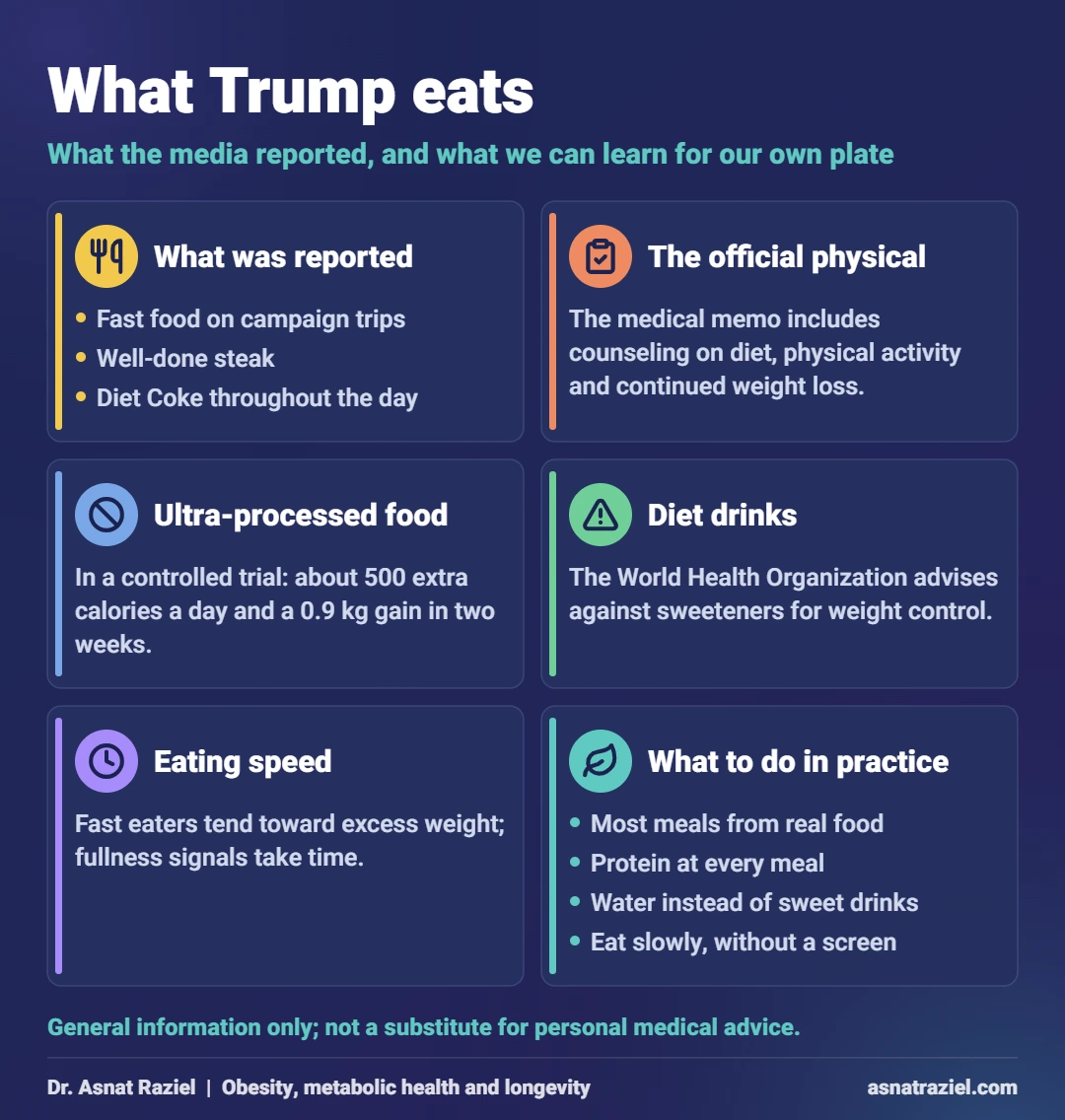
In the book “Let Trump Be Trump,” written by two of his campaign staffers, the authors say that the campaign plane had “four main food groups”: McDonald’s, KFC, pizza and Diet Coke. According to Global News’ summary, his regular McDonald’s order included two Big Macs, two Filet-O-Fish sandwiches and a chocolate milkshake. In addition, the authors said the plane was always stocked with chips, pretzels and Oreo cookies.
Tom Sietsema, the Washington Post’s restaurant critic, offered one explanation for this preference. In his view, fast-food chains are associated in Trump’s mind with cleanliness and food safety.
In the same article, Sietsema described another habit. At restaurants he usually orders a well-done steak, sometimes with ketchup. Also, according to Sietsema, he finishes his meal quickly.
As for drinks, The New York Times reported in 2017 on about a dozen cans of Diet Coke a day. What’s more, in January 2025 The Wall Street Journal reported that the button for ordering Diet Coke was back in the Oval Office.
What the official medical report says
The president’s physician issued an official memorandum on his annual physical at the end of May 2026. According to the memo, he weighed 238 pounds, about 108 kg, at a height of about 190 cm. The document states that he received preventive counseling on diet, increasing physical activity and continued weight loss.
In addition, the memo notes that he takes medication to manage cholesterol and aspirin, and that he has never smoked or drunk alcohol. Beyond that, the memo does not describe a menu or a nutrition plan. From here on, this article focuses on the science.
Lesson one: ultra-processed food drives overeating
Hamburgers, fries, cookies and snacks are classic examples of ultra-processed food. That is, industrial food with ingredients you would not find in a home kitchen. A controlled trial at the US National Institutes of Health (NIH) tested its effect directly.
The study included 20 adults, who ate an ultra-processed diet for two weeks and an unprocessed diet for two weeks. The two diets were matched for calories, sugar, salt and fiber. However, on the processed diet, participants ate about 500 calories a day more than on the other diet. The result: a gain of 0.9 kg in two weeks, compared with a loss of 0.9 kg on the unprocessed diet.
So my advice is simple: base most of your meals on real food. Vegetables, legumes, fish, eggs and whole grains are far more filling, usually for fewer calories.
Lesson two: diet drinks are not a weight-loss tool
Many people choose a diet drink to save calories. Indeed, swapping a sweetened drink for a sugar-free one cuts calories. But the World Health Organization advises against using non-sugar sweeteners for weight control. The recommendation applies to the whole population, except people who already have diabetes.
In practice, water, soda water and unsweetened tea are the best choices. An occasional diet drink is not a disaster. However, several cans a day keep the habit of a sweet taste alive.
Lesson three: eating speed matters
Eating fast is an easy habit to overlook. A meta-analysis of 23 studies found that people who eat quickly tend to carry excess weight. According to the data, their body mass index was 1.78 units higher on average, and their odds of obesity were 2.15 times higher.
Keep in mind that this is observational research, so it shows an association, not necessarily cause and effect. Still, the logic is clear. Fullness signals from the gut reach the brain only after several minutes. People who finish their plate before then usually eat more than the body needs.
What Trump eats, and what we can learn from it
This discussion reminds us that eating habits grow out of a busy schedule, travel and pressure. That is true for anyone with a demanding career. So the solution is planning, not willpower alone.
- Plan a healthy shopping basket ahead, so there is a ready alternative to a snack.
- Add a source of protein to every meal. Getting enough protein supports fullness and helps preserve muscle.
- When traveling, choose a dish with vegetables and protein, and skip the sweet drink and the fried side.
- Eat slowly, without a screen, and put your fork down between bites.
Sometimes changing habits alone is not enough. In those cases, medication for obesity is a legitimate part of treatment. You can read more about medications for obesity and metabolic disease on this site.
The bottom line on what Trump eats
The reports on what Trump eats offer a glimpse of very common habits: fast food, diet drinks and eating fast. Science shows that ultra-processed food drives overeating, that sweeteners are not a weight-loss tool, and that eating quickly is linked to excess weight. Ultimately, change starts with planning your next meal. If you would like to build a personal plan, Dr. Asnat Raziel and the multidisciplinary team will be happy to help.
This article provides general information and does not replace personal medical advice.
Questions and answers
What Trump eats, according to known sources
According to a book by his campaign staffers and press reports, he tends to eat fast food and well-done steak and to drink Diet Coke. There is no official food diary, and some of the reports are old.
Does Diet Coke help with weight loss?
Not in any proven way. The World Health Organization advises against using non-sugar sweeteners for weight control. Water remains the best choice.
How can I slow down my eating?
Eat at a table, without your phone, and put your cutlery down between bites. Also, start the meal with a salad or soup.
Sources
Memorandum From the Physician to the President
5 things ex-Donald Trump insiders reveal in their new tell-all book
President Trump’s reluctant foray into culinary diplomacy
Trump: View each day as TV episode
Diet Coke button returns to Oval Office
Association between eating rate and obesity: a systematic review and meta-analysis
WHO advises not to use non-sugar sweeteners for weight control in newly released guideline