By Dr. Asnat Raziel, bariatric surgeon specializing in obesity treatment, metabolic health and healthy longevity; Director of the Multidisciplinary Center for Obesity Treatment, Assia Medical, Assuta Ramat HaChayal, Tel Aviv
Weight loss without injections is bringing a new group of people into obesity treatment. In this article, I focus on them: who is choosing the daily pill, why the needle kept so many away, and what this shift means for long-term success.
Weight loss without injections: the pill that opens a new door
Weight loss without injections is no longer a distant dream. For years, GLP-1 drugs were given mainly as a weekly injection. Now the pill version of Wegovy is attracting millions of new patients. Many of them have never tried drug treatment for obesity. So this is a change in who gets treated, not only in the form of the drug.
The drug is based on semaglutide from Novo Nordisk. It mimics GLP-1, a natural satiety hormone that the gut releases after a meal. The hormone increases fullness, slows stomach emptying and acts on the hunger centers in the brain. Until now, everyone linked this revolution with an injection pen. However, the pill shows that simply removing the needle changes the rules of the game.
What was approved and when
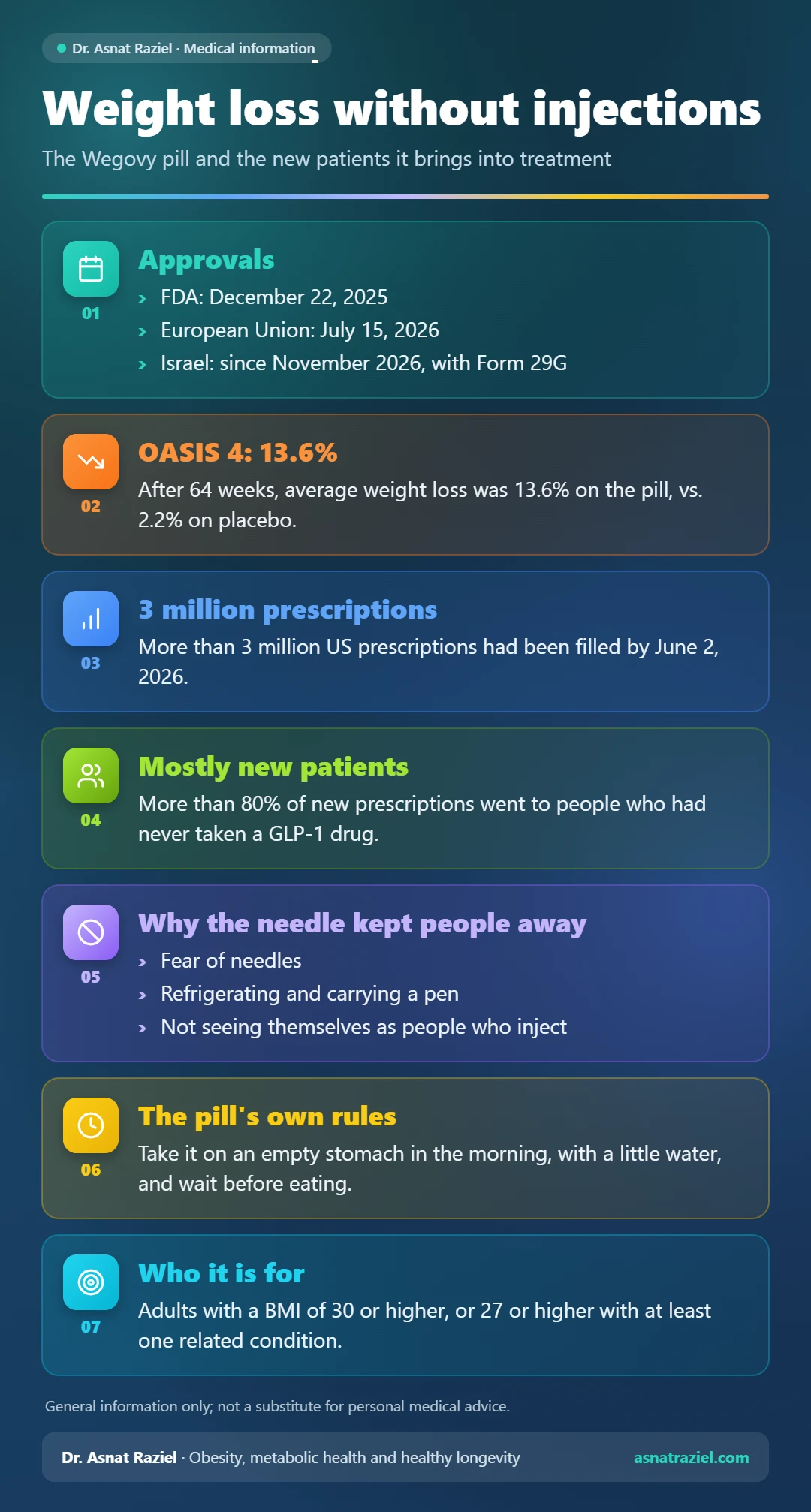
The FDA, the US Food and Drug Administration, approved the Wegovy pill on December 22, 2025. It is a daily 25 mg semaglutide pill for weight loss and for keeping weight off over time. In addition, the pill is approved there to lower the risk of serious heart events in adults with heart disease and overweight. Sales in US pharmacies began on January 5, 2026.
Europe came next. The European Commission approved the pill on July 15, 2026 for all EU countries. As of early November 2026, the pill is also available in Israel: it arrived in November 2026 and can be obtained with Form 29G, a special Ministry of Health prescription form. The full approval story appears in my article on the US approval of the pill.
What the OASIS 4 trial showed
The approval is based on the OASIS 4 study, published in NEJM. It included 307 adults with obesity or overweight and without diabetes. After 64 weeks, participants on the pill lost an average of 13.6% of their weight, compared with 2.2% in the placebo group. In other words, the gap was 11.4 percentage points.
Those who took the drug as prescribed lost 16.6% on average. In addition, about a third of them lost 20% or more of their weight. According to the company, the results are similar to those of the Wegovy 2.4 mg injection. A detailed comparison of the different pills appears in my article on Rybelsus versus the Wegovy pill. I take a closer look at these numbers in my article on what the Wegovy pill study really showed.
Millions of prescriptions, mostly for new patients
The first data from the United States surprised the whole market. In the first month, tens of thousands of prescriptions were written. But that was only the beginning. According to a company report from June 2026, more than 3 million prescriptions had been filled by June 2. The first million came after 12 weeks, and the next two million in just 10 weeks.
The even more interesting figure: more than 80% of new prescriptions went to people who had not been on a GLP-1 drug before. In other words, the pill does not just replace an injection. It brings people into treatment who had stayed away. Some feared needles, others found refrigeration and carrying a pen difficult, and some simply did not see themselves as people who “inject.”
Why the needle kept people away from treatment
The pill’s success is not only a matter of pharmacology. It reflects a deep understanding of the barriers to treatment. For many patients, weekly self-injection is a real obstacle. That is true even when the needle is very thin. I discuss this in more depth in my article on fear of injections and weight-loss treatment.
A daily pill, by contrast, fits easily into a routine. People see it as an ordinary medicine, not an invasive treatment. In a world where persistence determines long-term success, convenience plays a central role. I have written at length about the importance of sticking with obesity treatment.
Still, the pill has its own rules. You take it on an empty stomach in the morning, with a little water, and wait before eating or drinking. Because of this, guidance from the medical team is very important. If you are already on an injection and are thinking of switching, read about moving from the shot to the pill.
A behavioral shift, not just a technological one
The numbers above tell a story about people, not only about a molecule. When more than 80% of new prescriptions go to people who never used a GLP-1 drug, the main effect of the pill is on access. In other words, removing the needle removes a psychological barrier for many people. For them, a daily pill feels like an ordinary medicine. That is why convenience may matter as much as the drug itself. As a result, the real test now is persistence: staying on treatment over time, with a short fast each morning and medical follow-up.
Growing competition in the GLP-1 market
The pill does not exist in a vacuum. It competes with Mounjaro, which is based on tirzepatide and also acts on the GIP hormone pathway. Some patients have even switched from injections to the pill. This shows that convenience carries as much weight as the differences between the drugs.
Moreover, competitors also understand that the future lies in new ways of delivering these drugs. Eli Lilly developed Foundayo, a weight-loss pill that is not a protein. It was approved in the US in April 2026 and reached Israel in September 2026. Details appear in my guide to Foundayo treatment. I also wrote a broader look at the future of oral weight-loss drugs.
Not only weight loss
GLP-1 drugs have also proven effective beyond weight. They improve blood sugar control, lower the risk of heart events and improve other metabolic markers. So wider access to treatment may, over time, also affect the diseases that come with obesity.
However, it is important to remember that this is a drug treatment in every sense. The pill also has side effects, mainly in the digestive system. For example, in OASIS 4, 74.0% of patients on the pill reported digestive symptoms, compared with 42.2% on placebo. Most were mild to moderate.
Another step in the metabolic revolution
The view of obesity is changing deeply. In the past, it was seen as a behavioral failure. Today it is recognized as a chronic metabolic disease that needs tailored biological treatment. The arrival of the Wegovy pill is a milestone in this process, not just a technological development.
In the near future, the question will probably not be whether to inject. Instead, we will ask how to choose among many options: a weekly injection, a daily pill or advanced combinations. The decision depends on each person’s health, goals and preferences.
Who is weight loss without injections right for?
The pill is meant for adults with a BMI of 30 or higher, or a BMI of 27 or higher with at least one related condition. Examples include high blood pressure, prediabetes or heart disease. In addition, it is especially suitable for people who fear needles, travel a lot or prefer a morning pill routine.
On the other hand, the pill requires daily discipline. People who forget pills, or find it hard to wait before breakfast, may sometimes do better with a weekly injection. As with any obesity treatment, the doctor chooses the approach based on medical history, other medications and personal preferences. Finally, here too, treatment works best alongside a balanced diet, good sleep and physical activity.
The bottom line on weight loss without injections
Weight loss without injections opens treatment to many people who would not otherwise have sought it. The US data show that most people receiving the pill are new patients. Ultimately, the pill does not replace medical follow-up, good nutrition and physical activity. But it removes an important barrier on the way to treatment. It seems the GLP-1 revolution is only beginning.
The information in this article is general and does not replace personal medical advice.
References
Oral Semaglutide at a Dose of 25 mg in Adults with Overweight or Obesity
Wegovy pill approved in the US as first oral GLP-1 for weight management
Semaglutide and Cardiovascular Outcomes in Obesity without Diabetes