By Dr. Asnat Raziel, bariatric surgeon specializing in obesity treatment, metabolic health and healthy longevity; Director of the Multidisciplinary Center for Obesity Treatment, Assia Medical, Assuta Ramat HaChayal, Tel Aviv
Fear of injections: you are not alone
Fear of injections is one of the most common reasons people put off a weight-loss treatment that could help them. In my clinic, I hear it almost every week: “I want to start, but I just can’t bring myself to inject myself.” The good news is that you can learn to cope with this fear. In addition, the needles in today’s pens are very short and thin, and there are now pill alternatives, too.
This article explains why the fear happens, which practical techniques have evidence behind them, and what to do when the fear is especially strong.
How common is a fear of needles and injections?
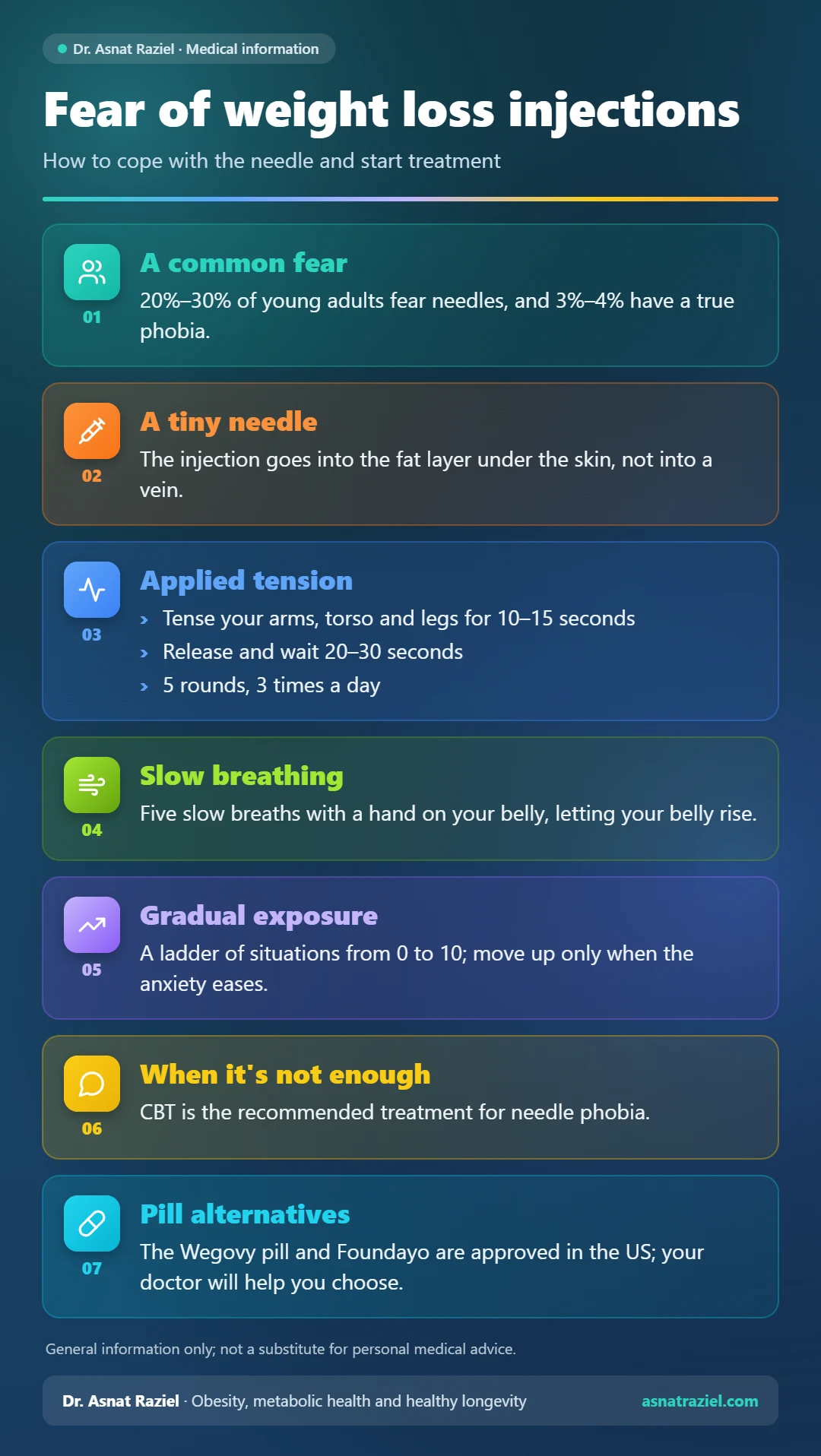
Fear of needles is far more common than most people think. A systematic review and meta-analysis of 119 studies found that most children are afraid of needles. Among young adults, the rate is 20% to 30%, and it usually declines with age. The fear is also more common in women than in men. Moreover, 16% of adult patients skipped a flu shot because of it.
However, ordinary fear is different from a clinical problem. Needle fear at the level of a true phobia, meaning fear that leads to consistent avoidance, affects about 3% to 4% of the population under strict definitions.
Why do some people faint?
In some people, the body has a special reaction called a vasovagal response. At first, heart rate and blood pressure rise for a moment. Then both drop quickly, which brings on dizziness, sweating, pallor and sometimes fainting. That is why coping with fainting differs from coping with ordinary anxiety, as I will explain below.
Fear of injections: what is really scary?
First, it helps to understand that standard weight-loss injections are very different from a blood test. The injection goes into the fat layer under the skin, not into a vein. The pens for drugs such as Wegovy and Mounjaro use very short, thin needles. In addition, international recommendations on injection technique, written for insulin, state that 4 mm pen needles are safe, effective and less painful.
In fact, for most of my patients, the pain itself is very slight. What weighs on them is the anticipation, the moment before pressing the button. So the main work is on thoughts and the body, not on the needle.
Proven techniques to overcome a fear of injections
Guy’s and St Thomas’ hospital in London publishes an excellent guide with techniques for coping with a fear of injections. Here are the main ones, adapted for a weekly injection at home.
Applied tension if you tend to faint
Applied tension, or deliberate muscle tensing, raises blood pressure and prevents the drop that causes fainting. Sit comfortably, then tense the muscles of your arms, upper body and legs for 10 to 15 seconds, until you feel warmth in your face. Next, release and wait 20 to 30 seconds. Repeat this five times, three times a day, for about a week before your first injection. Note: if you get a headache, do not tense your facial muscles.
Slow breathing when the problem is panic
On the other hand, if you do not faint but become anxious, breathing is your main tool. Sit upright but relaxed, place a hand on your belly, and take five slow breaths. Breathe in through your nose and out through your mouth, without straining. Here, too, it is worth practicing three times a day for a week.
A gradual exposure ladder
Write a list of situations related to needles, and rate each one from 0 to 10 by how distressing it feels. For example: thinking about the injection, looking at the pen, holding it, or pressing it against your skin without clicking. Start with the easiest step, stay with it until your anxiety drops, and only then move on. Sometimes you need to repeat a step several times, and that is perfectly fine.
Distraction and a fixed routine
Music, a conversation or a short video can reduce the sensation of pain. A fixed routine also helps a lot: the same day, the same time, the same place. Plan your day so the injection falls at a calm moment, not between two meetings. At first, you can also ask your partner to sit next to you.
Fear of injections and the first shot: practical tips
- Ask the nurse or doctor for a full demonstration at the clinic, and if possible, give the first injection there.
- Inject into the abdomen (at least 5 cm from the navel) or the thigh. When someone else gives the injection, the back of the upper arm is also an option.
- Change the injection site every week.
- With the Mounjaro pen, for example, you attach a new needle for each injection and hold the button down for about 5 seconds, according to the manufacturer’s instructions for use.
- Take a few slow breaths before pressing, and don’t rush.
If you are just starting out, it may help to go over each of these steps with your care team before your first dose.
When a fear of injections is too strong
Sometimes self-help techniques are not enough. In that case, cognitive behavioral therapy (CBT) is the recommended treatment for needle phobia. It is a short, focused treatment that usually works well. Local numbing creams such as EMLA are also available, but use them only in coordination with your doctor.
It is also important to remember that the fear does not always come alone. Sometimes it is part of broader anxiety or distress around weight. For this reason, I recommend keeping an eye on your mood throughout treatment, since weight-loss medications and mental health can affect each other.
Needle-free alternatives
Medicine is moving toward fewer needles. In other fields, regulators have already approved emergency drugs such as nasal epinephrine (adrenaline). In obesity care, the FDA approved the Wegovy pill (oral semaglutide at 25 mg a day) in December 2025. Then, in April 2026, the FDA also approved Foundayo (orforglipron), a daily pill you can take with or without food.
However, availability in Israel, price and personal suitability vary. Either way, a pill is not right for everyone. So it is best to weigh it together with your doctor, and not just because of the fear.
The bottom line
Fear of weight-loss injections is a natural and common reaction, not a reason to give up on treatment. Applied tension, slow breathing, gradual exposure and a fixed routine help most people within the first few weeks. When that is not enough, CBT is available, and so are pill alternatives. If the fear is holding you back, tell your care team. You can also read more about me and my clinic, or contact us with any questions.
The information in this article is general and does not replace personal medical advice.
Frequently asked questions
Is the fear of injections justified? Does it hurt?
Most patients describe a slight, brief sting. The needles in the pens are very short and thin, and the injection goes into the fat layer, not into a vein.
What should I do if I feel I am about to faint?
Sit or lie down right away. Then use applied tension in your arms and legs. It is a good idea to practice the technique in advance and not to be alone for the first few injections.
Can someone else inject me?
Yes. A family member who has learned the technique can give the injection, and then the back of the upper arm is also an option. Over time, many people switch to injecting themselves.
Can a weight-loss pill replace the injection?
For some patients, yes. In the US, the FDA has already approved the Wegovy pill and Foundayo. The decision depends on availability, expected effectiveness and your health status, so it is best made together with your doctor.
Sources
The fear of needles: A systematic review and meta-analysis
Needle phobia and overcoming your fear
New Insulin Delivery Recommendations
Mounjaro KwikPen: Instructions for use
FDA Approves Novo Nordisk’s Wegovy Pill, Marking First Oral GLP-1 for Weight Management