By Dr. Asnat Raziel, bariatric surgeon specializing in obesity treatment, metabolic health and healthy longevity; Director of the Multidisciplinary Center for Obesity Treatment, Assia Medical, Assuta Ramat HaChayal, Tel Aviv
The no-reflow phenomenon is one of the hidden problems of heart attack treatment: the blocked artery is opened, yet parts of the heart muscle still do not get enough blood. In this article, I explain a new laboratory study that points to the tiny cells responsible for this problem. It also suggests how GLP-1, the hormone behind drugs such as Ozempic and Wegovy, may help reopen the smallest blood vessels of the heart.
In recent years, GLP-1 drugs have become one of the central topics in medicine. They were first developed to treat type 2 diabetes. Later, it became clear that they are also very effective for treating obesity. Now it appears that their effect may be even broader.
A new paper published in 2026 in Nature Communications describes an intriguing biological mechanism. According to the researchers, the hormone GLP-1 does not only reduce appetite and improve metabolism. It may also protect the heart after a heart attack. The effect works through the tiny blood vessels that feed the heart muscle.
This finding could be very significant. If the mechanism is translated into clinical treatment, GLP-1 drugs may improve blood flow to the heart after an ischemic event. In this way, they may limit damage to the heart muscle and support recovery.
What is the no-reflow phenomenon?
When a person has a heart attack, one of the most important treatments is opening the blocked artery with an urgent catheterization. This procedure restores blood flow in the main coronary artery. Sometimes, however, the story does not end there.
According to the NHLBI heart attack treatment guide, procedures that open blocked arteries are often done as soon as a heart attack is confirmed, because early treatment limits heart damage.
Even after the large artery is opened, blood does not always reach the tiny vessels inside the heart muscle. These microscopic vessels may remain blocked. Doctors call this the no-reflow phenomenon.
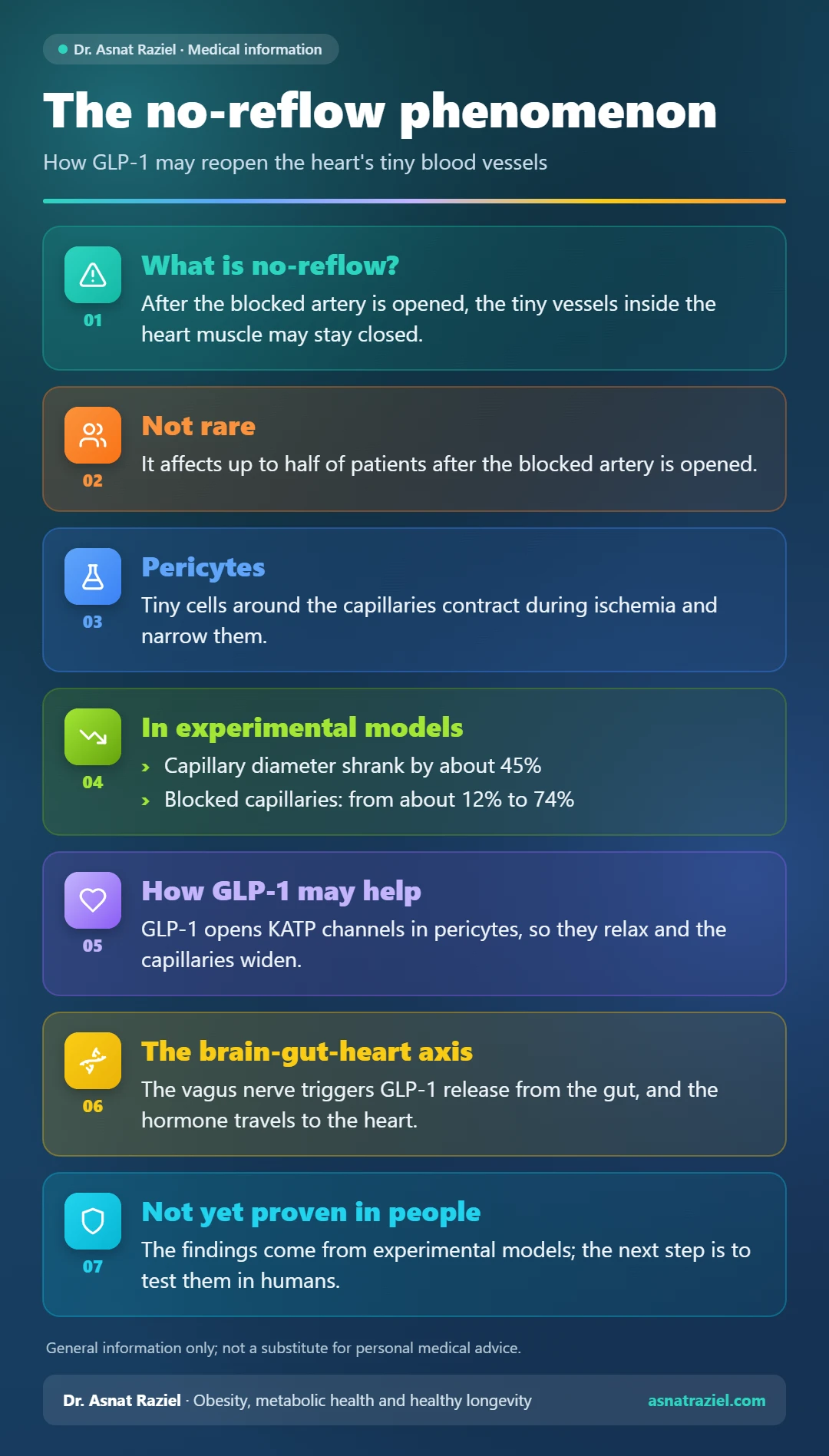
Although the artery is open and blood flows through it again, parts of the heart tissue do not receive enough blood and oxygen. The problem is not rare. It affects up to half of patients after the blocked artery is opened.
When the no-reflow phenomenon occurs, the damage to the heart muscle may be greater. The result can be weaker heart function, a larger infarct, a higher risk of heart failure and even higher mortality.
That is why understanding what blocks the tiny vessels has become one of the central challenges of modern cardiology. Researchers are looking for ways to improve blood flow at the level of the heart’s microcirculation as well.
Device makers are exploring this stage, too. For example, Israel Hayom reported on an Israeli first-in-human trial of a balloon placed in the heart’s main vein right after the blocked artery is reopened. The company says it should deliver more oxygen to the damaged heart muscle.
Pericytes: the cells that close the tiny vessels
The new study focused on special cells called pericytes. These are tiny cells that wrap around the capillaries, the smallest blood vessels in the body.
Pericytes act like microscopic muscles of the circulation. They can contract and relax. In this way, they control the width of the capillaries and the amount of blood that flows through them.
During ischemia, a state in which heart tissue lacks oxygen, the pericytes contract. This contraction narrows the capillaries and reduces blood flow.
The problem is that in many cases this contraction does not go away, even after the main artery is opened during catheterization. Although flow in the large artery returns, the capillaries themselves stay narrow and are sometimes blocked. As a result, parts of the heart muscle keep receiving less blood and oxygen. This is the core of the no-reflow phenomenon.
In experimental models, after an ischemic event the capillary diameter at the pericytes shrank by about 45%. At the same time, the share of blocked capillaries rose sharply, from about 12% under normal conditions to about 74% after ischemia.
These figures show how much pericyte contraction can impair blood flow inside the heart muscle. Even after the main coronary artery is opened, blood flow at the microvascular level may remain limited, and the no-reflow phenomenon persists.
How GLP-1 may counter the no-reflow phenomenon
The researchers found that the hormone GLP-1 can relax pericytes and reopen the tiny capillaries in the heart. When the capillaries widen, blood flow through the microvascular network improves. As a result, blood reaches heart tissue better, even after an ischemic event.
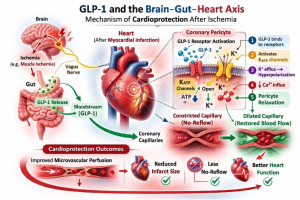
The mechanism works in several clear biological steps. First, GLP-1 binds to receptors on the surface of the pericytes. This binding activates special potassium channels in the cell, called KATP channels. When these channels open, potassium ions leave the cell.
The loss of potassium hyperpolarizes the cell membrane. This process reduces the entry of calcium into the cell. When the calcium level falls, the pericytes relax.
Relaxed pericytes allow the capillaries around them to widen. Consequently, resistance to blood flow drops and blood flow inside the heart muscle improves. Blood can reach areas damaged by ischemia and nourish the tissue.
The researchers also showed how essential this mechanism is. When they blocked the GLP-1 receptor or the KATP potassium channels, the protective effect disappeared completely. The capillaries stayed constricted, and blood flow did not improve.
These findings strengthen the understanding that GLP-1 does not act only on hunger or metabolism. It may also act directly on the blood vessels of the heart.
The brain-gut-heart pathway behind this protection
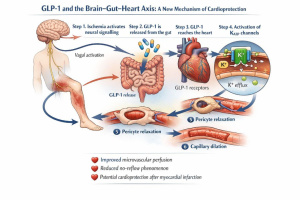
One of the most fascinating findings of the study is a biological communication pathway between different organs. The researchers found that when ischemia occurs in one organ, for example in the limb muscles, a nerve mechanism is activated through the vagus nerve. This is one of the main nerves of the autonomic nervous system.
Activation of the nerve leads to the release of GLP-1 from cells in the gut. The hormone enters the bloodstream, travels through the body and reaches the heart.
When GLP-1 reaches the heart, it activates biological mechanisms that may protect the heart muscle from ischemic damage. In this way, the body switches on an internal defense system in response to a lack of oxygen.
The findings point to a new communication axis between different organs: the brain, the gut and the heart. Along this axis, the nervous system, the digestive system and the cardiovascular system work together.
This cooperation between systems activates a natural protective mechanism. The mechanism helps maintain blood flow to the heart muscle and limit damage after an ischemic event. The researchers call it the brain-gut-heart signaling pathway, a biological signaling route that links the brain, the gut and the heart.
Why the no-reflow phenomenon matters clinically
In recent years, evidence from large clinical trials has shown that GLP-1 drugs reduce major cardiovascular events. Patients who take these drugs have lower rates of heart attack, stroke and cardiovascular death. Until recently, however, it was not entirely clear which biological mechanism explains this protective effect.
The new study offers a possible and important explanation. According to the findings, GLP-1 drugs do not work only through weight loss, better blood sugar levels or reduced inflammation. They may also act directly on the tiny vessels of the heart, ease the no-reflow phenomenon and improve microvascular blood flow after an ischemic event.
If this mechanism also works in humans, the clinical implications could be broad. Better blood flow to the heart’s capillaries may reduce infarct size after a heart attack and help preserve heart muscle tissue.
In addition, better blood flow may improve heart function after the event and reduce the risk of developing heart failure later on. Ultimately, this effect might also improve survival after a cardiac event. It could make GLP-1 drugs an important tool not only for treating obesity and diabetes, but also for protecting the heart. For the clinical side, see my article on GLP-1 drugs after a heart attack.
What this study does not prove yet
It is important to read these findings carefully. The measurements of pericytes and blocked capillaries come from experimental models, not from patients after a heart attack. Therefore, the study explains a possible mechanism, but it does not show that a GLP-1 drug prevents the no-reflow phenomenon in people.
The clinical benefit of GLP-1 drugs for the heart rests on other evidence: large clinical trials that showed fewer heart attacks, strokes and cardiovascular deaths. The new study may help explain that benefit. Still, the next step is to test whether the mechanism works in humans as well. Until then, it is a promising direction, not a new treatment.
If you are considering one of these drugs, the decision should be based on the proven indications and on a conversation with your doctor. You can read what to check first in my article on what to know before starting Wegovy or Mounjaro.
Beyond weight loss: a new paradigm in medicine
For years, GLP-1 drugs were seen mainly as tools for treating diabetes and obesity. They were meant to improve blood sugar control, reduce appetite and support weight loss. In recent years, however, more and more studies point to a much broader picture.
It now appears that this may be a drug family with deep, body-wide effects. The drugs do not act through a single pathway. They influence several biological mechanisms at the same time.
Beyond their metabolic effect, the drugs may improve metabolism, reduce inflammatory processes and protect the cardiovascular system. In addition, they may also act on the tiny blood vessels and improve blood flow in the tissues.
The new study adds an important layer to our understanding of how the heart is protected. It shows that the body’s systems do not work separately. Instead, they work as part of a complex network of communication between organs.
Through biological signaling pathways that connect the brain, the gut and the heart, the body activates sophisticated protective mechanisms. These mechanisms help it cope with stress and ischemia and preserve heart function.
The information in this article is general and does not replace personal medical advice.