By Dr. Asnat Raziel, bariatric surgeon specializing in obesity treatment, metabolic health and healthy longevity; Director of the Multidisciplinary Center for Obesity Treatment, Assia Medical, Assuta Ramat HaChayal, Tel Aviv
Cardiovascular outcome trials are the studies that tell us whether a drug actually prevents heart attacks, strokes and cardiac deaths. In this article, I walk through the key trials of the new obesity drugs one by one. For each trial, I explain what it proved, which patients took part, and where its conclusions stop.
Cardiovascular outcome trials: beyond weight loss
Ten years ago, the idea that obesity drugs could protect the heart sounded like a dream. For years, people saw these medications as a way to lose weight and improve appearance. In recent years, however, the picture has changed completely. Large studies now show that the new drugs affect not only weight but also the heart, blood vessels, kidneys and liver.
At the European Congress on Obesity, ECO 2026, a special session focused on heart outcome studies of drugs in the GLP-1 and GIP families. The experts stressed that obesity medicine is moving from a focus on weight to a broader view of cardiometabolic health, meaning the health of the heart, blood vessels and metabolism together. The message was clear: treating obesity is gradually becoming a way to prevent heart disease as well.
How cardiovascular outcome trials came about
The road to this change was long. In the previous decade, most diabetes drug trials asked a single question: is the drug safe for the heart? After concerns about some older drugs, health authorities required proof that new treatments did not raise the risk of cardiac events.
Then something surprising happened. Very large trials showed that some of the new drugs were not only safe for the heart but also reduced heart attacks, strokes and cardiac deaths. This was the start of the era of CVOTs, or cardiovascular outcome trials. These trials measure hard clinical events, not just lab values.
SELECT: heart protection without diabetes
One of the most important studies discussed at the congress was the SELECT trial. It tested semaglutide at a dose of 2.4 mg, the active ingredient in Wegovy. The trial enrolled 17,604 people aged 45 and older who had overweight or obesity and existing heart disease, but no diabetes.
The results were clear-cut. A major cardiac event (cardiac death, heart attack or stroke) occurred in 6.5% of patients on semaglutide, compared with 8.0% on placebo. That is a 20% relative reduction in risk. Following the trial, the U.S. Food and Drug Administration (FDA) approved Wegovy in March 2024 to reduce cardiovascular risk as well. For the first time, an obesity drug had proven that it protects the heart. I cover the trial in more depth in my article on how Wegovy protects the heart in the SELECT trial.
The medical significance is enormous. Obesity is no longer just an indirect risk factor that works through diabetes or high blood pressure. It is a biological disease, and treating it directly lowers cardiac risk.
Cardiovascular outcome trials show more than weight loss
One of the most interesting shifts in the field is the understanding that GLP-1 drugs act on many systems at once. Beyond weight loss and better blood sugar control, they reduce chronic inflammation and blood pressure. In addition, they improve blood lipids, blood vessel function and kidney function, and they shrink the fat around the internal organs.
The experts at the congress emphasized that part of the effect on the heart does not come from weight loss alone. An analysis of SELECT data published in The Lancet in October 2025 found that only about a third of the benefit was explained by a smaller waist circumference. Moreover, the amount of weight lost in the first months did not predict later cardiac risk. In other words, direct biological mechanisms are most likely at work here too. I describe the bigger picture in my article on cardiovascular-kidney-metabolic syndrome.
SURPASS-CVOT: tirzepatide against a proven drug
Since the congress, another important verdict has arrived. The SURPASS-CVOT trial compared tirzepatide, the active ingredient in Mounjaro, with dulaglutide. Dulaglutide is a GLP-1 drug that had already been shown to protect the heart. The trial included 13,299 patients with type 2 diabetes and atherosclerotic heart disease.
A major cardiac event occurred in 12.2% of patients on tirzepatide, compared with 13.1% on dulaglutide. Tirzepatide was not inferior to the protective drug, but it was not proven superior to it either. Based on these results, the FDA approved Mounjaro on August 28, 2026 to reduce cardiovascular risk in high-risk adults with type 2 diabetes. You can read more in my article on what the Mounjaro heart approval means for people with diabetes.
SUMMIT: heart failure with preserved ejection fraction
One of the most intriguing areas today is the link between obesity and heart failure. This mainly refers to HFpEF, or heart failure with preserved ejection fraction. In this condition, the heart struggles to relax and fill properly. Obesity sharply raises the risk of HFpEF through inflammation, fat around the heart, high blood pressure and metabolic damage.
The congress also featured the SUMMIT trial of tirzepatide. It enrolled 731 patients with HFpEF and obesity. Cardiac death or worsening heart failure occurred in 9.9% of patients on tirzepatide, compared with 15.3% on placebo. In addition, patients’ quality of life clearly improved. That is why this field is likely to become central to cardiology in the coming years.
SURMOUNT-OSA: sleep apnea is not just snoring
Another study mentioned at the congress was SURMOUNT-OSA, which tested tirzepatide in obstructive sleep apnea. In patients who did not use a CPAP machine, the apnea-hypopnea index (AHI) fell by 25.3 events per hour with tirzepatide, compared with 5.3 on placebo. Following the trial, the FDA approved Zepbound (tirzepatide for obesity) in December 2024 as the first drug for obstructive sleep apnea in people with obesity.
Sleep apnea raises the risk of high blood pressure, heart rhythm disorders, stroke and heart failure. Therefore, treating it improves both sleep and cardiac risk. I write more about this in my article on obesity and sleep apnea.
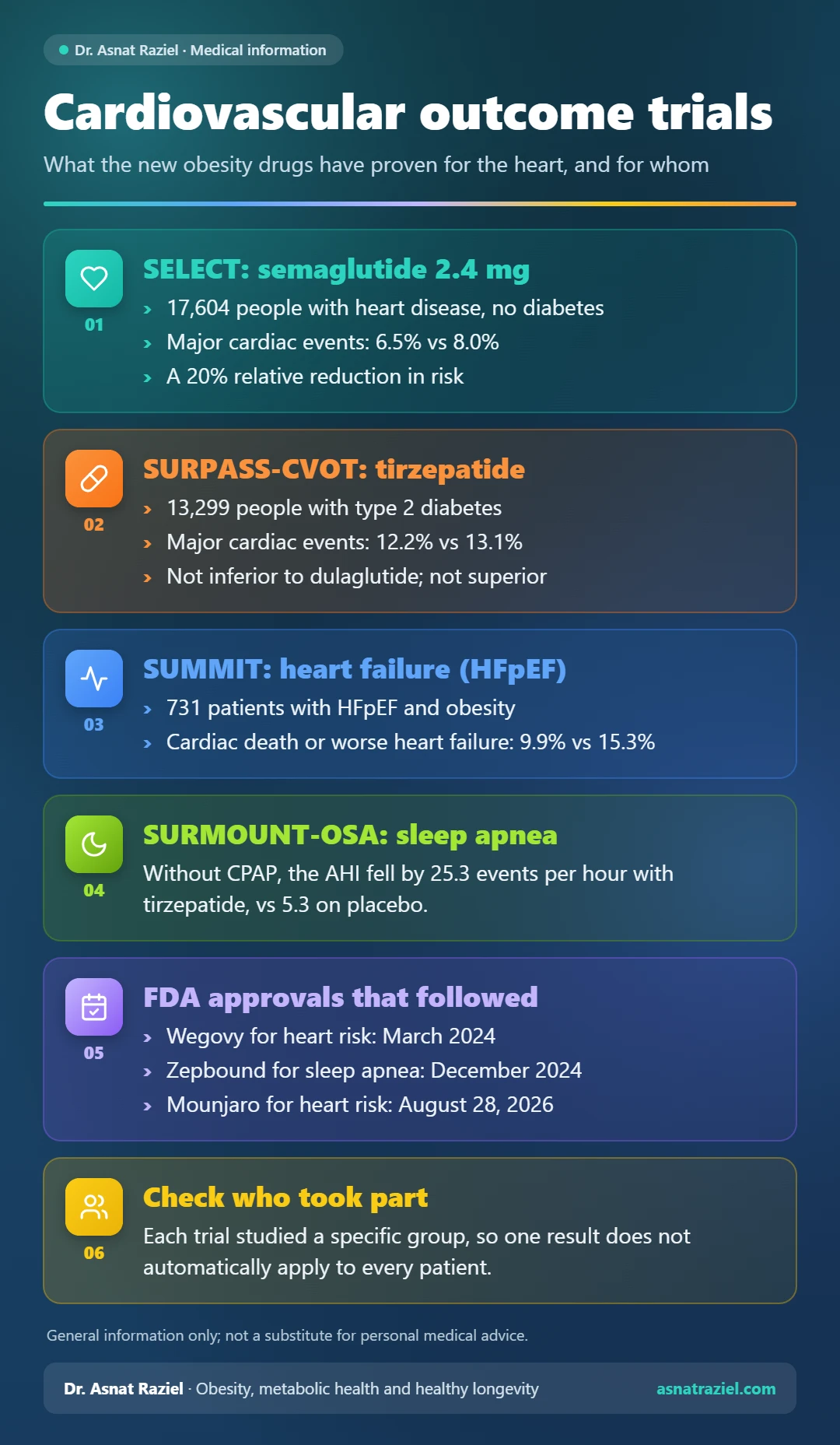
Who each trial applies to: a short reading guide
When you read about these trials, it helps to ask one simple question: who took part? Each trial answers a different question, in a different group of patients.
- SELECT: semaglutide 2.4 mg in people aged 45 and older with overweight or obesity and existing heart disease, but without diabetes.
- SURPASS-CVOT: tirzepatide in people with type 2 diabetes and atherosclerotic heart disease, compared with dulaglutide rather than placebo.
- SUMMIT: tirzepatide in people with obesity and heart failure with preserved ejection fraction.
- SURMOUNT-OSA: tirzepatide in people with obesity and obstructive sleep apnea.
In other words, a result from one trial does not automatically apply to every patient. That is also why your own diagnosis matters so much when choosing a treatment.
Cardiovascular outcome trials and a new metabolic medicine
One of the strongest messages at the congress was that the term “weight-loss drugs” is no longer accurate. Many experts now speak of cardiometabolic therapies. The goal is not only to reduce weight. It is also to lower the risk of heart disease, diabetes, fatty liver, heart failure and sleep apnea.
Still, it is important to be precise. Heart protection has been proven in specific trials, in specific populations and at specific doses. Treatment is tailored to each patient according to their condition, their other medical conditions and the approved indication.
The future: prevention at an early stage
Future studies will explore even broader questions. Will treating obesity prevent heart disease even before diabetes appears? Will we match treatment to a personal cardiometabolic profile? And will cardiologists treat obesity as a core part of cardiology? The direction is clear. Obesity is one of the main engines of chronic disease in the modern world. I discuss the wider link between obesity and the heart in my article on how obesity is changing cardiovascular medicine.
Bottom line on cardiovascular outcome trials
The data from cardiovascular outcome trials of obesity drugs have grown much stronger over the past three years. SELECT proved heart protection without diabetes, SUMMIT showed a benefit in heart failure, and SURPASS-CVOT led to a heart approval for Mounjaro. Ultimately, the new medications are not just weight-loss drugs. They are becoming central tools for protecting the heart, the blood vessels and the metabolic health of millions of people.
Pills are part of this story too, and I summarize the orforglipron phase 3 trials in a separate article.
The information in this article is general and does not replace personal medical advice.
References
Semaglutide and Cardiovascular Outcomes in Obesity without Diabetes
Tirzepatide Gets FDA Approval to Cut Cardiovascular Risk in Type 2 Diabetes
Cardiovascular Outcomes with Tirzepatide versus Dulaglutide in Type 2 Diabetes
Tirzepatide for Heart Failure with Preserved Ejection Fraction and Obesity
Tirzepatide for the Treatment of Obstructive Sleep Apnea and Obesity
FDA Approves First Medication for Obstructive Sleep Apnea
The studies were funded by Novo Nordisk and Eli Lilly, the companies that make the drugs.