By Dr. Asnat Raziel, bariatric surgeon specializing in obesity treatment, metabolic health and healthy longevity; Director of the Multidisciplinary Center for Obesity Treatment, Assia Medical, Assuta Ramat HaChayal, Tel Aviv
Weight-loss drugs and frailty: what has changed in the medical conversation
Weight-loss drugs and frailty have become a central question in obesity medicine for older adults. In this article, I focus on the safety side: how to use these drugs after 65 while protecting muscle, strength and independence. I have written separately about what new research shows about semaglutide in older adults and about the wider challenges of weight loss later in life.
Drugs in the GLP-1 family, including Wegovy and Mounjaro, have become a central tool in treating obesity and diabetes. They lead to significant weight loss, improve blood sugar control and reduce the risk of cardiovascular disease.
But as their use expands, we are learning that in older age the story is far more complex. The question is not only how many kilograms are lost. It is also what the body loses along the way, and what the functional cost of that weight loss is. The main message of the current literature is clear: these drugs are effective in older age too, but they call for a careful, personal and multidisciplinary approach.
Why treatment in older age is different
For younger and middle-aged people, weight loss is almost always an achievement. In older age, however, it can be a double-edged sword. Many people aged 65 and over have a low muscle reserve even before treatment. In addition, many suffer from reduced strength, frailty and a high risk of falls.
In this situation, rapid weight loss without preserving muscle can worsen function and threaten independence. Often this is obesity with hidden sarcopenia, meaning low muscle mass that is masked by fat. So treatment aimed only at the number on the scale may miss the target. I explain why this matters in my article on why body composition matters more than weight.
Are weight-loss drugs effective in older age?
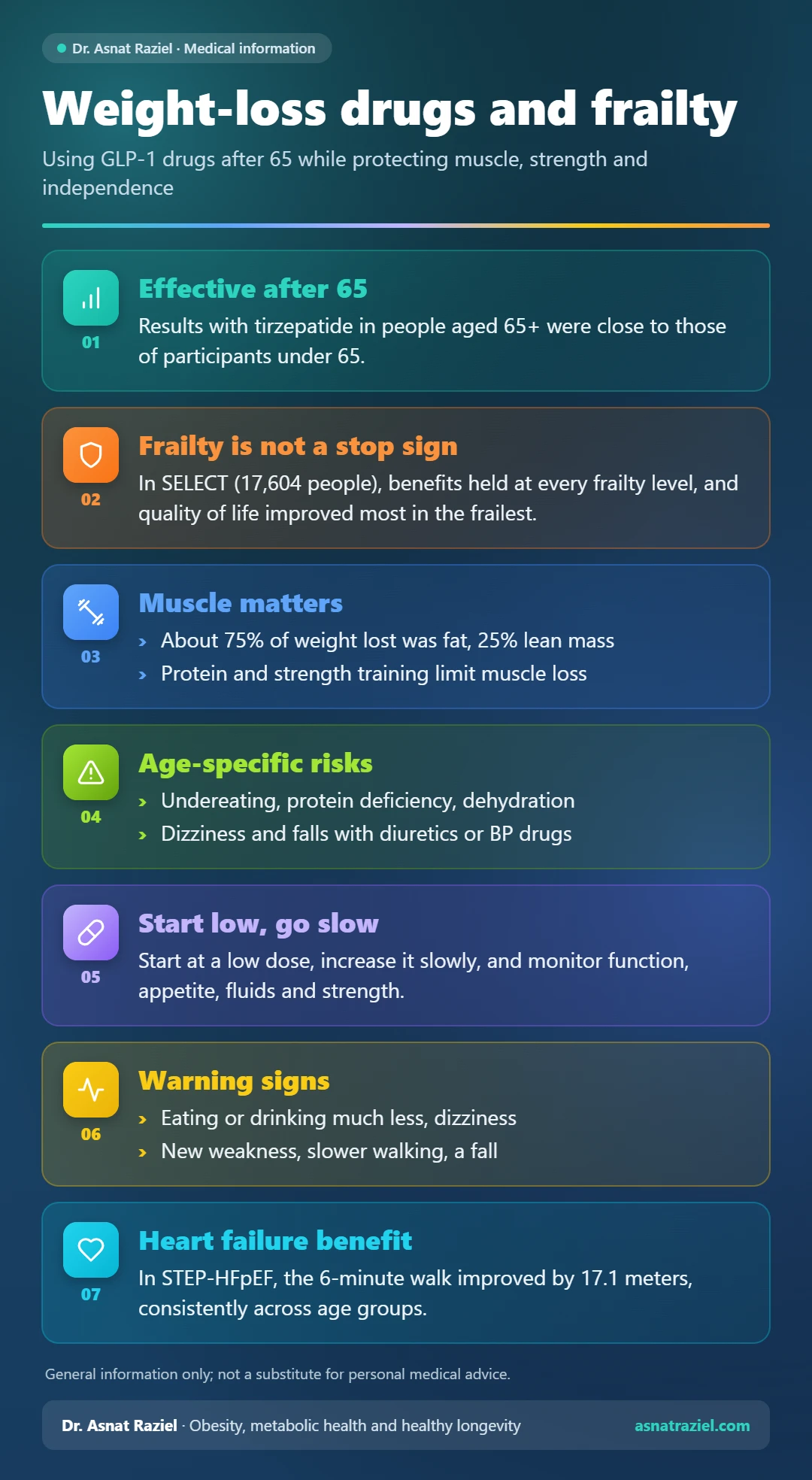
The new data are reassuring. A 2026 analysis examined tirzepatide, the active ingredient in Mounjaro, in people aged 65 and over. The analysis included the SURMOUNT trials, the sleep apnea trial and the SUMMIT trial in heart failure. Weight loss, improvement in risk factors and quality of life were close to the results of participants under 65.
With semaglutide, the active ingredient in Wegovy, the picture is similar. An analysis of the SUSTAIN 6 and PIONEER 6 trials in people with diabetes looked at four age groups, including people over 70. The drug reduced cardiac events and weight in all groups. In addition, the rate of severe hypoglycemia, a dangerous drop in blood sugar, did not rise compared with placebo.
Weight-loss drugs and frailty: not an automatic reason to give up
One of the most important findings of 2026 concerns frailty. An analysis of the SELECT trial divided 17,604 participants by a frailty index. Semaglutide reduced heart failure events, hospitalizations and death from any cause, with no difference by level of frailty. What is more, the improvement in quality of life was especially large among the frailest participants.
The researchers stress that this is a secondary analysis, so it raises a hypothesis rather than proving it. Still, their conclusion is clear: frailty alone should not rule out weight-loss drugs. The concern about hypoglycemia is especially low when the drugs are given without insulin or a sulfonylurea.
Weight-loss drugs and frailty: muscle takes center stage
One of the most prominent topics in the scientific discussion is the drugs’ effect on muscle mass. In a SURMOUNT-1 substudy, 160 participants had a DXA scan, a test that maps fat and muscle. About 75% of the weight lost was fat, and about 25% was lean mass. The researchers saw a similar ratio in the group aged 65 and over.
In other words, some muscle loss is an expected part of weight loss, but it is not inevitable. A protein-rich diet and regular strength training can limit it and preserve strength and function. The message is sharp: protein and exercise are not a nice extra, but an essential part of treatment. You will find practical guidance in my article on preserving muscle mass on weight-loss medication.
Side effects and age-specific consequences
The drugs’ side effects, mainly in the digestive system, are well known. In older age, however, their consequences can be much heavier. A drop in appetite can lead to undereating, protein deficiency and dehydration. In addition, combining the drugs with diuretics or blood pressure medication raises the risk of dizziness and falls.
That is why the recommendation is to start at a low dose and increase it slowly. It is important to monitor function, appetite, fluid intake and strength, not just weight. More details appear in my article on the side effects of GLP-1 drugs.
Weight-loss drugs and frailty: warning signs during treatment
When weight-loss drugs and frailty meet, the risks are functional, so the warning signs are functional too. Based on the risks described above, watch for:
- Eating much less than usual, or skipping meals altogether.
- Drinking less, or feeling dizzy when standing up.
- New weakness, slower walking or difficulty getting up from a chair.
- A fall, or a near fall.
If any of these appear, contact your care team. The pace of treatment, the diet or other medications may need adjusting. The goal is to lose fat, not strength.
Who are weight-loss drugs especially suitable for in older age?
According to current evidence, GLP-1 drugs are especially suitable for older adults with:
- Type 2 diabetes and excess weight.
- Obesity with related conditions in which weight loss improves function, such as sleep apnea, joint pain or fatty liver.
- A high risk of cardiovascular disease, or heart failure with obesity.
There is one clear condition: treatment is given as part of a multidisciplinary approach, not as a stand-alone drug solution. For example, in people with heart failure and obesity, the STEP-HFpEF trials showed an improvement of 17.1 meters in a 6-minute walk test. The effect was also consistent across age groups.
Treatment principles emerging from the literature
In our clinic, we follow several principles:
- A functional assessment before starting treatment.
- Goals beyond weight, including strength, walking and independence.
- Personalized protein intake.
- Strength training, even at moderate intensity.
- Monitoring function, not just kilograms.
- Planning the maintenance phase from the very start.
Looking ahead
Despite the progress, large studies in people aged 80 and over are still lacking. A review in the journal Drugs & Aging concluded that there are still no dedicated guidelines for drug treatment of obesity in older age. The researchers therefore call for studies that also examine geriatric outcomes: muscle preservation, bone quality and fat distribution. This is likely to be the main direction of research in the coming years.
Weight-loss drugs and frailty: the bottom line
Weight-loss drugs in older age are an important tool, but their success depends on how they are used. When given carefully, with nutritional and exercise support and functional monitoring, they improve more than weight and blood sugar. They can also improve quality of life and independence. Ultimately, in older age the goal is not just to get thinner. The goal is to stay strong, steady and independent.
The information in this article is general and does not replace personal medical advice.
References
Pharmacological Treatment of Obesity in Older Adults
The tirzepatide trials were funded by Lilly, and the semaglutide trials by Novo Nordisk.




