By Dr. Asnat Raziel, bariatric surgeon specializing in obesity treatment, metabolic health and healthy longevity; Director of the Multidisciplinary Center for Obesity Treatment, Assia Medical, Assuta Ramat HaChayal, Tel Aviv
Food noise research: what is food noise in the first place?
Food noise research has moved fast in the past two years. Today we can measure it with a short questionnaire, estimate how many people live with it and test how treatments change it. In this article, I focus on the data: what researchers measure, what the surveys found and what the drug studies showed.
Food noise is a state in which your thoughts keep returning to food, even without real hunger. In recent years, the term has become central in obesity care and metabolic health. Many people experience it, but only recently has science begun to define and measure it. That is why it is important to understand: someone who is preoccupied with food all day is not necessarily lacking self-control. Often it is an expression of a phenomenon that starts in the brain, not in the stomach.
This understanding changes the medical point of view. Instead of focusing only on what people eat, we also look at the mechanisms that lead to eating. A previous article of mine dealt with the chemistry of hunger and practical ways to treat constant food thoughts. This time, we will focus on why it happens and what the new food noise research teaches us.
Not hunger, but thoughts that won’t let go
Food noise is not ordinary hunger. It does not start with a feeling of emptiness in the stomach, but with a crowded head. For example, a person plans the next meal while still in the middle of the current one. They check again and again what is in the fridge, or feel an urge to eat something more. Many patients describe it as an “inner noise” that never stops.
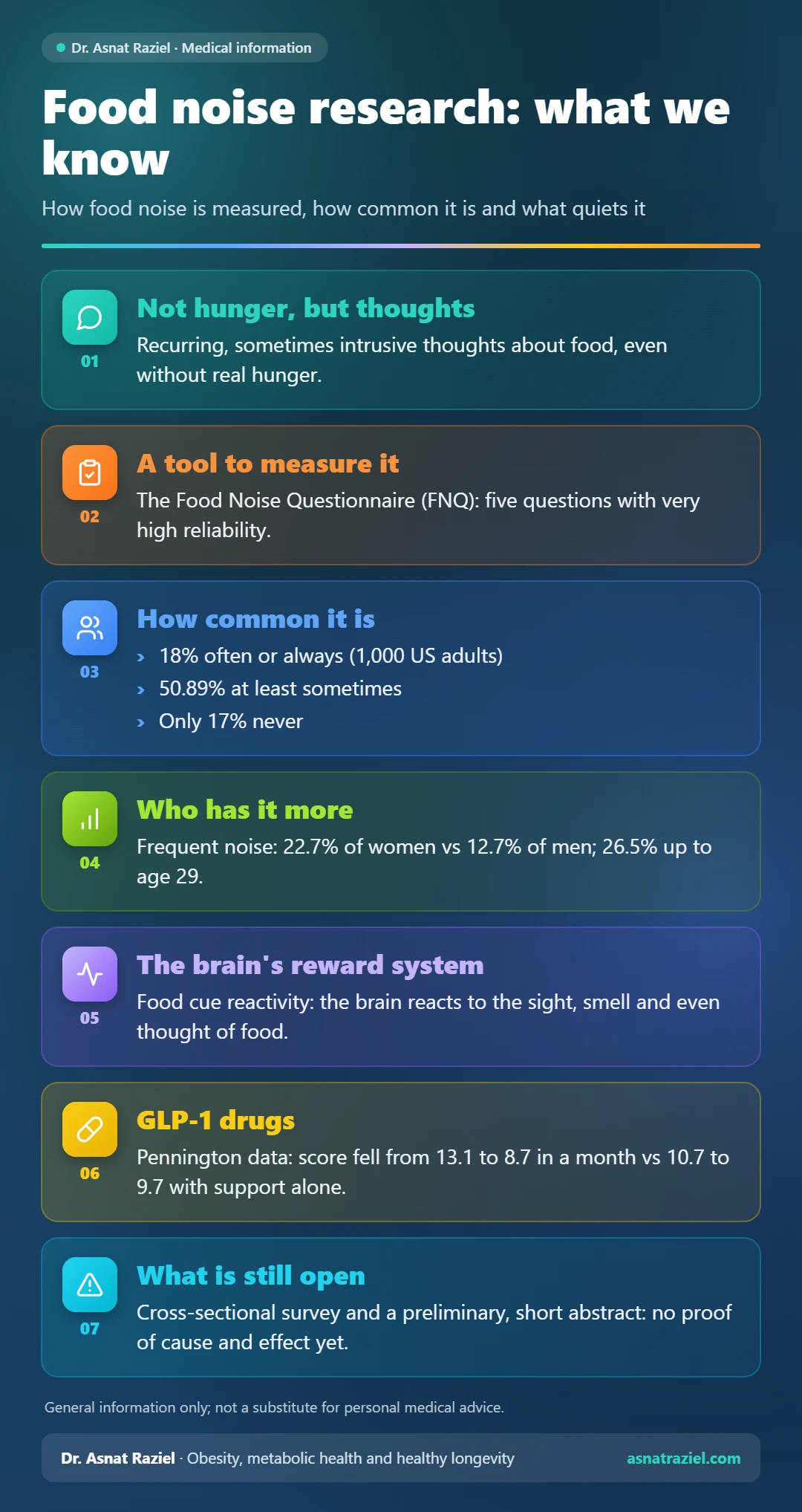
These thoughts keep coming back and are sometimes intrusive. They steal attention, hurt concentration and create a feeling of constant struggle. To measure the phenomenon, researchers developed the Food Noise Questionnaire (FNQ). The questionnaire includes only five questions, and in testing it showed very high reliability. In other words, there is now a scientific tool that makes it possible to track food noise throughout treatment. For food noise research, that is a turning point.
Food noise research: how many people experience it?
A nationally representative survey in the United States, published in 2026, examined the question in 1,000 adults. About 18% of them reported such noise often or always. In addition, 50.89% experienced it at least sometimes. Only 17% said they never experience it.
The data also revealed differences between groups. Frequent food noise appeared in 22.7% of women, compared with 12.7% of men. Up to age 29, the rate reached 26.5%. The strongest link was with a feeling of loss of control over eating. However, the researchers stress that this is a preliminary cross-sectional study, so it raises hypotheses and does not prove cause and effect.
Food noise and the brain’s reward system
To understand the phenomenon, we need to look at the brain. The reward system, which works partly through dopamine, is responsible for the feeling of pleasure and the anticipation of it. Food high in sugar and fat activates this system very strongly. In this way, the brain learns to expect pleasure, even when the body does not need energy.
A scientific review from Penn State University suggests understanding the noise through a concept called food cue reactivity. In other words, the brain reacts strongly to the sight, the smell and even the thought of food. The reaction depends on each person’s hunger level, stress, habits and biology. Hence the situation many people know well: the body is full, but the brain keeps “talking” about food. I also wrote about the link between the brain and appetite in my article on hunger that starts in the brain and food cravings.
Why is the phenomenon so common today?
The environment we live in feeds the noise. Food is available at every moment, and we encounter it on screens, in ads and on social media. Every such cue brings our thoughts back to food. In addition, ultra-processed foods are built to increase the desire for more. The combination of sugar, fat and texture activates the reward system especially strongly. I expanded on this in my article on ultra-processed food and the brain.
Stress also plays an important role. Emotional overload, fatigue and pressure strengthen the tendency to think about food and to seek comfort in it. In this way, eating becomes a tool for emotional regulation, and the cycle grows stronger. Paradoxically, strict diets can also make the phenomenon worse. When you try hard “not to think” about food, the brain actually intensifies the preoccupation with it.
How food noise affects quality of life
Food noise is not just a nutritional challenge. The recurring thoughts create a mental load, hurt concentration and increase fatigue. Many people experience frustration, guilt and a sense of failure, even when they put in a great deal of effort. The stronger the noise, the harder it is to stick with the process and maintain results. The meaning is clear: this is not just an eating behavior, but an ongoing mental experience.
Food noise research on medication: when the thoughts calm down
One of the most important developments came from modern drug treatment. Many patients report that alongside weight loss, their thoughts about food also quiet down. For some of them, this is the first time they have felt inner calm around food. A controlled study of semaglutide already showed less hunger and fewer food cravings in 2017. In addition, participants reported better control over eating.
In 2026, researchers from the Pennington Biomedical Research Center presented new data at the European Congress on Obesity. They studied 417 adults in a digital weight-loss program. Among those who started a GLP-1 drug alongside behavioral support, the food noise score fell from 13.1 to 8.7 within a month. By contrast, in the group that received behavioral support alone, the score fell from 10.7 to 9.7. However, this is early food noise research: a preliminary abstract with short follow-up, and Weight Watchers funded the study. You can read how the drugs act on the brain’s fullness centers in my article on how the new obesity drugs work on the brain.
Food noise research: what we know and what we don’t yet
When I sum up food noise research for patients, I separate what is solid from what is still open. We can now measure food noise with a validated five-question tool, the FNQ. We also know it is common: in a national survey of 1,000 American adults, 18% reported it often or always, more often women and people up to age 29. On the other hand, that survey was cross-sectional and cannot show cause and effect. Likewise, the drug data are encouraging but short. The drop from 13.1 to 8.7 was measured over a single month, in a preliminary abstract funded by Weight Watchers.
How can food noise be reduced?
The modern approach combines several tools, because there is no single solution that suits everyone. First, structured, organized eating reduces the need for constant decisions. As a result, the mental load also drops. Second, physical activity helps balance both body and brain and improves mood. In addition, good-quality sleep supports hormonal balance and reduces stress.
Moreover, tools from the world of mindfulness help you notice the thoughts without acting on them automatically. People who eat in response to emotions will find more tools in my guide to coping with emotional eating. Finally, in suitable cases, drug treatment can reduce the intensity of the noise and make the whole process easier.
A shift in medical thinking
Understanding food noise changes how we view obesity. It widens the discussion beyond calories and menus. Instead, it turns attention to the biological and mental mechanisms that drive behavior. Today, many professionals see food noise as an important marker in the treatment process. The question is not only how much weight a person has lost, but also how much their inner experience has changed.
The bottom line
Ultimately, food noise research shows that this is a real, measurable and common phenomenon. It is not a weakness and not a lack of discipline. Success in treatment is not measured only by the numbers on the scale. We also measure it by a sense of calm, freedom and control.
The information in this article is general and does not replace personal medical advice.
Questions and answers
Is food noise the same as hunger?
No. It is not physical hunger, but recurring thoughts about food that start in the brain.
Does everyone have food noise?
No. In the American survey, 17% said they never experience it. The phenomenon is common in people with overweight or obesity, but it also appears in others.
Can you control the noise on your own?
Sometimes lifestyle changes reduce it. However, in many cases a broader treatment approach is needed.
Can medication help?
Yes. Treatments in the GLP-1 family also affect thoughts around food, not just appetite.
Does the noise disappear completely?
In some people it decreases greatly and even disappears, especially when treatment is personalized.
References
What Is Food Noise? A Conceptual Model of Food Cue Reactivity
Development and validation of the Food Noise Questionnaire
Weight Watchers funded the Pennington study, and researchers from the company took part in the Food Noise Questionnaire study. Novo Nordisk funded the semaglutide study.