By Dr. Asnat Raziel, bariatric surgeon specializing in obesity treatment, metabolic health and healthy longevity; Director of the Multidisciplinary Center for Obesity Treatment, Assia Medical, Assuta Ramat HaChayal, Tel Aviv
Hedonic hunger: the brain, pleasure and obesity
Hedonic hunger is the drive to eat for pleasure, even when the body doesn’t need energy. At the European Congress on Obesity, ECO 2026 in Istanbul, one of the most fascinating lectures was devoted to this topic. It wasn’t about the stomach, body fat or medications. Instead, it tackled a basic question: why do we eat?
The keynote was given by Prof. Turgay Dalkara, a neurologist and brain researcher at Bilkent University in Turkey. He described the mechanisms that govern hunger, fullness, the pleasure of food and the drive to seek it out. In addition, he linked them to emotions, memories, stress, culture and habits. His message was clear: human eating is not controlled by energy needs alone. Rather, a whole neural network connects the body, our emotions and the modern environment.
The brain doesn’t just count calories
According to Dalkara, most of the body’s survival mechanisms work quietly. We don’t feel how the body regulates blood pressure, temperature or blood sugar. Hunger, however, has to become a conscious feeling. Only then does it get us up and looking for food.
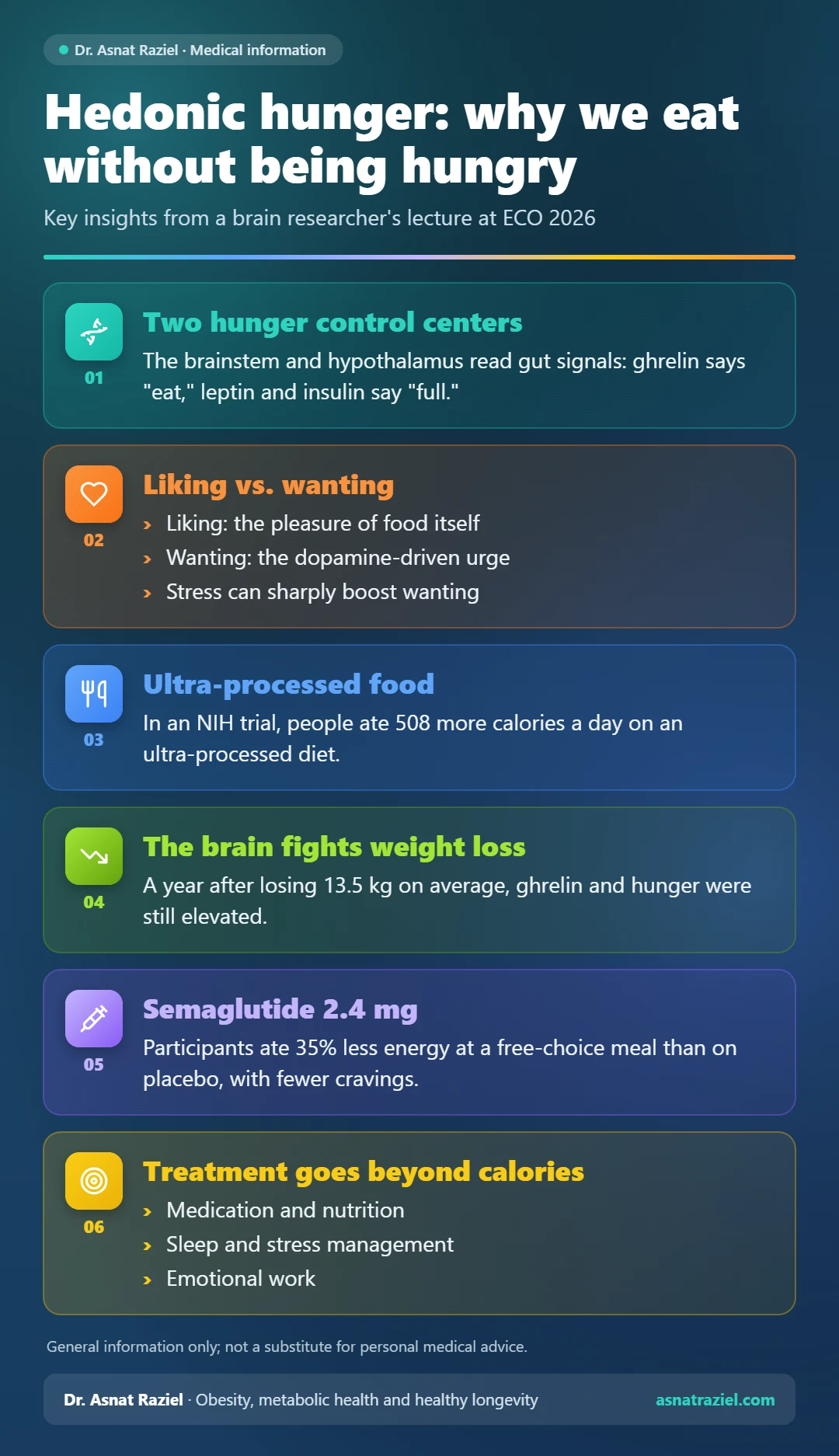
Two brain regions start the process. The first is the brainstem, which receives information from the digestive system through the vagus nerve. The second is the hypothalamus, a small control center that is in constant conversation with the stomach, the pancreas and fat tissue. When the stomach is empty, it releases ghrelin, a hormone that signals the brain that energy is needed. On the other hand, leptin and insulin signal that the stores are full and promote satiety. You’ll find a detailed explanation of this system in my article on the hormones and brain circuits behind satiety. But that is only where the story begins.
Hedonic hunger: food is also emotion, memory and pleasure
Once the brain picks up these biological signals, they travel on to the limbic system. This is a deep emotional region responsible for feelings, reward and pleasure. One of its key areas is the nucleus accumbens. Inside it are tiny pleasure hotspots that amplify the enjoyment of sweet taste, alongside areas linked to aversion and discomfort.
That’s how the brain turns a need for energy into an emotional experience. We’re not just hungry. We want, we crave, we enjoy, and we look for comfort and reward. The term hedonic hunger, proposed by appetite researchers almost twenty years ago, describes exactly this gap between physiological need and desire.
Liking and wanting: two systems in the brain
Dalkara distinguished between two important concepts. Liking is the pleasure of the food itself. Wanting, by contrast, is the drive and motivation to get it. According to a review by neuroscientist Kent Berridge and a colleague, these are partly separate systems in the brain. The wanting system is tied to dopamine and the reward circuitry. That’s why stress, tension and emotional overload can sharply increase the urge to eat, even without real hunger. I also explain this connection in my article on stress and obesity.
Humans don’t eat like lab animals
One amusing part of the lecture dealt with the difference between people and laboratory animals. Lab animals have taught us a great deal about hunger and fullness. Even so, humans add many more layers: culture, religion, memories, family meals, advertising, habits and planning ahead. “Lab animals don’t go out to restaurants,” Dalkara said with a smile. We do.
We eat on holidays, at meetings and in front of the TV. In addition, we eat out of nostalgia, fatigue, pressure, boredom or joy. Sometimes we eat simply because “it’s dinnertime,” even when the body isn’t hungry at all. Dalkara also described people who eat large amounts before a religious fast, although they aren’t hungry. The reason is that the brain plans ahead for the expected shortage.
The modern environment widens this gap even further. In a controlled trial at the US National Institutes of Health, participants on an ultra-processed diet ate 508 more calories a day than on an unprocessed diet. This happened even though the meals were matched for calories, sugar, fat and fiber. So cravings don’t come only from free will. They also come from what’s in front of us.
What happens in the brain during a diet?
An important part of the lecture focused on the brain’s plasticity. According to Dalkara, fasting and weight loss change the connections between nerve cells in the hunger centers. In animal studies, these changes later increase hunger and the tendency to regain weight.
We see a similar picture in humans. In a study published in NEJM, 50 participants lost an average of 13.5 kg on a low-calorie diet. A year later, their ghrelin levels were still higher than at baseline, and their hunger remained strong. In other words, the brain doesn’t “like” a drop in energy stores, and it switches on powerful compensation mechanisms.
The lecture reinforced one of the central insights of obesity medicine. Obesity is not a failure of willpower. Rather, it is a biological and neurological condition in which the brain itself defends body weight. You can read more about this in my article on obesity as a chronic disease.
How do the new medications affect hedonic hunger?
The mechanisms described in the lecture help explain why GLP-1 and GIP medications work so well. Wegovy and Ozempic contain semaglutide. Mounjaro contains tirzepatide. These drugs don’t act only on the stomach or the pancreas. They also influence the brain’s centers for hunger, reward and craving.
For example, in a controlled trial of semaglutide 2.4 mg, participants ate 35% less energy at a free-choice meal than on placebo. In addition, they reported better control of eating and fewer, weaker cravings. Many patients describe a drop in “food noise,” the constant preoccupation with food. In other words, these drugs don’t just lower appetite. They change the way the brain experiences food. I expand on this in my article on why we think about food all the time.
Eating to survive or eating for pleasure?
At the end of the lecture, Dalkara concluded that in humans, pleasure and reward mechanisms sometimes override survival mechanisms. In a world where food is available on every corner and comes with nonstop stimuli, the brain struggles to stay balanced.
The clinical implications are profound. To treat obesity effectively, talking about calories is not enough. We need to understand the brain, emotions, the environment and the reward system. For this reason, the right treatment often combines medication, nutrition, sleep, stress management and emotional work. You’ll find practical tools in my guide on how to overcome emotional eating.
The bottom line on hedonic hunger
Hedonic hunger is not a weakness. It is an ancient brain system designed to keep us alive, and today it meets an environment full of temptations. Understanding this removes guilt and points the way to the right treatment. Ultimately, the better we understand the brain, the better we can help patients eat by choice rather than by compulsion.
The information in this article is general and does not replace personal medical advice.
References
Hedonic hunger: a new dimension of appetite?
‘Liking’ and ‘wanting’ in eating and food reward: Brain mechanisms and clinical implications
Advances in the neurobiological bases for food ‘liking’ versus ‘wanting’
Long-term persistence of hormonal adaptations to weight loss




