By Dr. Asnat Raziel, bariatric surgeon specializing in obesity treatment, metabolic health and healthy longevity; Director of the Multidisciplinary Center for Obesity Treatment, Assia Medical, Assuta Ramat HaChayal, Tel Aviv
Exercise snacks and smartwatches: technology that knows when to get up
Exercise snacks, short bursts of movement spread through the day, are at the heart of a new wave of obesity research. Could your smartwatch soon recognize that you are about to sink into another hour of sitting? And could it send you a small suggestion to move at exactly the right moment? Studies presented at the European Congress on Obesity, ECO 2026, tried to answer these questions.
Instead of asking people to “start working out,” researchers are looking for ways to fit short, tailored movement into everyday life. To do this, they combine artificial intelligence, wearable sensors and real-time questionnaires. This article is not about which device to buy. If that is your question, see my comparison of smart rings and smartwatches. Here, the focus is on timing: when and how a wearable can prompt you to move.
From the lab to real life
One of the biggest problems in physical activity research is the gap between the lab and real life. People sit, stand up, get tired and rush around. They work, care for children and cope with emotional and physical strain. That is why researchers developed a platform called HealthReact. It links a fitness band with short questionnaires on the phone, which are sent right after activity or after a long stretch of sitting.
The researchers found that it was better to send the questionnaire right after the movement ended. That way, it does not interrupt the person mid-activity. In addition, in the pilot study, with 52 participants from four countries, response rates were low: a median of only 49%. As a result, the researchers refined the rules for triggering the questionnaires.
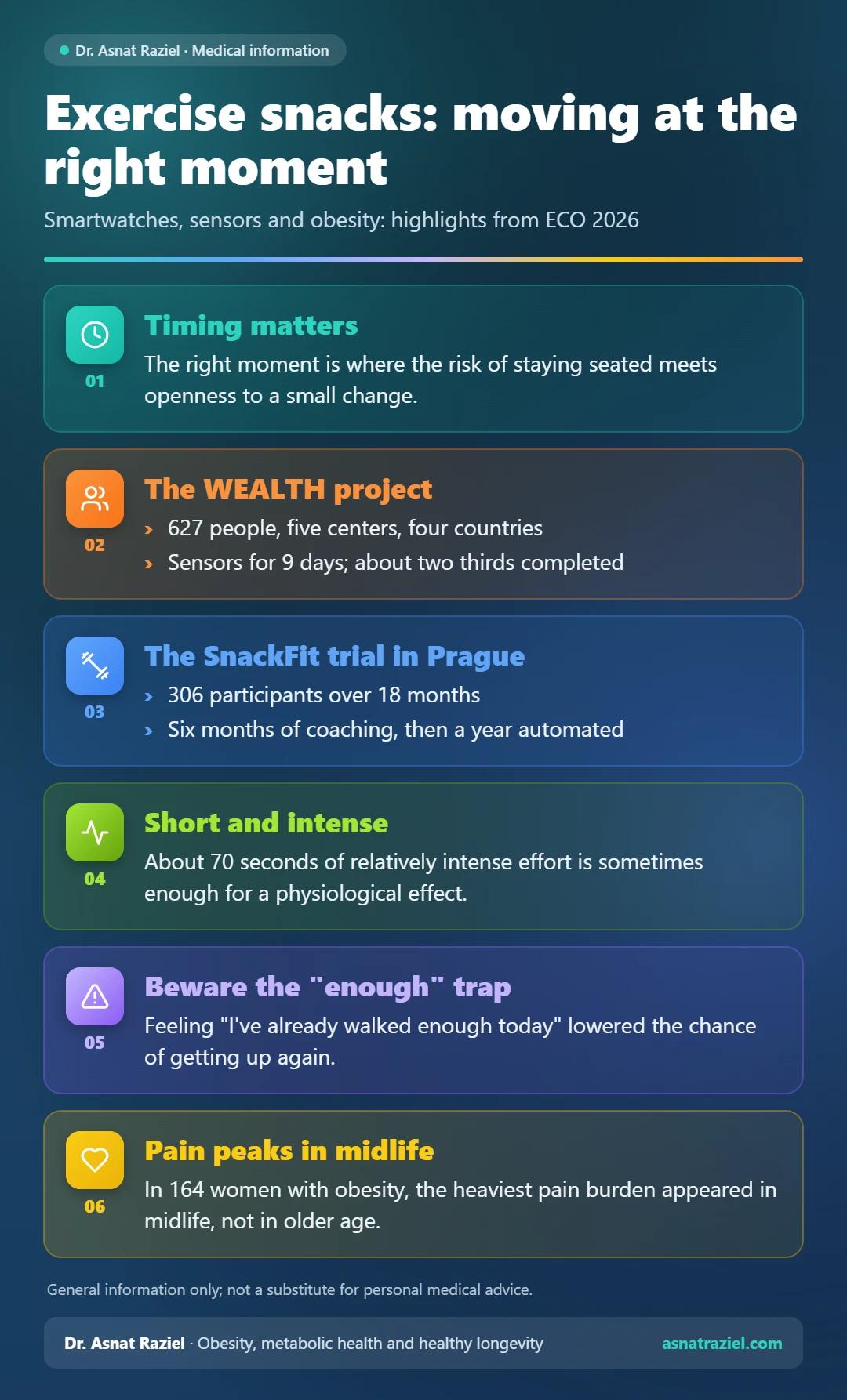
Then came the larger project. The WEALTH project included 627 people at five centers in the Czech Republic, France, Germany and Ireland. Participants wore sensors for 9 days in a row and answered many questionnaires every day. According to the data presented at the congress, about two thirds of them completed the tasks. That is a very good result for this field.
Not just “how much did you move,” but “when is the best time to move”
The researchers presented a new way of thinking. The right moment for an intervention is not random. It arises where vulnerability meets opportunity. In other words, the person is at risk of staying seated, but is also open to a small change. Real-time studies showed that the willingness to get up and move varies a great deal during the day.
Interestingly, fatigue and pain did not always reduce the willingness to move. By contrast, the feeling that “I’ve already walked enough today” actually lowered the chance of getting up again. The researchers noted that in people with obesity, energy levels change throughout the day, especially in the afternoon and evening.
Exercise snacks instead of long workouts
One of the most intriguing projects is SnackFit, a program for people with obesity from Charles University in Prague. It combines sensors, real-time questionnaires and digital support. Its goal is not to build your life around the gym. Instead, it adds exercise snacks: short moments of movement throughout the day. A few stairs. A short walk. Deliberately getting up from your chair.
According to the trial registration, this is an 18-month randomized trial with 306 participants, run in family medicine. For the first six months, participants will receive human coaching. After that, for a full year, support will be automated, through a smartwatch and personalized alerts. In Canada, too, researchers are testing a similar approach: four one-minute bouts of vigorous effort, at least five days a week.
Exercise snacks and smartwatches: how much activity do you really need?
An interesting question that came up was how to measure activity in people with obesity. Most watches and sensors were developed using data from people without obesity. As a result, they may be less accurate for part of the population. Even so, the researchers stressed that full accuracy is not needed to achieve a benefit. Even an alert that arrives at almost the right moment may change behavior over time.
What about intensity? According to lab work presented at the session, about 70 seconds of relatively intense effort is sometimes enough to produce a physiological effect. In addition, a study published in Nature Medicine, based on a wearable sensor, linked short bursts of vigorous activity in daily life with lower mortality. The World Health Organization guidelines also state that every movement counts. In people with obesity, however, the intensity should be tailored to the individual. It is also worth reading about walking to keep the weight off.
How to fit exercise snacks into your day
What can you take from this research today? First, think small: a few stairs, a short walk or deliberately getting up from your chair all count. Second, pay attention to timing. In people with obesity, energy often shifts in the afternoon and evening, so plan your movement breaks with that in mind. Third, be wary of the thought “I’ve already walked enough today.” According to the research, it lowers the chance of getting up again. Finally, match the intensity to your body, especially if you live with pain.
The future of exercise snacks: glucose, blood pressure and AI
In the future, these systems may also include continuous glucose monitoring, cuffless blood pressure measurement and heart rate variability. The goal is a smart system that recognizes when a person needs a small intervention, and when it is better to leave them alone.
Alongside the progress, however, ethical questions came up. The researchers noted that transferring personal data to the servers of commercial companies created regulatory difficulties. Therefore, they are developing systems in which the data go directly from the device to the university or research center.
Pain and obesity: not just a joint problem
Another part of the session presented a study on musculoskeletal pain in women with obesity. It included 164 women aged 21 to 65. The researchers examined pain, functional limitations and seeking care. The most common pains were in the lower back, knees and neck. The surprising finding, however, was that the highest burden appeared in midlife, not in older age.
According to the researchers, this may be an important window for intervention, before function declines. That is why obesity treatment cannot be reduced to the advice to “do sports.” It requires a personal approach that addresses pain, fear of movement, emotional state and functional ability. It is also important to preserve muscle strength, as I explain in my article on sarcopenic obesity. To learn how to combine movement and nutrition the right way, read my article on diet and exercise for weight loss.
The bottom line on exercise snacks and smartwatches
One of the most striking lines in the discussion was: “It’s not a disease, it’s a person.” In other words, even when we talk about exercise snacks, smartwatches, sensors and artificial intelligence, the person remains at the center: their personal story, their difficulties, their environment and their real life. Other tools, such as virtual reality for weight loss, are also being studied. In the end, technology can help us get up from the chair, but the decision and the support remain human.
The information in this article is general and does not replace personal medical advice.
References
Exercise Snacks in Adults Living With Obesity: Protocol for a Randomized Feasibility Trial
World Health Organization 2020 guidelines on physical activity and sedentary behaviour




