By Dr. Asnat Raziel, bariatric surgeon specializing in obesity treatment, metabolic health and healthy longevity; Director of the Multidisciplinary Center for Obesity Treatment, Assia Medical, Assuta Ramat HaChayal, Tel Aviv
Healthspan: not just adding years to life, but life to years
Healthspan, the number of years we live in good health, is the real goal of longevity medicine, one of the most fascinating fields in modern medicine. In the past, medicine focused mainly on diagnosing and treating disease after it appeared. Today, the goal is much broader: to prevent disease, slow the aging process and maintain a high quality of life for many years.
But one thing should be clear from the start. Longevity is not a quest for eternal life. The true aim is to add life to years, not just years to life. In this article, I focus on what the evidence shows really extends healthspan, and why you do not need to become a biohacker to benefit.
What is longevity medicine?
It is a science-based medical approach. It combines preventive medicine, metabolic health, nutrition, physical activity, sleep and mental health. In addition, it draws on advanced technologies. The goal is to lower the risk of chronic disease and extend the years of good health.
This approach does not ask only, “How many years will we live?” It asks a far more important question: what will the quality of those years be? That is why the central concept in the field is healthspan, the number of years a person stays healthy, independent, active and mentally sharp. Lifespan, by contrast, is life expectancy, meaning the number of years alone. The World Health Organization also declared the Decade of Healthy Ageing 2021-2030 based on the same idea.
The gap between lifespan and healthspan
Why does this matter so much? Because life expectancy has risen much faster than healthy life expectancy. A study of 183 countries that are members of the World Health Organization found that the gap has widened over the past twenty years. Today it averages 9.6 years. For women, the gap is 2.4 years wider than for men.
In other words, many of us live almost a decade with disease, disability or dependence. This is exactly where longevity medicine comes in: it tries to close that gap.
Quality of life is part of health
In recent years, there has been a growing understanding that excellent test results are not enough. A person can reach perfect blood sugar, cholesterol and blood pressure values. Even so, they may still be lonely, stressed, tired or lacking meaning. On the other hand, many people stay healthy thanks to movement, social ties, a sense of fulfillment and balanced habits.
The data support this. A meta-analysis of 148 studies with 308,849 participants found a clear link. People with strong social relationships had a 50% greater likelihood of survival over the follow-up period. That is why modern longevity medicine sees mental health, relationships and a sense of meaning as part of the treatment itself. I explain how sleep and mood affect the brain in my article on sleep and brain health.
You don’t have to be a biohacker to extend your healthspan
The longevity world is flooded with marketing today: NAD infusions, dozens of supplements, stem cells, sophisticated tests and futuristic technologies. Some of these may be appropriate in certain cases. However, the biggest influence on health still comes from our daily habits.
Regular physical activity, a Mediterranean diet, maintaining muscle mass and good sleep are the foundation. Likewise, reducing stress and not smoking affect risk far more than any single supplement. These are also the interventions with the strongest evidence. For example, the PREDIMED trial included 7,447 people at high cardiovascular risk. A Mediterranean diet with extra-virgin olive oil reduced major cardiovascular events by 31% compared with a low-fat diet. With nuts, the reduction was 28%.
Muscle: the key organ for a longer healthspan
One of the biggest shifts in medical thinking concerns muscle. Today we understand that muscle mass and strength are central markers of healthy aging. With age, we naturally lose muscle. But we can slow this process with strength training, enough protein and regular movement.
The PURE study followed about 140,000 people in 17 countries. Every 5 kg drop in grip strength was linked to a 16% higher risk of death. In fact, grip strength predicted mortality better than systolic blood pressure. In addition, a Cochrane review found that exercise reduces the rate of falls in older adults by 23%. Strong muscles also improve blood sugar control and help preserve independence. That is why almost every longevity program includes resistance training. Read more about this marker in my article on grip strength and aging.
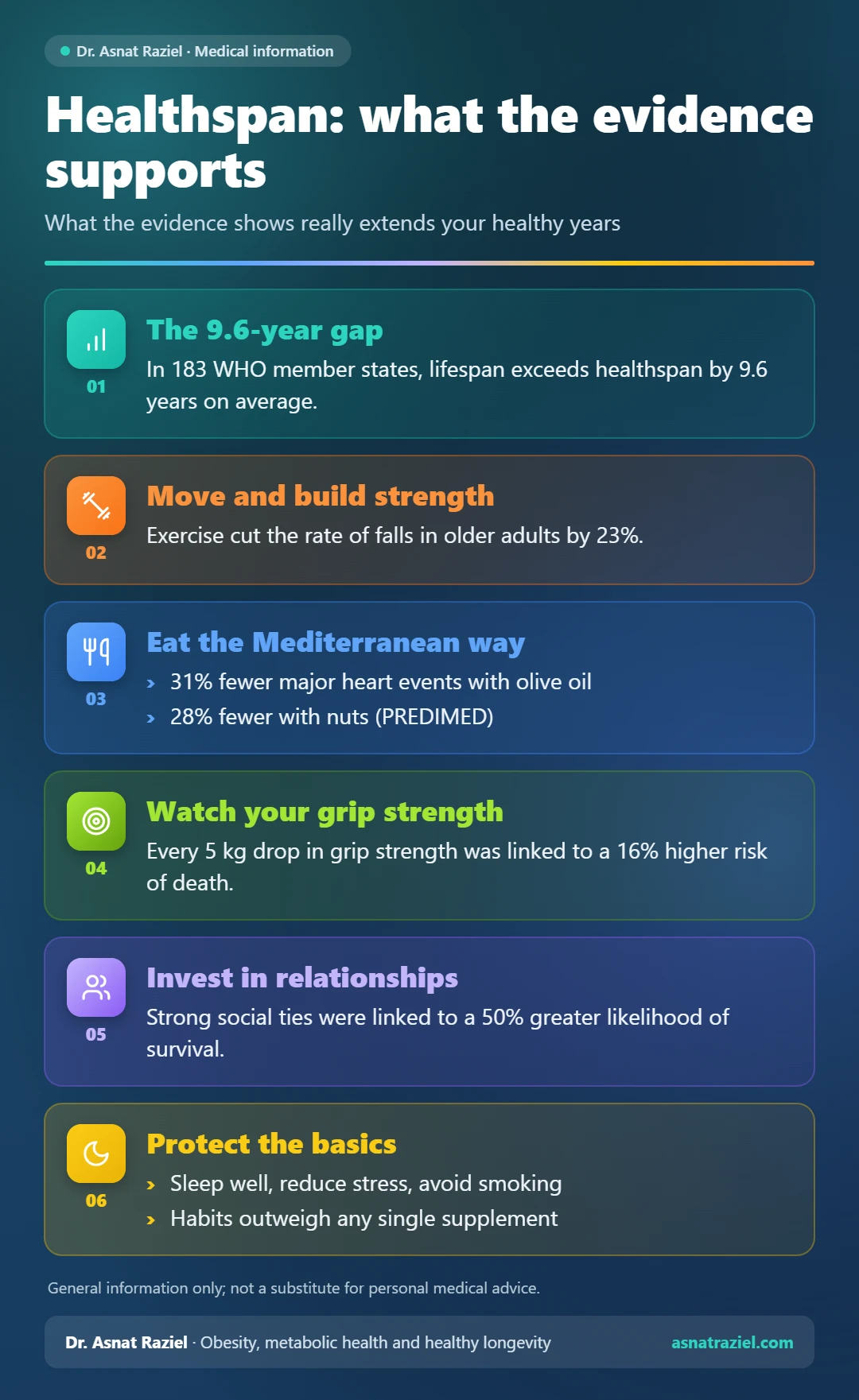
Five evidence-based steps for a longer healthspan
If you want to start today, here is how the findings above translate into practice:
- Move and build strength: exercise cut the rate of falls in older adults by 23%, and strength training slows muscle loss.
- Eat the Mediterranean way: in PREDIMED, major cardiovascular events fell by 31% with olive oil and by 28% with nuts.
- Keep an eye on your grip: every 5 kg drop in grip strength was linked to a 16% higher risk of death.
- Invest in relationships: strong social ties were linked to a 50% greater likelihood of survival.
- Protect the basics: sleep well, reduce stress and avoid smoking.
Only after that does it make sense to add advanced tests and technologies, chosen for you personally.
Personalized longevity medicine
One of the most exciting areas is the shift to personalized medicine. Advanced blood tests, biological age assessment and body composition measurements provide a broad picture. In addition, fitness tests, sleep monitoring, genetic testing and artificial intelligence help clarify each person’s risk profile. You can read about tools for measuring biological age in my article on epigenetic clocks.
The goal is not to do as many tests as possible. Rather, the goal is to choose the right interventions for each patient, and to build an effective plan that can be sustained for years.
Health begins long before disease
The traditional medical model kicks in when pain, diabetes, high blood pressure or heart disease appear. Longevity medicine, by contrast, works years earlier. It identifies risk factors before disease develops. It improves metabolic health, reduces chronic inflammation and preserves muscle. In addition, it improves sleep and strengthens physical and mental resilience. In many cases, small early changes prevent significant disease later on.
The future of longevity medicine has already begun
In the coming years, we will see growing integration of artificial intelligence, biological age, wearables and continuous monitoring. Genomics, advanced testing and personalized medicine will also take center stage. For example, a smart ring already tracks sleep, heart rate and activity today. For a closer look at how these data can become daily habits, see my article on longevity in daily life.
But alongside all the innovation, the foundation remains simple. Eat well, move, sleep well, maintain your muscle, nurture relationships and reduce stress. Technology does not replace a healthy lifestyle. Instead, it helps tailor that lifestyle precisely to each person.
The bottom line on healthspan and longevity medicine
Longevity medicine does not promise eternal life. Nor is it about chasing youth. Instead, it offers a new medical vision: preventing disease rather than only treating it, and preserving function rather than waiting for decline. Ultimately, the goal is to give people more years of health, independence, energy and quality of life. This is the future of medicine, and it has already begun.
The information in this article is general and does not replace personal medical advice.
References
WHO’s work on the UN Decade of Healthy Ageing (2021-2030)
Global Healthspan-Lifespan Gaps Among 183 World Health Organization Member States
Social relationships and mortality risk: a meta-analytic review
Exercise for preventing falls in older people living in the community




